← Back to All Resources About This Resource
Most people read the Psalms the way they eat from a buffet…a little from here, a favorite from there. But the Psalter is a carefully architected five-book collection, and once you see its structure, everything changes.
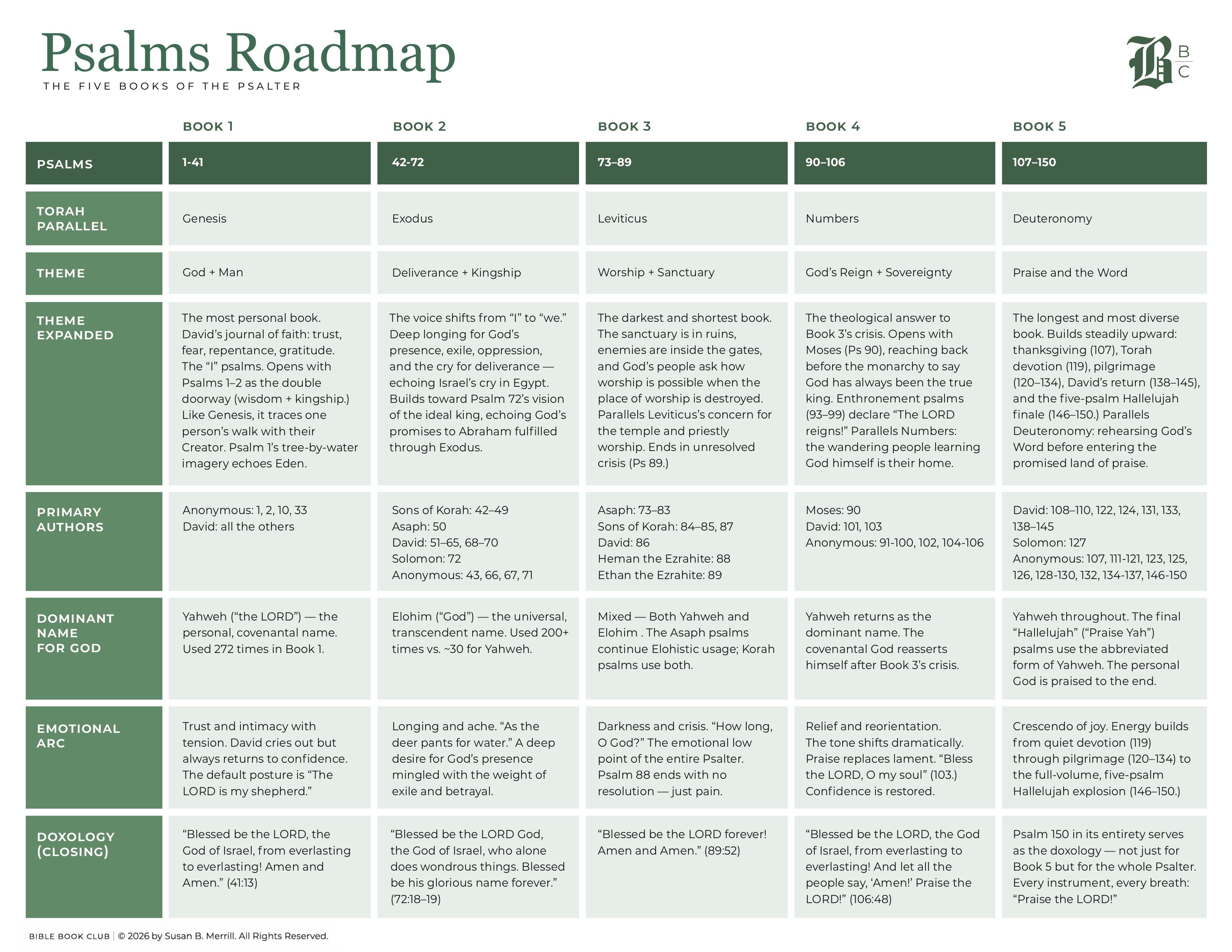
This Psalms summary chart gives you the full roadmap at a glance. Each of the five books beautifully mirrors a book of the Torah, has a specific theme, unique authors, a specific dominant name for God, and carries its own emotional arc.
Book 1 (Psalms 1–41): The most personal. David’s unfiltered journal of faith, trust, fear, repentance, and gratitude.
Book 2 (Psalms 42–72): The voice shifts from “I” to “we,” and a deep longing for God’s presence and deliverance.
Book 3 (Psalms 73–89): This is the Psalter’s darkest and shortest book. The sanctuary is in ruins, enemies are inside the gates, and this book ends in unresolved crisis.
Book 4 (Psalms 90–106): This book is the theological answer to Book 3’s crisis, opening with Moses and declaring that God has always been the true king.
Book 5 (Psalms 107–150): This is the longest and most diverse book building steadily toward thanksgiving, Torah devotion, pilgrimage, David’s return, and the five-Psalm Hallelujah.
In this Psalms Roadmap, we give you standout Psalms, the doxology that closes each book, insight into the types of Psalms, and specific verses that link the Psalms and the New Testament. We hope this chart gives you greater clarity and confidence as you read through the Book of Psalms with us in the Bible Book Club!
Please feel free to download the chart, keep it in your Bible, and use it every time you open the Psalter.
( ) God + Man 1 Genesis 1-41 Anonymous: 1, 2, 10, 33 David: all the others Yahweh (“the LORD”) — the personal, covenantal name. Used 272 times in Book 1. Trust and intimacy with tension. David cries out but always returns to confidence. The default posture is “The LORD is my shepherd.” “Blessed be the LORD, the God of Israel, from everlasting to everlasting! Amen and Amen.” (41:13) The most personal book. David’s journal of faith: trust, fear, repentance, gratitude. The “I” psalms. Opens with Psalms 1–2 as the double doorway (wisdom + kingship.) Like Genesis, it traces one person’s walk with their Creator. Psalm 1’s tree-by-water imagery echoes Eden. 3 Worship + Sanctuary Leviticus 73–89 Asaph: 73–83 Sons of Korah: 84–85, 87 David: 86 Heman the Ezrahite: 88 Ethan the Ezrahite: 89 Mixed — Both Yahweh and Elohim . The Asaph psalms continue Elohistic usage; Korah psalms use both. Darkness and crisis. “How long, O God?” The emotional low point of the entire Psalter. Psalm 88 ends with no resolution — just pain. “Blessed be the LORD forever! Amen and Amen.” (89:52) The darkest and shortest book. The sanctuary is in ruins, enemies are inside the gates, and God’s people ask how worship is possible when the place of worship is destroyed. Parallels Leviticus’s concern for the temple and priestly worship. Ends in unresolved crisis (Ps 89.) 2 Deliverance + Kingship Exodus 42-72 Sons of Korah: 42–49 Asaph: 50 David: 51–65, 68–70 Solomon: 72 Anonymous: 43, 66, 67, 71 Elohim (“God”) — the universal, transcendent name. Used 200+ times vs. ~30 for Yahweh. Longing and ache. “As the deer pants for water.” A deep desire for God’s presence mingled with the weight of exile and betrayal. The voice shifts from “I” to “we.” Deep longing for God’s presence, exile, oppression, and the cry for deliverance — echoing Israel’s cry in Egypt. Builds toward Psalm 72’s vision of the ideal king, echoing God’s promises to Abraham fulfilled through Exodus. “Blessed be the LORD God, the God of Israel, who alone does wondrous things. Blessed be his glorious name forever.” (72:18–19) 4 God’s Reign + Sovereignty Numbers 90–106 Moses: 90 David: 101, 103 Anonymous: 91-100, 102, 104-106 Yahweh returns as the dominant name. The covenantal God reasserts himself after Book 3’s crisis. Relief and reorientation. The tone shifts dramatically. Praise replaces lament. “Bless the LORD, O my soul” (103.) Confidence is restored. “Blessed be the LORD, the God of Israel, from everlasting to everlasting! And let all the people say, ‘Amen!’ Praise the LORD!” (106:48) The theological answer to Book 3’s crisis. Opens with Moses (Ps 90), reaching back before the monarchy to say God has always been the true king. Enthronement psalms (93–99) declare “The LORD reigns!” Parallels Numbers: the wandering people learning God himself is their home. 5 Praise and the Word Deuteronomy 107–150 David: 108–110, 122, 124, 131, 133, 138–145 Solomon: 127 Anonymous: 107, 111-121, 123, 125, 126, 128-130, 132, 134-137, 146-150 Yahweh throughout. The final “Hallelujah” (“Praise Yah”) psalms use the abbreviated form of Yahweh. The personal God is praised to the end. Crescendo of joy. Energy builds from quiet devotion (119) through pilgrimage (120–134) to the full-volume, five-psalm Hallelujah explosion (146–150.) Psalm 150 in its entirety serves as the doxology — not just for Book 5 but for the whole Psalter. Every instrument, every breath: “Praise the LORD!” The longest and most diverse book. Builds steadily upward: thanksgiving (107), Torah devotion (119), pilgrimage (120–134), David’s return (138–145), and the five-psalm Hallelujah finale (146–150.) Parallels Deuteronomy: rehearsing God’s Word before entering the promised land of praise. Psalms Roadmap 1-41 73–8942-72 90–106 107–150 Individual lament and trust. Also: royal psalms (2, 18, 20–21), wisdom (1, 37), hymns (8, 19), thanksgiving (30, 34.) The personal voice dominates. Communal lament dominates (74, 77, 79–80, 82–83, 85–86, 88.) Historical recitation (78.) Trust psalms are rare. This is the Psalter’s valley. Community and individual lament, royal/messianic psalms. Korah psalms introduce communal worship. Imprecatory psalms appear (58, 69). Ends with royal hope (72.) Enthronement hymns (“The LORD reigns”), praise, historical recitation (105–106.) Lament nearly disappears. The shift from Books 1–3 to Books 4–5 is dramatic. Praise and thanksgiving dominate. Also: Torah meditation (119), pilgrimage songs (120–134), lament (137), wisdom (127–128.) The volume rises steadily to 150. Ps 2:1–2 → Acts 4:25–26 Ps 2:7 → Acts 13:33, Heb 1:5 Ps 2:8 → Rev 2:26-27 Ps 8:4–6 → Heb 2:6–8 Ps 16:8–11 → Acts 2:25–28 (Peter at Pentecost) Ps 22:1 → Matt 27:46 (Jesus on the cross) Ps 22:18 → John 19:24 Ps 31:5 → Luke 23:46 Ps 34:8 → 1 Pet 2:3 Ps 78:2 → Matt 13:35 (Jesus’ parables) Ps 78:24 → John 6:31 (Bread from heaven) Ps 45:6–7 → Heb 1:8–9 (Christ’s throne) Ps 68:18 → Eph 4:8 Ps 69:9 → John 2:17 (Zeal for God’s house) Ps 69:25 → Acts 1:20 (Judas) Ps 72 → Messianic imagery echoed across Gospels Ps 91:11–12 → Matt 4:6, Luke 4:10–11 (Satan’s temptation of Jesus) Ps 95:7–11 → Heb 3:7–11, 4:3–7 (Rest and faithfulness) Ps 102:25–27 → Heb 1:10–12. Ps 110:1 → Most quoted OT verse in the NT (Matt 22:44; Mark 12:36; Acts 2:34–35; Heb 1:13, and many more) Ps 110:4 → Heb 5:6, 7:17–21 (Melchizedek priesthood) Ps 118:22–23 → Matt 21:42, Acts 4:11, 1 Pet 2:7 (Cornerstone) Ps 118:26 → Matt 21:9 (Palm Sunday) Ps 1: The blessed life. Ps 2: The anointed king. Ps 8: Human dignity. Ps 19: Heavens + Torah. Ps 22: “My God, why have you forsaken me.” Ps 23: The shepherd. Ps 34: “Taste and see.” Ps 37: “Delight yourself in the LORD.” Ps 73: “My feet almost slipped.” Ps 84: “How lovely is your dwelling place.” Ps 86: David’s lone prayer. Ps 88: The darkest psalm (no resolution.) Ps 89: “Where are your former mercies?” Ps 42–43: “As the deer pants.” Ps 46: “Be still and know.” Ps 51: David’s repentance. Ps 63: “Earnestly I seek you.” Ps 69: Messianic suffering. Ps 72: The coming king. Ps 90: “Teach us to number our days.” Ps 91: Refuge and protection. Ps 95: “Come let us sing.” Ps 100: “Make a joyful noise.” Ps 103: “Bless the LORD, O my soul.” Ps 110: Most quoted psalm in the NT. Ps 118: “This is the day.” Ps 119: The great acrostic (176 v.) Ps 121: “I lift my eyes.” Ps 137: “By the rivers of Babylon.” Ps 139: “Fearfully and wonderfully made.” Ps 150: The grand finale. 1 3 2 4 5 Psalms Roadmap