What is the meaning of the Book of Psalms?
The Book of Psalms is the story of God’s relationship with us told through a sacred playlist that turns our deepest struggles and highest hopes into a conversation with Him.
Psalms 1-2 Introduction
Our study of the Book of Psalms will be unique because it’s not like any other in the Bible. This book is actually a playlist of songs, and there is a song for every emotion and situation known to man.
The creation of this book was just another brilliant move on God’s part, because everyone has a soundtrack running in their head.
- When we’re driving home after a frustrating day
- When we’re awestruck at the birth of a child
- When we’re grieving a great tragedy
- When we’re nervous, afraid, celebrating, or just exhausted.
You get the picture. Songs find us when words fail. Most often, we don’t get to choose the song our heart sings; our heart responds to life. That’s not a modern phenomenon. The Apple or Spotify playlist that you choose is a modern phenomenon, but the playlist of your heart is not. That’s ancient. That’s how humans have always been wired. And the Book of Psalms is the original playlist God selected for all humanity. The 150 songs that were created for us:
- To provide peace when we are afraid.
- To express wonder when we are inspired.
- To worship when we are amazed.
- To comfort when we grieve.
More than anything, this playlist will give you the confidence to know that God understands your heart and every emotion of your life. There is a lyric written for the exact place your heart is right now. This is God’s songbook. This is the playlist of your heart.
The Uniqueness of the Book of Psalms
The Bible is a collection of stories that together tell a much larger story of the history of our redemption with Jesus as the ultimate hero.
What is the longest and most popular book in the Bible?
Psalms is by far the most popular book in the Bible according to YouVersion and Bible Gateway. Matthew, John, and Genesis follow, but far behind. And Psalms has more chapters than any other book at 150, but in word count, Jeremiah is the longest book in the Bible. Genesis is second, and Psalms is third.
What is the significance of Psalm 117 in the Bible?
The Book of Psalms is located strategically in the middle of the Bible, and Psalm 117 is the exact middle chapter of Psalms. There are 1189 chapters, and Psalm 117 is the 595th, so there are 594 chapters before it and 594 chapters after it. And oddly, Psalm 117 is also the shortest psalm.
What is the Bay Psalm Book and why is it valuable?
The Bay Psalm Book is the first book ever printed in British North America in 1640, just twenty years after the Pilgrims arrived. Apparently, the Puritans were unhappy with the existing English translations, which they felt were too loose with the original Hebrew. So they made their own. Only 11 copies are known to exist today.
In 2013, one copy of the Bay Psalm Book sold at Sotheby’s for $14.2 million, which was a record for a printed book. How interesting that, of all the words that could have been published first on this continent, the colonists chose the Psalms. They hungered for God’s playlist, the words to express to God what their heart felt. Our challenge, as we read, will be to give our hearts the same songs to sing.
Historical and Literary Context
How does the Book of Psalms fit into the Bible?
Psalms belongs to the Old Testament, which has five divisions. We are now in the third division called the Poetry & Wisdom Books: Job, Psalms, Proverbs, Ecclesiastes, and Song of Songs. These books are quite different and have a unique purpose. God has a plan in his design of the Bible. The divisions are like a roadmap:
- The Torah gives us the rules of the road.
- The History Books show us what happens when Israel drives on the road.
- The Wisdom Books pull over at the rest stop to ponder: Where are we going? Why do people suffer? How do I navigate relationships? What makes life worth living?
In the Bible Book Club, we have already finished reading through the Torah and the History Books!
Why does God shift the focus from Israel to the human condition?
God places the Wisdom Books after the history of Israel’s rise and fall because wisdom is often born from experience. Once you know the rules and you’ve experienced the difficulty of life, you are finally ready to wrestle with difficult questions. Questions about suffering, meaning, love, and morality.
How do the five Wisdom Books of the Bible differ?
Each of the five Wisdom Books have a unique focus:
- Job: Suffering
- Psalms: Emotion—joy, worship, grief, anger
- Proverbs: Living wisely
- Ecclesiastes: The meaning in life
- Song of Solomon: Love and intimacy.
Who wrote the Book of Psalms?
The Book of Psalms has many authors, and many are unknown. However, David wrote the most. Remember, the psalms are songs, and David loved music. He organized the temple’s music ministry in 1 Chronicles:
1 Chronicles 15:16-17 16 David told the leaders of the Levites to appoint their fellow Levites as musicians to make a joyful sound with musical instruments: lyres, harps and cymbals.
17 So the Levites appointed Heman son of Joel; from his relatives, Asaph son of Berekiah; and from their relatives the Merarites, Ethan son of Kushaiah;
All three of those named musicians contributed to the Book of Psalms.
How many psalms did King David write?
King David wrote 73 of the 150 psalms in the Bible, which is nearly half of the collection. The remaining psalms were composed by several different authors:
- King David: 73 psalms
- Asaph: 12 psalms
- Levites (from the tribe of Korah): 11 psalms
- Solomon: 2 psalms
- Moses: 1 psalm (and this one is by far the oldest psalm)
- Ethan: 1 psalm
- Heman: 1 psalm
- Anonymous: 49 psalms
When was the Book of Psalms written and how was it compiled?
The Book of Psalms was written over a thousand-year span and then stitched together. The oldest psalm, written by Moses, may date as early as 1400 BC, and the last psalms were written during or after the exile sometime in the 400 BC range.
How is the Book of Psalms organized?
The Book of Psalms is divided into five sections, which are five smaller “books” within the larger book. Each section ends with a doxology, and this verse of praise marks its conclusion. Each book, on its own, is a micro-journey from difficulty toward doxology (praise to God).
The whole collection of psalms together does the same on a macro scale, building from Psalm 1 all the way to Psalm 150. Book five is the praise crescendo of the whole Psalter. None of this was random. All of it was by design.
What is the purpose of the Book of Psalms?
The psalms are songs, and the songs are a teaching tool. There were no printed books at this time, so the songs served to expand their memory of the Word. This is brilliant because people remember words more easily when sung.
The word “psalm” comes from the Greek psalmos, which is music played on a stringed instrument. The Hebrew title for the book is Tehillim, which means “praises.” Both titles tell us that psalms were not read but sung.
How are the five Books of Psalms connected to the Torah?
The editors organized the five Books of the Psalms to mirror the five books of the Torah, creating a counterpart hymnbook to the Torah. The Torah is God speaking down to His people; the psalms are His people singing back to Him. And the editors arranged each of the five books around a theme from the corresponding book of the Torah:
- Book 1: Echoes Genesis (God and Man)
- Book 2: Echoes Exodus (Deliverance and Kingship)
- Book 3: Echoes Leviticus (Worship and Sanctuary)
- Book 4: Echoes Numbers (God’s Reign and Sovereignty)
- Book 5: Echoes Deuteronomy (Praise and the Word)
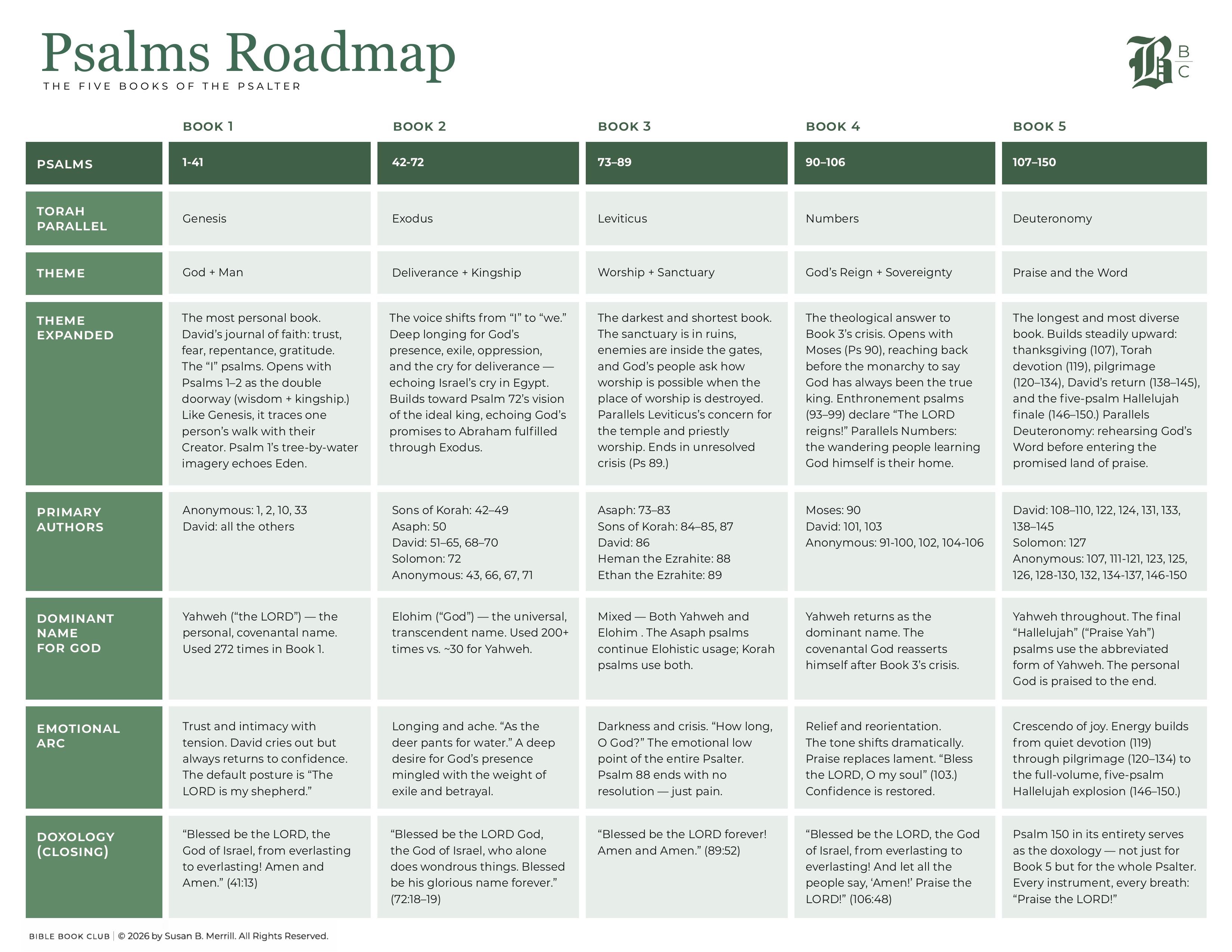
If you’re like us and have a passion for studying the mystery of how God divinely organized the Bible, we have created a tool for you called A Psalms Roadmap. It is a table of the five Books of the Psalms and includes: themes, authors, standout psalms, doxologies, dominant psalm types, and so much more.
What are the main types of genres found in Psalms?
There are seven different types of psalms. Think of them like musical genres on a streaming app that listeners can add songs from to a playlist. Once you know the genre (or type of psalm), you can find the playlist that speaks (or sings) what your heart feels. Here are the seven main types of psalms found in the Bible:
Psalms of Lament
- Definition: Cries of distress. God knows we struggle, so this type gets the most airtime and makes up the largest category.
- Typical Pattern: Address to God → Complaint → Request for help → Expression of trust → Vow of praise.
- Key Example: Psalm 22
Psalms of Praise
- Definition: Celebrate who God is and call us to worship.
- Key Example: Psalm 8
Psalms of Thanksgiving
- Definition: Similar to praise but more specific. They respond to what God has done rather than who God is.
- Key Example: Psalm 116
Royal or Messianic Psalms
- Definition: Connected to kings and point forward to Christ.
- Key Example: Psalm 2
Wisdom Psalms
- Definition: Read more like Proverbs than songs.
- Key Example: Psalm 1
Psalms of Trust or Confidence
- Definition: Songs of assurance.
- Key Example: Psalm 23 (“The Lord is my shepherd, I shall not want” is the one most familiar.)
Imprecatory Psalms
- Definition: Call down judgment and curses. These psalms are not favorites.
- Key Example: Psalm 69
Note: Most psalms don’t fit neatly into just one box. Psalm 22 starts as a lament and ends as praise. And Psalm 89 begins as a hymn and falls into complaint.
What is the most intriguing fact about the Book of Psalms?
The Book of Psalms is miraculously stitched together over time into the masterpiece it is. Imagine trying to build a cathedral over centuries with different architects, stonemasons, and artists, none of whom ever sat in the same room together.
- In one generation, they laid the foundation and built the walls.
- A generation later, they added windows.
- Four hundred years later, they replaced the windows with stained glass.
- Years after that, someone added an altar.
- Generations later, frescos, marble, and an ornately carved cross.
And yet, when you walk inside, everything works together. The light from a window built in one century, filtered through stained glass installed in another, falls in a kaleidoscope of color on the altar built in a third generation, and the brightest gold beam lands on the Cross. That’s the psalms. Written by different people across centuries—Moses, David, Asaph, the Sons of Korah, anonymous poets—then compiled and arranged by editors they never knew. And yet the final message has been stitched together with such careful genius that it is beyond man. It is a divine miracle. And the light it casts falls perfectly on the promised King, Jesus Christ.
Psalm 1: Blessed Is the One Who Finds Wisdom in the Word
Psalm 1
who does not walk in step with the wicked
2 but whose delight is in the law of the Lord,
and who meditates on his law day and night.
3 That person is like a tree planted by streams of water,
4 Not so the wicked!
They are like chaff
that the wind blows away.
5 Therefore the wicked will not stand in the judgment,
nor sinners in the assembly of the righteous.6 For the Lord watches over the way of the righteous,
but the way of the wicked leads to destruction.
What are orphan psalms and where are they located?
Psalms 1 and 2 are what scholars call “orphan psalms,” which means they have no superscription, no named author. They are placed at the beginning of the Book of Psalms by the book’s editors as the front door to the entire Book of Psalms. Psalm 1 is a wisdom psalm.
What two paths are contrasted in the text of Psalm 1?
Psalm 1 describes two paths and two destinies: the way of the blessed and the way of the judged. These are the dos and don’ts of life. Do read and study God’s Word. Don’t have anything to do with anything wicked.
1. Blessed Is the Man Who Delights and Meditates on the Law
The blessed are faithful in three ways: They neither walk, stand, nor sit with the wicked, sinners, or mockers.
How do they accomplish this?
By meditating on the law. The word “law” in Hebrew is Torah, which means “teaching” or “instruction.” And that is a huge clue from the editor. Verse 2 is pointing us back to the five books of the Torah, telling us the psalms are the Torah set to music.
What does it mean to be like a tree planted by streams of water?
Then in verse 3, the author paints a longed-for image straight out of Genesis, the very first book in the Torah. He says if a person meditates on God’s Word:
Psalm 1:3 3 That person is like a tree planted by streams of water.
That’s the Garden of Eden. It’s what we lost in the fall. We once had that life as a free gift.
Genesis 2:8-10 8 Now the Lord God had planted a garden in the east, in Eden; and there he put the man he had formed. 9 The Lord God made all kinds of trees grow out of the ground—trees that were pleasing to the eye and good for food. In the middle of the garden were the tree of life and the tree of the knowledge of good and evil. 10 A river watering the garden flowed from Eden
So Psalm 1 is a song about how to get back to that tree. How to live like a person rooted, watered, and flourishing. This song provides wisdom and the way. We must delight in God’s laws. That means to love the Lord deeply so our hearts overflow with love for Him. The result of such devotion is fruit. Whatever they do prospers. Not necessarily financial success, but in the things that glorify God and build His kingdom. While the man who obeys is blessed, this wisdom song also gives the alternative.
2. Judged Is the One Who Is Wicked
A wicked person is one whose life points away from God. This battle, the struggle to be wise and not wicked, is one that we must still fight today. Paul struggled with it and expressed it like this:
Romans 7:21-25 21 So I find this law at work: Although I want to do good, evil is right there with me. 22 For in my inner being I delight in God’s law; 23 but I see another law at work in me, waging war against the law of my mind and making me a prisoner of the law of sin at work within me. 24 What a wretched man I am! Who will rescue me from this body that is subject to death? 25 Thanks be to God, who delivers me through Jesus Christ our Lord!
Thanks be to God, for sure, because we have Someone to stand in judgement for us. We are delivered through Jesus Christ.
Psalm 1 is an invitation to us to read God’s word. It’s an invitation to streams of living water, to a heavenly reception of “well done, my good and faithful servant!” Jesus is the only one who deserves such a blessing as Psalm 1 describes. He never walked with the wicked, stood in the way of sinners, or sat with mockers. And He did it for us. Jesus’ righteousness is credited to us, which turns this wisdom psalm into a psalm of praise for us!
Psalm 2: Blessed Are All Who Take Refuge in the King
Psalm 2 is a Royal or Messianic Psalm. It points us to kings and to the promise of Christ.
Psalm 2
against the Lord and against his anointed, saying,
4 The One enthroned in heaven laughs;
the Lord scoffs at them.
5 He rebukes them in his anger
and terrifies them in his wrath, saying,
6 “I have installed my king
on Zion, my holy mountain.”He said to me, “You are my son;
today I have become your father.
8 Ask me,
and I will make the nations your inheritance,
the ends of the earth your possession.
9 You will break them with a rod of iron;
you will dash them to pieces like pottery.”10 Therefore, you kings, be wise;
be warned, you rulers of the earth.
11 Serve the Lord with fear
and celebrate his rule with trembling.
12 Kiss his son, or he will be angry
and your way will lead to your destruction,
for his wrath can flare up in a moment.
Blessed are all who take refuge in him.
Which New Testament verses explicitly quote from Psalm 2?
Acts 4, Acts 13, and Revelation 2 all explicitly quote from Psalm 2. The psalmist is warning that the world will set itself against God and His anointed. The word “anointed” in Hebrew is Messiah, implying a king, or future king, of God’s choosing. Is this Jesus Christ? Acts 4 confirms it is and quotes these very verses from Psalm 2:
Acts 4:25-26 25 You spoke by the Holy Spirit through the mouth of your servant, our father David:
“‘Why do the nations rage
and the peoples plot in vain?
26 The kings of the earth rise up
and the rulers band together
against the Lord
and against his anointed one.
The foreshadowing of Christ keeps going in Psalm 2. More details are added to what we know about this king.
- He is installed on Zion.
- He is God’s son.
- The nations are his inheritance.
- The earth is his possession.
The Apostle Luke confirms the meaning of this by quoting verse 7 in Acts 13:
Acts 13:32-33 32 “We tell you the good news: What God promised our ancestors 33 he has fulfilled for us, their children, by raising up Jesus. As it is written in the second Psalm:
“‘You are my son;
today I have become your father.’
And the Apostle John affirmed verse 9 by quoting it in Revelation:
Revelation 2:26-27 26 To the one who is victorious and does my will to the end, I will give authority over the nations— 27 that one ‘will rule them with an iron scepter and will dash them to pieces like pottery’—just as I have received authority from my Father.
If you are fascinated by the links between the Old and New Testaments in the psalms, we’ve included standout New Testament cross-references for every psalm in our Psalms Roadmap.
Psalm 2 ends with a “therefore here is what you should do.” Be wise, be warned, serve God, and submit to his son.
The Pillars at the Gate: Connecting Psalms 1 + 2
The first thing to note about Psalm 2 is its tie to Psalm 1. Both are orphan psalms, which means they have no superscription. Many scholars see the lack of superscription as intentional. A superscription usually tells you who wrote it, what the occasion was, or the tune it was sung to.
How do Psalms 1 and 2 function together as an introduction?
These two psalms function as an introduction to the entire book or Psalter, and the book ends the same way. Psalms 146-150 are also orphans as the closing praise chorus of the whole book.
The second thing to note is the structure of these psalms. Psalms 1 and 2 are the pillars at the front gate. They are the door to the other 148 psalms, and they have a special job to do:
- Psalm 1 is a wisdom psalm for the individual, and it speaks of two paths a person can take: the path to wisdom through the Torah and the path to judgment through rebellion.
- Psalm 2 is a royal or messianic psalm for the nations, and it speaks of two kingdoms: the kingdoms on earth and the kingdom of heaven.
The ancient singers knew these two psalms go together, because Psalm 1 begins with Blessed is the one and Psalm 2 ends with Blessed are all. The two psalms are bookended.
- Psalm 1 teaches: the Law of God is the foundation for a blessed individual life.
- Psalm 2 teaches: the King of God is the foundation for a blessed world.
What is the significance of the 1, 19, 119 and 2, 20, 120 structural threads?
There are two major thematic threads that run through the entire Book of Psalms, and both of them begin in the opening verses. Then they follow a precise numerical pattern, alternating between the Word of God and the Messiah.
Thread 1: The Word of God (Psalms 1, 19, 119)
These three chapters of Psalms are sometimes called the “Torah Psalms.” Together, they move from invitation → wonder → total devotion.
- Psalm 1: Opens with a simple image that the person who delights in God’s law is like a tree planted by streams of water. This doorway psalm sets the tone for everything that follows.
- Psalm 19: Expands the image. It looks up at the heavens “the skies proclaim the work of his hands,” and then turns to the Torah, describing it as more desirable than gold, sweeter than honey. Now God’s instruction isn’t just a path to walk. It’s woven into creation itself.
- Psalm 119: The longest chapter in the Bible, at 176 verses. It’s more than a flat image; it is multi-dimensional. It’s an acrostic poem that circles back to God’s Word again and again from every conceivable angle, almost like the psalmist can’t stop talking about it.
Note the pattern in Psalms 1, 19, and 119, all focus on the Word of God. Now the second thread, and this is the Bible Bender. Psalms 1, 19, and 119 focus on the Word, and Psalms 2, 20, and 120 focus on the Messiah.
The Second Thread: The Messiah and the Kingdom (Psalms 2, 20, 120)
Psalms 2, 20, and 120 trace different threads: one centered on kingship, another on conflict, and the other on the tension of living in a hostile world. Together, this trio moves from God’s anointed king → prayer in crisis → personal exile and longing.
- Psalm 2: This is the royal counterpart to Psalm 1. Where Psalm 1 introduces the righteous individual, Psalm 2 introduces God’s anointed king and the nations raging against him. It’s messianic, dramatic, and it asks the big political-theological question: Who’s really in charge? Is Psalm 2 a prophecy about Jesus? It is a foreshadowing of the king to come who would save.
- Psalm 20: A prayer for the king before battle. The community rallied around their leader, trusting not in chariots and horses but in the name of the Lord.
- Psalm 120: Opens the Songs of Ascent (Psalms 120-134). It’s a cry for deliverance from a hostile world with a longing for peace.
Note the pattern in Psalms 2, 20, and 120: all focus on the Messiah and the eternal kingdom.
Bible Bender of the Book of Psalms
The Book of Psalms, this sacred playlist of songs, was not random in its message, structure, numbers, hundreds of years, and dozens of authors. It is miraculously stitched together for us, and the message still holds today. Live by God’s instruction while trusting in His anointed King, even when the world rages, even when you feel far from peace.
The playlist of your heart is already playing. It has been since before you woke up this morning. The question isn’t whether there’s a song in you. There always is. The question is: Are you singing it alone, or are you singing it to God? That’s what the psalms teach us how to do. They take the cry already in our heart and turn it into a conversation.
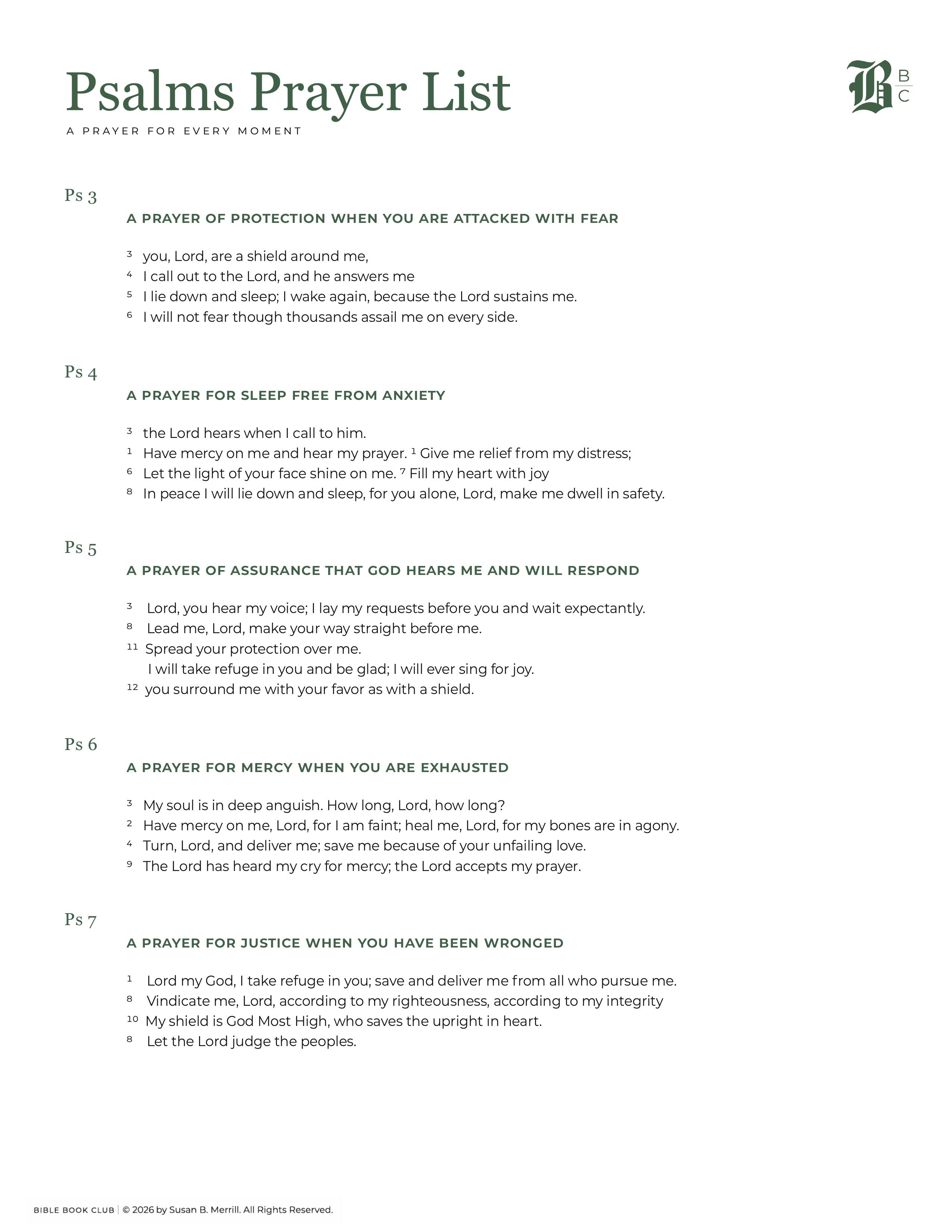
Join us for our Bible study on Psalms 3-8 here.
New Psalms Playlist Song
The first song on our Psalms Playlist is:
- “I Delight in You” (Psalm 1) by Shane and Shane, Kingdom Kids
Listen to the entire Psalms Playlist on Apple Music or Spotify.
Group Discussion Questions for Psalms 1 and 2
- Everyone has a soundtrack running in their head. With the psalms, God gives us His playlist. When has a psalm or a song met you in a moment and moved your heart?
- Psalm 1 compares a person who meditates on God’s law day and night to a flourishing tree planted by streams of water. What is one small thing you could do this week to meditate on God’s law and become more like that tree?
- Do you have a modern playlist of songs that help you remember to lean on God, especially when your emotions are high?