Previously on Bible Book Club
In the last psalms, we reached the climax of Book 3, the parallel to Leviticus, which is often called the darkest book of the Psalms. The sanctuary is gone, and the lesson for us even today is: “Sometimes we must worship when the promise and the reality no longer match.” Psalm 88 gave us the one psalm in the whole book with no happy ending: ” Darkness is my closest friend,” our permission to bring unresolved grief to God. Psalm 89 celebrated the covenant with David for 37 verses, then accused God of renouncing it, closing on a question, not an answer: “How long, Lord?”
Psalms 90-99 Introduction
Book 3 left us hanging on purpose, but God and the editors of the Psalms make sure we get an answer, and from Moses no less. In this episode, we begin Book 4: Psalms 90-106. We are past the halfway point of our marathon through the Psalms and starting the climb up from the darkest middle point.
Recall that the Book of Psalms is the story of God’s relationship with us, told through a sacred playlist that turns our deepest struggles and highest hopes into a conversation with Him. It is God’s song playlist for your heart.
What is Psalms Book 4 about?
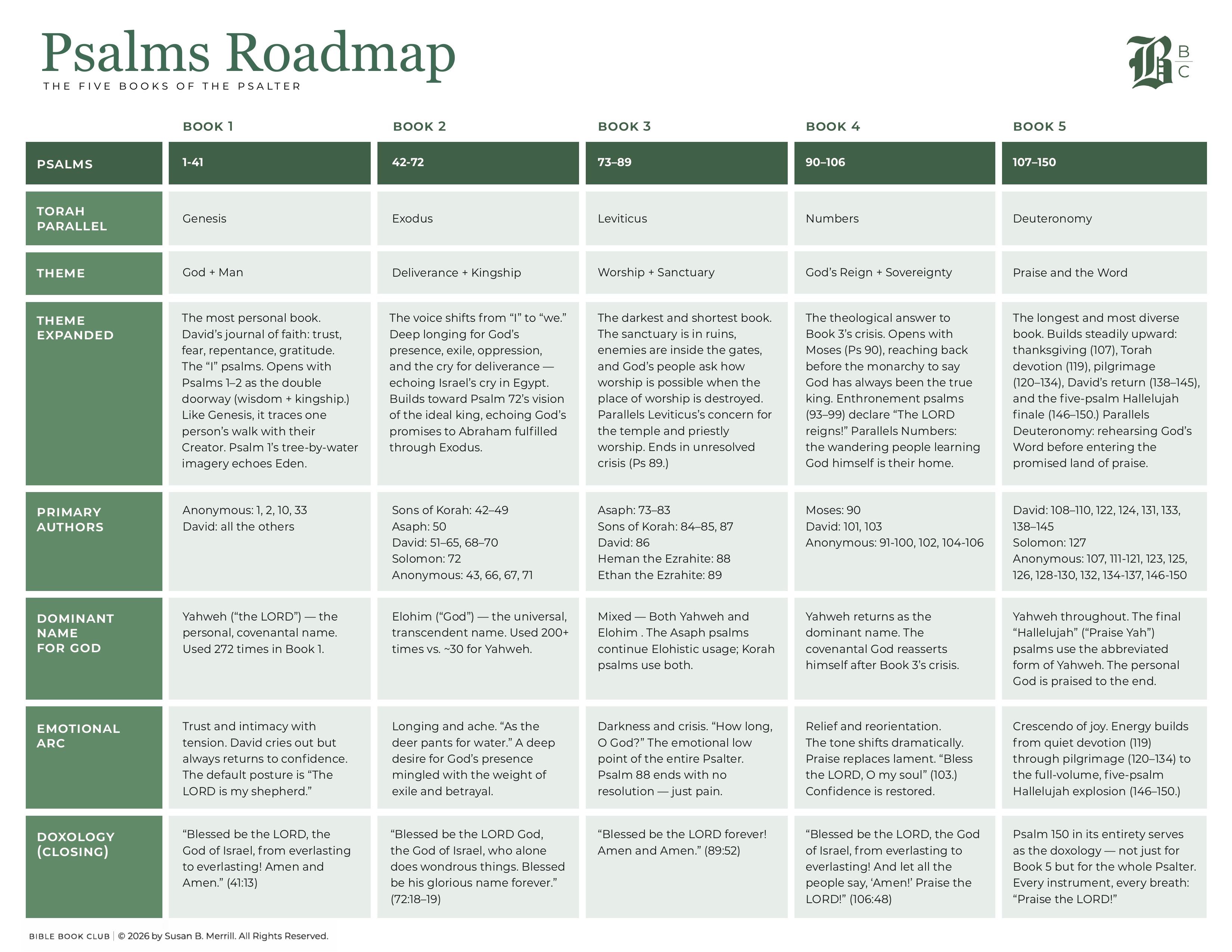
First, a quick review of where we have been and where we are going in Book 4. The editors of the Psalms arranged the five books of the Psalms to mirror the five books of the Torah. The Torah is God speaking down to His people with instruction. The Psalms are His people singing back up to Him in worship. Each book is its own micro-journey from difficulty toward doxology.
- Book 1 is the companion to Genesis. Its theme is God and man.
- Book 2 is the companion to Exodus. The theme is deliverance and kingship.
- Book 3 is the companion to Leviticus. The theme is worship and sanctuary. It’s the book that grieved the ruin of the sanctuary and the Babylonian exile.
- Book 4 is the companion to Numbers. The theme of Psalm Book 4 is Wilderness and God’s Sovereignty.
Why is Book 4 of the Psalms considered the “wilderness” book?
Book 3 was the valley, and Book 4 is the wilderness road out of the valley. Numbers is the book of a people with no home, wandering for forty years. A whole generation that never reaches the Promised Land, and yet God goes with them the entire way, His presence in a pillar of cloud and fire.
Similarly, that is where the Psalms Book 3 left God’s people: no home. The Temple was gone: no sanctuary, no worship, and even no king. The Mosaic and Davidic covenants were broken, and they were in exile. Book 4 does not answer that crisis by rebuilding the Temple or crowning a new king. Instead, Book 4 takes us all the way back to Moses and the wilderness, to the God who is:
Psalm 90:1 1 our dwelling place throughout all generations.
Before there was ever a sanctuary to lose, the throne that was and never will be empty.
The heartbeat of Book 4 is three words: The Lord reigns.
Over and over in Psalms 93, 96, 97, and 99, the people sing not “the Lord will reign someday,” but “the Lord reigns,” right now, present tense. Even when you can’t see Him reigning, He is.
In Book 3, the tone was grief. They thought they couldn’t worship because the dwelling place of God, the Temple, was gone. Book 4 answers: God’s dwelling place was never restricted to a building. And this we know to be confirmed in the New Testament.
1 Corinthians 3:16 16 Don’t you know that you yourselves are God’s temple and that God’s Spirit dwells in your midst?
Why is Psalm 90 the only psalm written by Moses?
Book 4 opens with the oldest psalm. Psalm 90 is “a prayer of Moses the man of God,” the only psalm attributed to Moses, and it is placed first here on purpose. After that, most of Book 4 is anonymous.
David appears only twice, in Psalms 101 and 103. However, Moses returns as a mention in Psalms 99, 103, 105, and 106. Appropriately, because of the theme. This is the book about wilderness and God’s sovereignty, and therefore linked to Moses. The man who led God’s people through the wilderness under God’s kingship. The one who, more than anyone, knew what it was to follow God with no settled home and nothing to hold onto but His presence.
Psalm 90: Our Dwelling Place Throughout All Generations
Psalm 90
A prayer of Moses the man of God.
1 Lord, you have been our dwelling place
throughout all generations.
2 Before the mountains were born
or you brought forth the whole world,
from everlasting to everlasting you are God.3 You turn people back to dust,
saying, “Return to dust, you mortals.”
4 A thousand years in your sight
are like a day that has just gone by,
or like a watch in the night.
5 Yet you sweep people away in the sleep of death—
they are like the new grass of the morning:
6 In the morning it springs up new,
but by evening it is dry and withered.7 We are consumed by your anger
and terrified by your indignation.
8 You have set our iniquities before you,
our secret sins in the light of your presence.9 All our days pass away under your wrath;
we finish our years with a moan.
10 Our days may come to seventy years,
or eighty, if our strength endures;
yet the best of them are but trouble and sorrow,
for they quickly pass, and we fly away.
11 If only we knew the power of your anger!
Your wrath is as great as the fear that is your due.
12 Teach us to number our days,
that we may gain a heart of wisdom.13 Relent, Lord! How long will it be?
Have compassion on your servants.
14 Satisfy us in the morning with your unfailing love,
that we may sing for joy and be glad all our days.
15 Make us glad for as many days as you have afflicted us,
for as many years as we have seen trouble.
16 May your deeds be shown to your servants,
your splendor to their children.17 May the favor of the Lord our God rest on us;
establish the work of our hands for us—
yes, establish the work of our hands.
What is Psalm 90 about?
God is eternal, but our time is limited, so we must live wisely. Book 3 closes in crisis: Israel has lost the Temple and therefore the presence of God. Book 4 opens with hope from history: God’s dwelling place was with them before the Temple and will be throughout all generations. To prove this, Moses rewinds all the way to the beginning in Genesis. He takes us to the creation of the world.
Psalm 90:2 2 Before the mountains were born or you brought forth the whole world, from everlasting to everlasting you are God.
Before David, or Israel, or Abraham, God was there. He was, is, and always will be the:
Psalm 90:1 1 ...dwelling place throughout all generations.
This is good news. When our days run out, we will dwell with him. But what about before that? Moses is clear: he wants God to:
Psalm 90:12 12 Teach us to number our days…
What does ‘teach us to number our days’ mean in Psalm 90:12?
“Teach us to number our days” in Psalm 90:12 means every day is a day that the Lord has made. Every day is an opportunity to make something of our time. And if we do...
Psalm 90:12 12…we may gain a heart of wisdom.
Gaining “wisdom.” The word can be found over 200 times in the Bible, 55 of those in the Book of Proverbs. There will be much to learn about wisdom in our Bible study on the Book of Proverbs, which is up next, but be assured it is one of God’s priorities for us.
Proverbs 8:11 11 for wisdom is more precious than rubies, and nothing you desire can compare with her.
We cannot know the number of days God has planned for us. But we can count them as they pass, and in counting weigh their worth. We can ask ourselves, “Did I grow in wisdom, and stature, and in favor with God and man as Jesus did in Luke 2:52? By what word or deed did I glorify God today?”
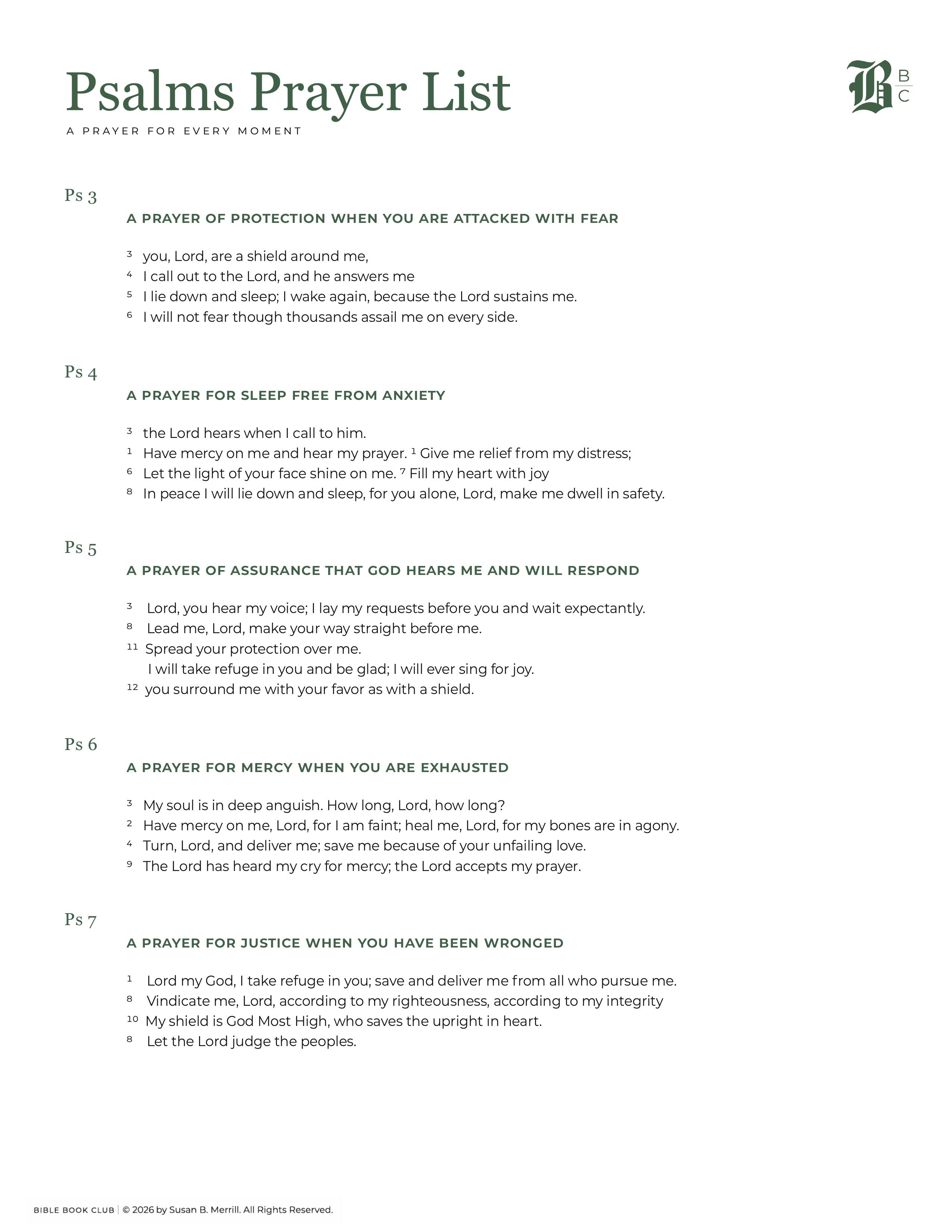
A Prayer from Psalm 90 Asking God to Teach Us How to Live Intentionally
1 Lord, you have been our dwelling place throughout all generations.
2 Before the mountains were born or you brought forth the whole world,
from everlasting to everlasting you are God.12 Teach us to number our days, that we may gain a heart of wisdom.
17 May the favor of the Lord our God rest on us; establish the work of our hands for us.
In 1719, Isaac Watts published the Hymn ‘O God Our Help in Ages Past,’ which is a paraphrase of Psalm 90. “Our shelter from the stormy blast, and our eternal home” is Watts’ rendering of Psalm 90:1’s “dwelling place.” We added it to the Psalms Playlist!
Psalm 91: He Will Command His Angels Concerning You
Psalm 91
1 Whoever dwells in the shelter of the Most High
will rest in the shadow of the Almighty.2 I will say of the Lord, “He is my refuge and my fortress,
my God, in whom I trust.”3 Surely he will save you
from the fowler’s snare
and from the deadly pestilence.4 He will cover you with his feathers,
and under his wings you will find refuge;
his faithfulness will be your shield and rampart.
5 You will not fear the terror of night,
nor the arrow that flies by day,
6 nor the pestilence that stalks in the darkness,
nor the plague that destroys at midday.
7 A thousand may fall at your side,
ten thousand at your right hand,
but it will not come near you.
8 You will only observe with your eyes
and see the punishment of the wicked.9 If you say, “The Lord is my refuge,”
and you make the Most High your dwelling,10 no harm will overtake you,
no disaster will come near your tent.
11 For he will command his angels concerning you
to guard you in all your ways;
12 they will lift you up in their hands,
so that you will not strike your foot against a stone.
13 You will tread on the lion and the cobra;
you will trample the great lion and the serpent.14 “Because he loves me,” says the Lord, “I will rescue him;
I will protect him, for he acknowledges my name.
15 He will call on me, and I will answer him;
I will be with him in trouble,
I will deliver him and honor him.
16 With long life I will satisfy him
and show him my salvation.”
What is Psalm 91 about?
Those who dwell in the shelter of God are guarded by His angels. It is a promise and the obvious focus of this psalm. The result of the promise has a benefit. It is a list of things we will not fear.
One of those has an interesting story. It is the plague that destroys at midday. In ancient Israel and the surrounding Near East, midday in the desert was not just uncomfortable. It was deadly. High noon brought scorching heat, sunstroke, severe dehydration, and oppressive hot desert winds that could choke travelers.
When Jewish scholars translated the Hebrew Bible into Greek, they rendered the Hebrew phrase not just as a physical heat stroke or plague but as “the demon of the midday.” Later, when Saint Jerome translated the Bible into Latin, he kept this wording, but his translation explicitly framed the “noonday plague” as a spiritual or demonic force.
What is the ‘noonday demon’ in Psalm 91:6?
In the 4th century CE, early Christian monks living in the Egyptian desert adopted the “noonday demon” translation to explain a specific psychological and spiritual struggle. Around noon, when the desert heat was at its peak and the day felt endlessly long, monks would experience intense listlessness, spiritual apathy, and a desire to abandon their vows.
The monk Evagrius Ponticus identified the state as acedia (spiritual sloth or apathy) and called it the work of the “noonday demon.” It’s the spirit that attacks when a person is at their most tired, overheated, and vulnerable.
What does the noonday demon have to do with us today?
I believe we, as a culture, could be at risk for this state of acedia or spiritual apathy. Not from the heat. We have been blessed with air conditioning! Our acedia may be from the near-constant presence of a different source of light other than the sun, although just as searing and possibly as oppressive.
This light doesn’t come from looking up but rather down at the phone, the computer, or a tablet. It is scientifically disrupting our circadian rhythm, which leaves us tired, vulnerable, and open to spiritual attack, just like the monks in the desert. For them, it was an apathy they had to fight for a few hours each day. Unfortunately for us, the light is available even in the dark, 24 hours a day.
Back to Our Psalm and Another Demon
The devil himself quoted Psalm 91:11, 12 in the books of Matthew and Luke when Jesus was tested in the Wilderness.
Matthew 4:5-7 5 Then the devil took him to the holy city and had him stand on the highest point of the temple. 6 “If you are the Son of God,” he said, “throw yourself down. For it is written:
“‘He will command his angels concerning you,
and they will lift you up in their hands,
so that you will not strike your foot against a stone.’”7 Jesus answered him, “It is also written: ‘Do not put the Lord your God to the test.’”
How did Satan misquote Psalm 91 when tempting Jesus?
The Devil challenges Jesus to test God’s promise to protect him, but the Devil alters the quote. He omits “to guard you in all your ways.” The omission isn’t an accident. It fundamentally changes the meaning of the Scripture, turning a promise of God’s protection into a justification for recklessness.
In Hebrew, a person’s “ways” refer to their path of righteous duty, obedience, and walking in God’s will. So Psalm 91’s original intent is that God promises angelic protection to the believer as they faithfully walk in His ways. By cutting out “in all your ways,” Satan removes the condition of walking in God’s path. He invites Jesus to jump off the Temple in a reckless stunt outside of God’s plan and demands that God rescue Him anyway.
Jesus catches the subtle distortion immediately. He doesn’t get into a debate over the omitted phrase. Instead, He answers with Deuteronomy 6:16: “Do not put the Lord your God to the test.”
Psalm 91 is all about resting in God’s care. The Devil tried to make it about testing God’s care. He failed.
A Prayer from Psalm 91 for Trust in God’s Care
1 Whoever dwells in the shelter of the Most High will rest in the shadow of the Almighty.
2 I will say of the Lord, “He is my refuge and my fortress, my God, in whom I trust.”11 For he will command his angels concerning you to guard you in all your ways;
12 they will lift you up in their hands, so that you will not strike your foot against a stone.
Psalm 92: The Righteous Will Flourish
Psalm 92
A psalm. A song. For the Sabbath day.
1 It is good to praise the Lord
and make music to your name, O Most High,
2 proclaiming your love in the morning
and your faithfulness at night,
3 to the music of the ten-stringed lyre
and the melody of the harp.4 For you make me glad by your deeds, Lord;
I sing for joy at what your hands have done.
5 How great are your works, Lord,
how profound your thoughts!
6 Senseless people do not know,
fools do not understand,
7 that though the wicked spring up like grass
and all evildoers flourish,
they will be destroyed forever.9 For surely your enemies, Lord,
surely your enemies will perish;
all evildoers will be scattered.
10 You have exalted my horn like that of a wild ox;
fine oils have been poured on me.11 My eyes have seen the defeat of my adversaries;
my ears have heard the rout of my wicked foes.12 The righteous will flourish like a palm tree,
they will grow like a cedar of Lebanon;
13 planted in the house of the Lord,
they will flourish in the courts of our God.
14 They will still bear fruit in old age,
they will stay fresh and green,15 proclaiming, “The Lord is upright;
he is my Rock, and there is no wickedness in him.”
What is Psalm 92 about?
Praise for God’s love for the righteous and victory over the wicked. This is a psalm of thanks like many we have read. This one is for the Sabbath reading. It provides assurance that the righteous are cared for and the wicked will perish.
A Prayer from Psalm 92 for God’s Care and Works
1 It is good to praise the Lord and make music to your name, O Most High,
2 proclaiming your love in the morning and your faithfulness at night.4 You make me glad by your deeds, Lord; I sing for joy at what your hands have done.
12 The righteous will flourish like a palm tree, 13 planted in the house of the Lord.
5 How great are your works, Lord, how profound your thoughts!
Psalm 93: The Lord Reigns
Psalm 93
1 The Lord reigns, he is robed in majesty;
the Lord is robed in majesty and armed with strength;
indeed, the world is established, firm and secure.
2 Your throne was established long ago;
you are from all eternity.3 The seas have lifted up, Lord,
the seas have lifted up their voice;
the seas have lifted up their pounding waves.
4 Mightier than the thunder of the great waters,
mightier than the breakers of the sea—
the Lord on high is mighty.5 Your statutes, Lord, stand firm;
holiness adorns your house
for endless days.
What is Psalm 93 about?
Celebrating God’s sovereignty. The opening of this psalm 1 The Lord reigns is directly tied to Book 4’s theme of God’s sovereignty. This Psalm is the first of a distinct category of psalms called the enthronement psalms. The enthronement psalms include 93 and 95-99. We will cover the category together. To do that, we must first discuss the one lament in this episode, Psalm 94.
Psalm 94: When Anxiety Was Great Within Me
Psalm 94
1 The Lord is a God who avenges.
O God who avenges, shine forth.
2 Rise up, Judge of the earth;
pay back to the proud what they deserve.
3 How long, Lord, will the wicked,
how long will the wicked be jubilant?4 They pour out arrogant words;
all the evildoers are full of boasting.
5 They crush your people, Lord;
they oppress your inheritance.
6 They slay the widow and the foreigner;
they murder the fatherless.
7 They say, “The Lord does not see;
the God of Jacob takes no notice.”8 Take notice, you senseless ones among the people;
you fools, when will you become wise?
9 Does he who fashioned the ear not hear?
Does he who formed the eye not see?
10 Does he who disciplines nations not punish?
Does he who teaches mankind lack knowledge?
11 The Lord knows all human plans;
he knows that they are futile.12 Blessed is the one you discipline, Lord,
the one you teach from your law;
13 you grant them relief from days of trouble,
till a pit is dug for the wicked.
14 For the Lord will not reject his people;
he will never forsake his inheritance.
15 Judgment will again be founded on righteousness,
and all the upright in heart will follow it.16 Who will rise up for me against the wicked?
Who will take a stand for me against evildoers?
17 Unless the Lord had given me help,
I would soon have dwelt in the silence of death.
18 When I said, “My foot is slipping,”
your unfailing love, Lord, supported me.
19 When anxiety was great within me,
your consolation brought me joy.20 Can a corrupt throne be allied with you—
a throne that brings on misery by its decrees?
21 The wicked band together against the righteous
and condemn the innocent to death.
22 But the Lord has become my fortress,
and my God the rock in whom I take refuge.
23 He will repay them for their sins
and destroy them for their wickedness;
the Lord our God will destroy them.
What does Psalm 94:19 say about anxiety and comfort?
Psalm 94:19 says that when our anxiety is great, God’s comfort will bring us joy. It is a cry against the wicked and protection for the righteous. It is a painful struggle to suffer while evil people prosper. In this psalm, we find a sweet refrain to recall: when our feet slip, God’s unfailing love will support us.
A Prayer from Psalm 94 When Your Anxiety Is Great
11 The Lord knows all human plans; he knows that they are futile.
21 The wicked band together against the righteous and condemn the innocent to death.
22 But the Lord has become my fortress, and my God the rock in whom I take refuge.
18 When I said, “My foot is slipping,” your unfailing love, Lord, supported me.
19 When anxiety was great within me, your consolation brought me joy.
Psalms 93 and 95-99 are generally recognized by biblical scholars as enthronement psalms (also referred to as Divine Kingship Psalms or “Yahweh Malak” Psalms). They celebrate the kingship, divine sovereignty, and reign of God over all creation, the nations, and Israel. They are primarily characterized by the Hebrew proclamation “YHWH malak,” translated as “The LORD reigns.”
What does “the Lord reigns” mean in the enthronement psalms?
Rather than focusing on a human king, the enthronement psalms proclaim God as the absolute ruler sitting on a heavenly throne, possessing power over all earthly kingdoms. Some theologians believe that the Israelites used these psalms in the annual New Year festival celebrating the symbolic “re-enthronement” or accession of God as King.
It is not hard to picture this as a celebration of God and king if you listen for the key phrases in these psalms.
- The Lord is mentioned around 39 times
- Sing, or a new song, 13 times
- Worship 7 times
- Joy, rejoice, glad, or jubilant: 16 times
Psalm 95-99: The Lord Reigns
Psalm 95
1 Come, let us sing for joy to the Lord;
let us shout aloud to the Rock of our salvation.
2 Let us come before him with thanksgiving
and extol him with music and song.3 For the Lord is the great God,
the great King above all gods.
4 In his hand are the depths of the earth,
and the mountain peaks belong to him.
5 The sea is his, for he made it,
and his hands formed the dry land.6 Come, let us bow down in worship,
let us kneel before the Lord our Maker;
7 for he is our God
and we are the people of his pasture,
the flock under his care.Today, if only you would hear his voice,
8 “Do not harden your hearts as you did at Meribah,
as you did that day at Massah in the wilderness,
9 where your ancestors tested me;
they tried me, though they had seen what I did.
10 For forty years I was angry with that generation;
I said, ‘They are a people whose hearts go astray,
and they have not known my ways.’
11 So I declared on oath in my anger,
‘They shall never enter my rest.’”
Psalm 96
1 Sing to the Lord a new song;
sing to the Lord, all the earth.2 Sing to the Lord, praise his name;
proclaim his salvation day after day.
3 Declare his glory among the nations,
his marvelous deeds among all peoples.4 For great is the Lord and most worthy of praise;
he is to be feared above all gods.
5 For all the gods of the nations are idols,
but the Lord made the heavens.
6 Splendor and majesty are before him;
strength and glory are in his sanctuary.7 Ascribe to the Lord, all you families of nations,
ascribe to the Lord glory and strength.8 Ascribe to the Lord the glory due his name;
bring an offering and come into his courts.
9 Worship the Lord in the splendor of his holiness;
tremble before him, all the earth.
10 Say among the nations, “The Lord reigns.”
The world is firmly established, it cannot be moved;
he will judge the peoples with equity.11 Let the heavens rejoice, let the earth be glad;
let the sea resound, and all that is in it.
12 Let the fields be jubilant, and everything in them;
let all the trees of the forest sing for joy.
13 Let all creation rejoice before the Lord, for he comes,
he comes to judge the earth.
He will judge the world in righteousness
and the peoples in his faithfulness.
Psalm 97
1 The Lord reigns, let the earth be glad;
let the distant shores rejoice.
2 Clouds and thick darkness surround him;
righteousness and justice are the foundation of his throne.
3 Fire goes before him
and consumes his foes on every side.
4 His lightning lights up the world;
the earth sees and trembles.
5 The mountains melt like wax before the Lord,
before the Lord of all the earth.
6 The heavens proclaim his righteousness,
and all peoples see his glory.7 All who worship images are put to shame,
those who boast in idols—
worship him, all you gods!8 Zion hears and rejoices
and the villages of Judah are glad
because of your judgments, Lord.9 For you, Lord, are the Most High over all the earth;
you are exalted far above all gods.10 Let those who love the Lord hate evil,
for he guards the lives of his faithful ones
and delivers them from the hand of the wicked.
11 Light shines on the righteous
and joy on the upright in heart.
12 Rejoice in the Lord, you who are righteous,
and praise his holy name.
Psalm 98
A psalm.
1 Sing to the Lord a new song,
for he has done marvelous things;
his right hand and his holy arm
have worked salvation for him.
2 The Lord has made his salvation known
and revealed his righteousness to the nations.
3 He has remembered his love
and his faithfulness to Israel;
all the ends of the earth have seen
the salvation of our God.4 Shout for joy to the Lord, all the earth,
burst into jubilant song with music;
5 make music to the Lord with the harp,
with the harp and the sound of singing,
6 with trumpets and the blast of the ram’s horn—
shout for joy before the Lord, the King.7 Let the sea resound, and everything in it,
the world, and all who live in it.
8 Let the rivers clap their hands,
let the mountains sing together for joy;
9 let them sing before the Lord,
for he comes to judge the earth.
He will judge the world in righteousness
and the peoples with equity.
Psalm 99
1 The Lord reigns,
let the nations tremble;
he sits enthroned between the cherubim,
let the earth shake.2 Great is the Lord in Zion;
he is exalted over all the nations.
3 Let them praise your great and awesome name—
he is holy.4 The King is mighty, he loves justice—
you have established equity;
in Jacob you have done
what is just and right.
5 Exalt the Lord our God
and worship at his footstool;
he is holy.6 Moses and Aaron were among his priests,
Samuel was among those who called on his name;
they called on the Lord
and he answered them.7 He spoke to them from the pillar of cloud;
they kept his statutes and the decrees he gave them.8 Lord our God,
you answered them;
you were to Israel a forgiving God,
though you punished their misdeeds.
9 Exalt the Lord our God
and worship at his holy mountain,
for the Lord our God is holy.
A Note on Psalm 95
The book of Hebrews quotes Psalm 95 directly in an extended mini commentary in Hebrews 3:7 through 4:7. The author of Hebrews uses one phrase in particular, which he repeats three times.
Psalm 95:7-8 7 Today, if only you would hear his voice, 8 “Do not harden your hearts as you did at Meribah, as you did that day at Massah in the wilderness,
The author of Hebrews makes a point of using the wilderness rebellion as a warning to the new church of believers.
What is the most jubilant enthronement psalm?
Psalm 98 is the most jubilant of the enthronement psalms because theologians view it as a prophetic vision of Christ’s Second Coming or eschatology. Christ’s first coming, the incarnation, was humble and quiet. But his second is portrayed in Revelation 19 as a victorious, celebratory roar.
In 1719, Isaac Watts was working on a project to adapt the Old Testament Psalms into Christian hymns through the lens of the New Testament. When Watts adapted Psalm 98, he titled his rewrite “The Messiah’s Coming and Kingdom.” Watts was writing about the Second Coming and the ultimate renewal of creation.
In 1848, American composer Lowell Mason set Isaac Watts’ adapted lyrics to music, and the opening line became the name of the song. From there, it became the beloved Christmas carol “Joy to the World.”
Is “Joy to the World” actually a Christmas song or about the Second Coming?
Joy to the World is a song about the Second Coming of Christ and is sung on the birthday of his first coming. So next time you sing “Joy to the World, the Lord is come, Let earth receive her king,” you will know that Isaac Watts wasn’t writing a nativity song. He was looking past the manger to the day Christ returns to reign.
We added “Joy to the World” to our Psalms Playlist!
What is Psalm 93, 95-99 about?
These psalms are about singing praise to the Lord who reigns as King and worshipping Him with joy. In our last psalms, Israel was in crisis. The Temple was decimated, and the hope for a king was gone.
The enthronement psalms answer the crisis in our last episode by changing the subject of kingship altogether. It moves from human kingship, failed and lost, to Divine Kingship, unshakable and sovereign over all. The enthronement psalms are a deliberate theological response to the Temple destruction and the Davidic monarchy in Book 3.
The anchor for these psalms of praise is the Lord Reigns. It is repeated four times:
- Psalm 93:1 1The Lord reigns, he is robed in majesty (Here comes the king)
- Psalm 96:10 10 Say among the nations, “The Lord reigns.” (Spread the news!)
- Psalm 97:1 1 The Lord reigns, let the earth be glad (Righteousness rules)
- Psalm 99:1 1 The Lord reigns, let the nations tremble (In awe of his holiness)
The four repeated phrases tell a story of their own, like a ripple of excitement in a real royal procession.
- The king appears.
- The excitement spreads.
- Relief that He will reign brings joy.
- As He passes, the humbling feeling of awe at His holiness.
Will this be a daily occurrence in heaven? Will we ever get used to being in the presence of God? Or will we fall at His feet every single time? Revelation gives us a hint.
Revelation 7:11-12 11 All the angels were standing around the throne and around the elders and the four living creatures. They fell down on their faces before the throne and worshiped God, 12 saying:
“Amen!
Praise and glory
and wisdom and thanks and honor
and power and strength
be to our God for ever and ever.
Amen!”
If the angels are falling at His feet, we most certainly will too, with the crescendo of a heavenly choir in surround sound.
A Prayer of Praise from Psalm 93, 95-99 for the Lord Who Reigns
93:1 The Lord reigns, he is robed in majesty;
95:1 Come, let us sing for joy to the Lord; let us shout aloud to the Rock of our salvation.
6 Come, let us bow down in worship, let us kneel before the Lord our Maker;
97:1 The Lord reigns, let the earth be glad 96:11 Let the heavens rejoice,
98:7 Let the sea resound, and everything in it, the world, and all who live in it.
Join us for our Bible study on Psalms 100-106.
New Psalms Playlist Song
- “O God Our Help in Ages Past” by Nathan Drake (Psalm 90)
- “Joy to the World” by David Archuleta (Psalm 98)
Group Discussion Questions for Psalms 90-99
- Moses prayed, “Teach us to number our days, that we may gain a heart of wisdom.” If you counted today as one of a limited number of days, what would you do differently?
- In our modern times, the “noonday demon” comes at us not through desert heat but through electronics that pull us away from rest, leaving us tired and vulnerable to spiritual attack. What’s one way you can fight the mindless scroll to protect yourself from the dangers of spiritual apathy?
- Satan twisted God’s promise of protection in Psalm 91 into an excuse to recklessly test God. In your own life, what is something good that Satan has tried to twist to tempt you?