Previously on Bible Book Club
In Psalms 3-8, we read five laments about fear, anxiety, God’s responsiveness, exhaustion, and being wrongly accused. We finished with one praise about the wonder of Creation and Man.
Psalms 9-16 Introduction
This block of psalms tells a story of its own. These eight psalms describe what it feels like to live in a broken world while trying to hold on to faith in God, but all from David’s perspective, because one man wrote all of them. David’s life was a battle, and throughout it he faced wicked intentions. But through this, he developed the faith to rely on God for his survival. This was the world Jesus lived through and the world we are living in right now.
In summary, the first six of the eight psalms define the problems of a broken world. The last two provide the solution: God. This is a psalm for when you feel personally vulnerable, perhaps because of what is going on in the world.
Psalm 9: Thanks for Protection in Times of Trouble
Psalm 9
For the director of music. To the tune of “The Death of the Son.” A psalm of David.
1 I will give thanks to you, Lord, with all my heart;
I will tell of all your wonderful deeds.
2 I will be glad and rejoice in you;
I will sing the praises of your name, O Most High.3 My enemies turn back;
they stumble and perish before you.
4 For you have upheld my right and my cause,
sitting enthroned as the righteous judge.
5 You have rebuked the nations and destroyed the wicked;
you have blotted out their name for ever and ever.
6 Endless ruin has overtaken my enemies,
you have uprooted their cities;
even the memory of them has perished.7 The Lord reigns forever;
he has established his throne for judgment.
8 He rules the world in righteousness
and judges the peoples with equity.
9 The Lord is a refuge for the oppressed,
a stronghold in times of trouble.
10 Those who know your name trust in you,
for you, Lord, have never forsaken those who seek you.11 Sing the praises of the Lord, enthroned in Zion;
proclaim among the nations what he has done.
12 For he who avenges blood remembers;
he does not ignore the cries of the afflicted.13 Lord, see how my enemies persecute me!
Have mercy and lift me up from the gates of death,
14 that I may declare your praises
in the gates of Daughter Zion,
and there rejoice in your salvation.15 The nations have fallen into the pit they have dug;
their feet are caught in the net they have hidden.
16 The Lord is known by his acts of justice;
the wicked are ensnared by the work of their hands.
17 The wicked go down to the realm of the dead,
all the nations that forget God.
18 But God will never forget the needy;
the hope of the afflicted will never perish.19 Arise, Lord, do not let mortals triumph;
let the nations be judged in your presence.
20 Strike them with terror, Lord;
let the nations know they are only mortal.
What is Psalm 9 about?
Psalm 9 is about protection for the vulnerable. David’s life was a battle, and throughout it he faced wicked intentions. But, through it all, he developed the faith to rely on God for his survival. This was the world Jesus lived through, and the world we are living in right now. When you feel personally vulnerable, praying this psalm will provide reassurance that God is protecting you.
How many battles did King David fight in the Bible?
Some estimate David fought between 50 and 60 military battles, according to what’s documented in the Bible, which is more than anyone else recorded in the Bible. It all began with Goliath when he was a teenager. Then he fought against the Philistines, Jebusites, Amalekites, Geshurites, Moabites, Edomites, Ammonites, and Arameans. There are surely many more battles not documented.
The point is, David is often in a vulnerable situation. He knows fear, pain, sorrow, devastation, loss, and at the same time trusts God for the purpose behind all of it. David sees God as a stronghold in times of trouble, and it gives him courage. The courage to do difficult things. And he thanks God for it. This is reflected in the psalms, where words of thanks, praise, and lament are mixed with the emotions that come from victory attained through loss. What difficulty are you facing? Can you thank God for being a stronghold or fortress for your protection?
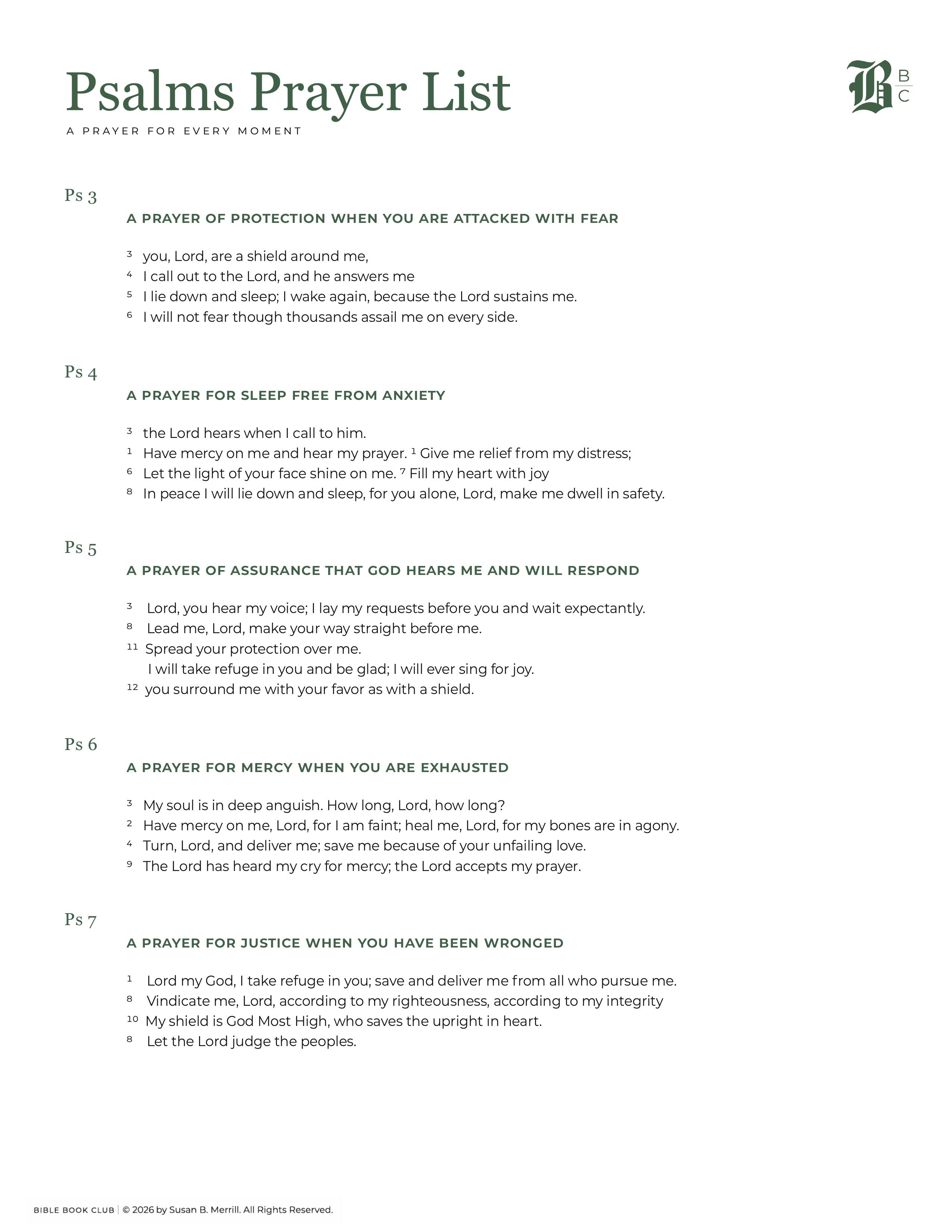
A Prayer of Thanks for Protection in Times of Trouble
1 I will give thanks to you, Lord, with all my heart; I will tell of all your wonderful deeds.
3 My enemies turn back; they stumble and perish before you.
4 For you have upheld my right and my cause,
9 The Lord is a refuge for the oppressed, a stronghold in times of trouble.
Psalm 9 is unique because it is a psalm of thanks, praise, and lament. There is a reason for that, which we will discuss in a moment.
Psalm 10: A Cry for God to Take a Stand Against the Wicked
Have you ever felt frustrated with God’s silence? This is a psalm for when you feel angry that evil seems to always win and God is nowhere to be found.
Psalm 10
1 Why, Lord, do you stand far off?
Why do you hide yourself in times of trouble?2 In his arrogance the wicked man hunts down the weak,
who are caught in the schemes he devises.
3 He boasts about the cravings of his heart;
he blesses the greedy and reviles the Lord.
4 In his pride the wicked man does not seek him;
in all his thoughts there is no room for God.
5 His ways are always prosperous;
your laws are rejected by him;
he sneers at all his enemies.
6 He says to himself, “Nothing will ever shake me.”
He swears, “No one will ever do me harm.”7 His mouth is full of lies and threats;
trouble and evil are under his tongue.
8 He lies in wait near the villages;
from ambush he murders the innocent.
His eyes watch in secret for his victims;
9 like a lion in cover he lies in wait.
He lies in wait to catch the helpless;
he catches the helpless and drags them off in his net.
10 His victims are crushed, they collapse;
they fall under his strength.
11 He says to himself, “God will never notice;
he covers his face and never sees.”12 Arise, Lord! Lift up your hand, O God.
Do not forget the helpless.
13 Why does the wicked man revile God?
Why does he say to himself,
“He won’t call me to account”?
14 But you, God, see the trouble of the afflicted;
you consider their grief and take it in hand.
The victims commit themselves to you;
you are the helper of the fatherless.
15 Break the arm of the wicked man;
call the evildoer to account for his wickedness
that would not otherwise be found out.16 The Lord is King for ever and ever;
the nations will perish from his land.
17 You, Lord, hear the desire of the afflicted;
you encourage them, and you listen to their cry,
18 defending the fatherless and the oppressed,
so that mere earthly mortals
will never again strike terror.
What is Psalm 10 about?
Psalm 10 is about frustration with God’s silence. In your own life, if you feel frustrated that God seems absent, praying this psalm will help you redirect your feelings to the God who sees, even when it feels like He isn’t looking.
What is the literary relationship between Psalm 9 and Psalm 10?
Psalms 9 and 10 were originally one in Hebrew, and they form an acrostic. Psalm 9 covers the first half of the Hebrew alphabet, and Psalm 10 covers the second half. That is why Psalm 10 has no superscription. Together they describe a battle.
How do the perspectives of Psalm 9 and Psalm 10 differ?
Psalm 9 is in the middle of the fight, looking back in thanks at what has transpired so far. Psalm 10 is looking forward in the battle and asking why God is standing so far off while the wicked prosper. So perhaps the battle took a bad turn.
While Psalm 9, originally one with Psalm 10, looks back at what God has done in thanksgiving, Psalm 10 looks forward with urgency in a lament. David is clearly frustrated with this battle and God’s lack of involvement.
- Verse 1: He questions God. Why is God hiding from them?
- Verses 2-11: He proceeds to describe the wicked.
- Verses 12-15: He stops describing the problem and demands a solution. He cries for God to “arise” and “do not forget the helpless.”
- Verses 16-18: His lament ends in praise as he returns to thoughts of the God he knows has been faithful to him in the past as the King who defends the oppressed against the wicked.
David shifts from questioning God’s absence in verse 1 to praising His kingship in verse 16. What is one area of your life where you need to make that same shift from “God, why are you hiding?” to “God, I know You hear my cry”?
A Prayer for God to Take a Stand Against the Wicked:
1 Lord, why do you hide yourself in times of trouble?
2 the wicked man hunts down the weak, who are caught in the schemes he devises.
14 But you, God, see the afflicted; you consider their grief.
17 you encourage them, and you listen to their cry,
18 defending the oppressed, so that mere earthly mortals will never again strike terror.
Psalm 11: Trust in God to Judge the Wicked
Do you ever feel like you want to escape the worldly chaos around you? This psalm is perfect for when the political or spiritual foundations of the country seem to be falling apart.
Psalm 11
1 In the Lord I take refuge. How then can you say to me: “Flee like a bird to your mountain. 2 For look, the wicked bend their bows; they set their arrows against the strings to shoot from the shadows at the upright in heart. 3 When the foundations are being destroyed, what can the righteous do?”
4 The Lord is in his holy temple; the Lord is on his heavenly throne. He observes everyone on earth; his eyes examine them. 5 The Lord examines the righteous, but the wicked, those who love violence, he hates with a passion. 6 On the wicked he will rain fiery coals and burning sulfur; a scorching wind will be their lot.
7 For the Lord is righteous, he loves justice; the upright will see his face.’
What is Psalm 11 about?
Psalm 11 is about cultural and moral collapse. If you feel like things are out of control, this prayer will remind you that God is in control.
What is the first psalm categorized under the trust category?
Psalm 11 is our first psalm from the trust category. The “trust category” of Psalms has the message: God, I am safe with you. David opens in verse 1 as if contemplating someone’s advice to “flee like a bird” from whatever evil is plaguing him.
The psalm could be referring to fleeing from Saul or Absalom. His world is falling apart, and evil is taking over. It is wise to flee temptation as Joseph did in Genesis 39, but it is wrong to flee from duty, as Nehemiah was encouraged to do in Nehemiah 6.
What does the word foundations mean in Biblical terminology?
In the Bible, the word “foundations” refers to the moral foundations of society. The moral foundations are summed up in the 10 Commandments, and David sees a world where all of them seem to be broken. That’s why in Psalm 11:3 David states that the foundations are being destroyed.
David gets bad advice to flee from the chaos, and he responds by choosing to stay. He refuses to give up on the world before him. Instead, he puts his trust in God to judge the righteous and the wicked. If you feel like things are out of control, this prayer will remind you that God is in control.
How to pray for trust in God to judge the wicked
4 The Lord is in his holy temple;
He observes everyone on earth;
the wicked, those who love violence, he hates7 For the Lord is righteous, he loves justice;
Psalm 12: A Cry for Protection from Deception and Lies
This psalm is for everyone, because we all have been on the other side of lies.
Psalm 12
For the director of music. According to sheminith. A psalm of David.
1 Help, Lord, for no one is faithful anymore;
those who are loyal have vanished from the human race.
2 Everyone lies to their neighbor;
they flatter with their lips
but harbor deception in their hearts.3 May the Lord silence all flattering lips
and every boastful tongue—
4 those who say,
“By our tongues we will prevail;
our own lips will defend us—who is lord over us?”5 “Because the poor are plundered and the needy groan,
I will now arise,” says the Lord.
“I will protect them from those who malign them.”
6 And the words of the Lord are flawless,
like silver purified in a crucible,
like gold refined seven times.7 You, Lord, will keep the needy safe
and will protect us forever from the wicked,
8 who freely strut about
when what is vile is honored by the human race.
What does the musical term Sheminith refer to in the psalms?
The word sheminith mentioned in Psalm 12 most likely refers to a melody or octave. It could also refer to an eight-stringed instrument. Refer back to our Psalm 5 Bible study to learn more about this term.
What is Psalm 12 about?
Psalm 12 is about deceitful words. The lament pattern of cry, complaint, request is very clear here:
- David cries out for help
- Complains that no one can be trusted and everyone lies
- Then requests that God protect them from the wicked
We are all deceived at some point in our lives, some more than others. If you are in a difficult relationship filled with deception, take heart and trust God for protection.
A Prayer for Protection Against Deception and Lies
1 Help, Lord, for no one is faithful anymore
2 Everyone lies; they harbor deception in their hearts.5 “ I will now arise,” says the Lord. “I will protect them from those who malign them.”
7 You, Lord, will protect us forever from the wicked
Psalm 13: A Cry for When There Is No End in Sight
Have you ever felt like you just can’t go on? This psalm is about David wrestling with the pain of waiting.
Psalm 13
For the director of music. A psalm of David.
1 How long, Lord? Will you forget me forever?
How long will you hide your face from me?
2 How long must I wrestle with my thoughts
and day after day have sorrow in my heart?
How long will my enemy triumph over me?3 Look on me and answer, Lord my God.
Give light to my eyes, or I will sleep in death,
4 and my enemy will say, “I have overcome him,”
and my foes will rejoice when I fall.5 But I trust in your unfailing love;
my heart rejoices in your salvation.
6 I will sing the Lord’s praise,
for he has been good to me.
What is Psalm 13 about?
Psalm 13 is about waiting when it emotionally or physically hurts. When there is no end in sight of a trial, you can feel panicked, claustrophobic, and trapped. We saw this emotion when we studied the Book of Job. He just wanted to escape his torture. David asks “how long” four times in this six-verse psalm.
Why is the phrase “how long” repeated four times in Psalm 13?
The fact that David has so few words and the same question speaks to mental exhaustion. He is at his end. Then suddenly his mind pivots from lament to trust in God’s unfailing love. Was this the secret to David’s faithfulness? This ability to give his heart the freedom to vent, without allowing it to spiral into despair?
In all of his psalms, David questions, complains, and laments, but he always brings it back to faith, trust, and hope. How can we get to that place of trust while in painful waiting? Can we pivot, as David always seems to, from despair to trust, praising and rejoicing in God’s salvation? How can we exercise our faith so that it has that kind of strength?
A Prayer for When There Is No End in Sight
1 How long, Lord? Will you forget me forever?
2 How long must I wrestle with my thoughts and day after day have sorrow in my heart?3 Look on me and answer, Lord my God. Give light to my eyes,
Psalm 14: A Cry of Frustration at the Arrogant Fool
This psalm is both a lament and a wisdom psalm; it addresses a unique situation. It is for anyone struggling in frustration with an unbeliever.
Psalm 14
For the director of music. Of David.
1 The fool says in his heart,
“There is no God.”
They are corrupt, their deeds are vile;
there is no one who does good.2 The Lord looks down from heaven
on all mankind
to see if there are any who understand,
any who seek God.
3 All have turned away, all have become corrupt;
there is no one who does good,
not even one.They devour my people as though eating bread;
they never call on the Lord.
5 But there they are, overwhelmed with dread,
for God is present in the company of the righteous.
6 You evildoers frustrate the plans of the poor,
but the Lord is their refuge.7 Oh, that salvation for Israel would come out of Zion!
When the Lord restores his people,
let Jacob rejoice and Israel be glad!
What is Psalm 14 about?
Psalm 14 is about frustration with an unbeliever. The Hebrew word for “fool” in verse 1 is Nabal. The story of Abigail and Nabal in 1 Samuel 25 is the story of a fool. This type of fool is not a fool because of a lack of intelligence.
The fool has a problem that originates in the heart. He doesn’t believe that there is a God. We would call him a practical atheist. Someone who does not deny God but lives as if there were no God. David is frustrated with these types of people and cries out to God.
What historical event inspired David to write Psalm 14?
It is possible that the historical event that inspired David to write Psalm 14 was when he met Nabal and, in his frustration, almost killed Nabal’s entire household had it not been for Abigail, who intervened.
You can listen to the entire story about how Abigail went from being married to the fool to being married to the king in season 9, episode 15 of the Bible Book Club Podcast.
A Prayer of Frustration Over Combative Unbelievers
1 The fool says in his heart, “There is no God.”
They are corrupt, their deeds are vile;4 They never call on the Lord.
5 But God is present in the company of the righteous.
6 The Lord is their refuge.7 Oh, that salvation for Israel would come out of Zion!
So far in this episode, David has made his case that the world is broken and populated with wicked people. In these last two psalms, he will come around to the solution to this problem. And it starts with us.
Psalm 15: Wisdom on How to Find Favor with God
Have you ever wondered if you measured up in God’s eyes? David did, and he shares his insights on how to grow closer to God.
Psalm 15
A psalm of David.
1 Lord, who may dwell in your sacred tent?
Who may live on your holy mountain?2 The one whose walk is blameless,
who does what is righteous,
who speaks the truth from their heart;
3 whose tongue utters no slander,
who does no wrong to a neighbor,
and casts no slur on others;
4 who despises a vile person
but honors those who fear the Lord;
who keeps an oath even when it hurts,
and does not change their mind;
5 who lends money to the poor without interest;
who does not accept a bribe against the innocent.Whoever does these things
will never be shaken.
What is Psalm 15 about?
Psalm 15 is about our relationship to God. David starts by asking who can dwell in God’s tent. The sacred tent is the Tabernacle that Moses built. It represents God’s dwelling place and is later replaced by the Temple.
Only the priests are allowed in the Tabernacle, and only the one High Priest is allowed in the innermost sanctuary called the Holy of Holies. This is where the presence of God is over the Ark of the Covenant. So physically approaching God’s holy presence is not an option for David, as he is not a priest. But David is craving intimacy with God and pondering how to be closer to Him. And he is wondering who is worthy to dwell in God’s presence. David answers his own question with a list of ten ways to dwell in God’s presence.
How can a person dwell in God’s presence according to Psalm 15?
According to Psalm 15, to dwell in God’s presence, David says we must do these ten things:
- Walk blamelessly
- Work righteousness
- Speak the truth
- Never slander
- Never wrong a neighbor
- Honor God
- Keep your word
- Don’t change your mind
- Never charge interest
- Don’t accept bribes.
The first three really encompass the rest. If we walk, work, and speak in obedience to God, then we will sense His pleasure:
- Someone whose walk is blameless has a character of integrity.
- A person who works righteousness is honest in their dealings.
- A person who speaks the truth is sincere.
This is not a prescription to be saved, but rather a description of how a saved person should live if they want to please God and have fellowship with Him. This faithful person will never be shaken. They won’t fear death, doubt their salvation, or lose hope that they will indeed live in the presence of God for eternity. If you desire to grow closer to God, let these words of David remind you of the path to favor.
A Prayer of Wisdom on How to Find Favor with God
1 Lord, who may dwell in your sacred tent?
2 The one whose walk is blameless, who speaks the truth from their heart;
3 whose tongue utters no slander, who does no wrong to a neighbor, ;
5 Whoever does these things will never be shake
Psalm 16: Trust That God Will Provide the Path to Life
Psalm 15 defines how we can find favor with God and stand in His presence. Psalm 16 explains why life with God is worth living. The hope of eternity. This is the first of 6 psalms that are a miktam.
Psalm 16
A miktam of David.
1 Keep me safe, my God,
for in you I take refuge.2 I say to the Lord, “You are my Lord;
apart from you I have no good thing.”
3 I say of the holy people who are in the land,
“They are the noble ones in whom is all my delight.”
4 Those who run after other gods will suffer more and more.
I will not pour out libations of blood to such gods
or take up their names on my lips.5 Lord, you alone are my portion and my cup;
you make my lot secure.
6 The boundary lines have fallen for me in pleasant places;
surely I have a delightful inheritance.
7 I will praise the Lord, who counsels me;
even at night my heart instructs me.
8 I keep my eyes always on the Lord.
With him at my right hand, I will not be shaken.9 Therefore my heart is glad and my tongue rejoices;
my body also will rest secure,
10 because you will not abandon me to the realm of the dead,
nor will you let your faithful one see decay.
11 You make known to me the path of life;
you will fill me with joy in your presence,
with eternal pleasures at your right hand.
What does the term miktam mean in the Book of Psalms?
We are not exactly sure what miktam means, but all six psalms that reference miktam end on a happy, triumphant note. Guesses as to the meaning of miktam include:
- A golden psalm.
- Secret, intimate prayer.
- Engraved yzviw so important it is etched somewhere never to be lost.
What is Psalm 16 about?
Psalm 16 is about hope for an eternal relationship with God. It is a song of trust that God will keep us safe and show us the path to life. Not simply life in this broken world, but eternal life, which He provides through faith in Christ.
What does the Hebrew word cheleq mean in Psalm 16?
The Hebrew word cheleq means “portion.” When the Israelites claimed the Promised Land, cheleq referred to their measured-out allotment of land. This allotment provided for the survival of their family. David echoes this sentiment, but he is adding to it a deeper spiritual reality by acknowledging life comes from relying on God as one’s portion, trusting He is the true source of provision.
What does it mean that God is my portion?
Today, we would say God is our portion, implying God is our ultimate provider. Our security is not tied to a bank account, a home, or a job, and God will sustain us through all of life’s circumstances.
How does Psalm 16 serve as a prophecy for Jesus Christ?
Psalm 16 includes a hidden resurrection prophecy because in Psalm 16:10 David says God will not abandon him to the realm of the dead. David is expressing a radical trust in God. One that he could not have foreseen and therefore is prophesying. David is declaring his confidence that his relationship with God will not end in his death.
Then he says that God will not let His faithful one see decay. David’s view of self and a vision of his promised greater son become blurred.
What does it mean that God’s faithful one will not decay?
David sees one who will not be abandoned to the realm of the dead and will not decay in death. This is clearly not David, who was buried, but an image of Christ. For Christ left the realm of the dead after 3 days and rose again, never to decay.
Peter quoted Psalm 16:8-11 directly in his sermon at Pentecost in Acts.
Acts 2:22-32 22 “Fellow Israelites, listen to this: Jesus of Nazareth was a man accredited by God to you by miracles, wonders and signs, which God did among you through him, as you yourselves know. 23 This man was handed over to you by God’s deliberate plan and foreknowledge; and you, with the help of wicked men, put him to death by nailing him to the cross. 24 But God raised him from the dead, freeing him from the agony of death, because it was impossible for death to keep its hold on him. 25 David said about him:
“‘I saw the Lord always before me.
Because he is at my right hand,
I will not be shaken.
26 Therefore my heart is glad and my tongue rejoices;
my body also will rest in hope,
27 because you will not abandon me to the realm of the dead,
you will not let your holy one see decay.
28 You have made known to me the paths of life;
you will fill me with joy in your presence.’29 “Fellow Israelites, I can tell you confidently that the patriarch David died and was buried, and his tomb is here to this day. 30 But he was a prophet and knew that God had promised him on oath that he would place one of his descendants on his throne. 31 Seeing what was to come, he spoke of the resurrection of the Messiah, that he was not abandoned to the realm of the dead, nor did his body see decay. 32 God has raised this Jesus to life, and we are all witnesses of it.
Peter validates for us what David prophesied. David is pointing forward to his greater son, Jesus.
Psalm 16 ends with a direct message to us about the path to life more meaningful to us than even David. He said:
Psalm 16:11 11 You make known to me the path of life; you will fill me with joy in your presence, with eternal pleasures at your right hand.
We know with clarity what David only saw in a vision.
What is the meaning of “path of life”?
The path to eternal life is faith in Christ; the presence that fills us with joy is the Holy Spirit. The eternal pleasure at God’s right hand will be in the new kingdom.
A Prayer of Trust that God Has Provided for Me in Eternity
1 Keep me safe, my God, for in you I take refuge.
5 Lord, you alone are my portion and my cup; you make my lot secure.
8 I keep my eyes always on the Lord. With him I will not be shaken.
11 You make known to me the path of life; you will fill me with joy in your presence.
Join us for our Bible study on Psalms 17-21 here.
New Psalms Playlist Song
- “My Refuge” (Psalm 16) by Craig Courtney, Beckenhorst Singers, and Dan Forrest
Listen to the entire Psalms playlist on Apple Music or Spotify.
Group Discussion Questions for Psalms 9-16
- David asks “how long” four times in a six-verse psalm. Then his mind quickly pivots from lament to trust in God’s unfailing love. Do you think this ability to vent without spiraling into despair is the secret to David’s faithfulness? How could you imitate this in your own faith walk?
- Psalm 15 describes 10 behaviors of someone who walks closely with God. Which of these 10 behaviors feels most like a place of potential growth for you right now?
- Psalm 16 says our security is not tied to a bank account, a home, or a job. God is our portion. What is one thing you tend to rely on for security more than God, and what would it look like to loosen your grip on it?