Previously on Bible Book Club
Psalm 103 gave us the line the episode was named for, “As far as the east is from the west.” It’s God’s picture of total forgiveness, your sins carried off so far they can’t be measured back to you. Psalms 105 and 106 closed Book 5 by telling Israel’s story twice: How faithful God was and how faithless the people were. Both hang on the same truth, “His love endures forever.”
Introduction to Psalms 107-118, the Beginning of Psalms Book 5
With Psalms 107-118, we begin Book 5, the final book of Psalms. We are out of the wilderness of Book 4 and in the home stretch.
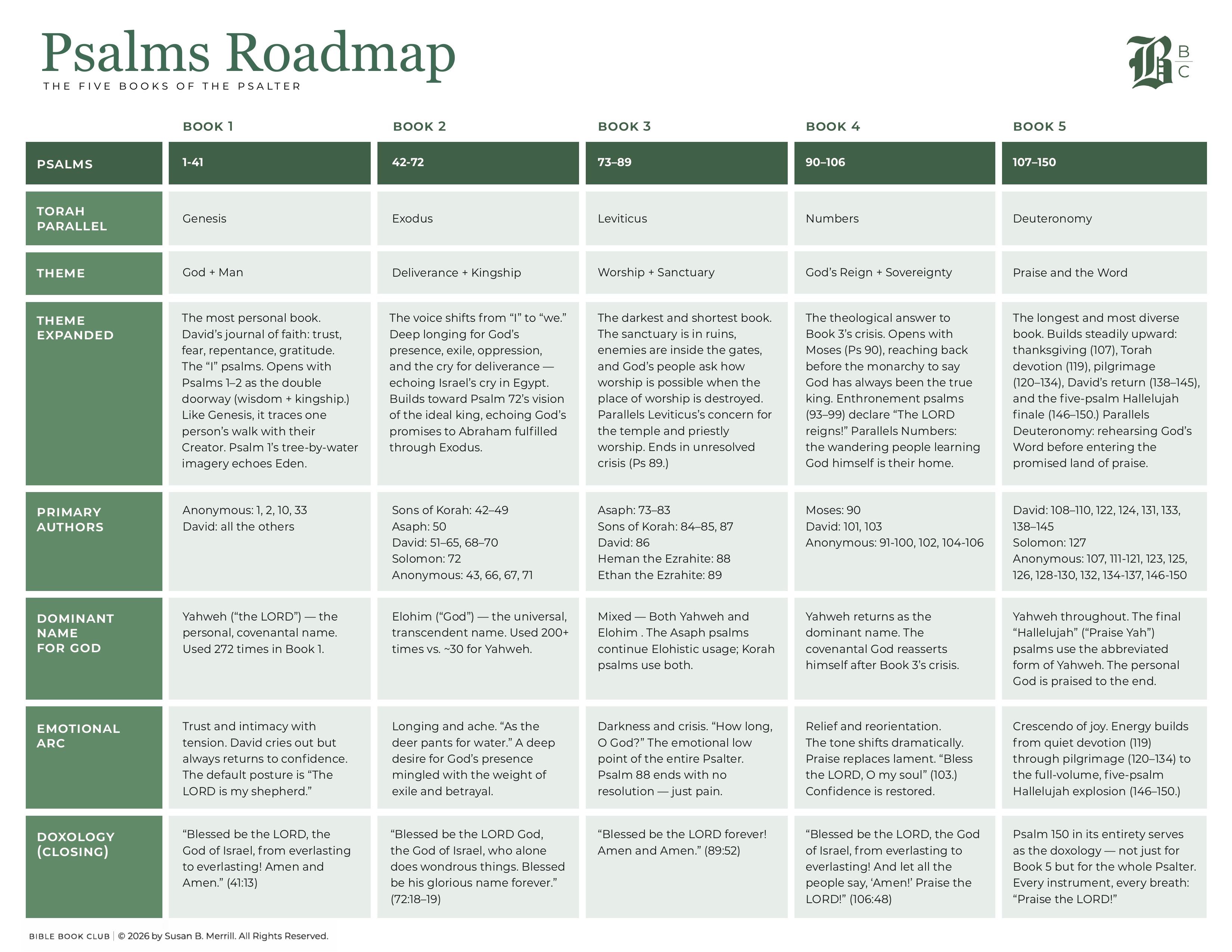
What are the 5 Books of the Psalms and their themes?
The editors of the Psalms arranged the five books of the Psalms to mirror the five books of the Torah.
- Book 1 is the companion to Genesis. Its theme is God and man.
- Book 2 is the companion to Exodus. The theme is deliverance and kingship.
- Book 3 is the companion to Leviticus. The theme is worship and sanctuary.
- Book 4 is the companion to Numbers. The theme is wilderness and God’s sovereignty.
- Book 5 is the companion to Deuteronomy. The theme is praise and the Word.
If Book 4 was the wilderness road to the Promised Land, Book 5 is the people standing on the bank of the Jordan about to cross into the promise. Because that’s where Moses left the Israelites before he died in the final chapter of Deuteronomy, reciting God’s Word to the people on the edge of the Promised Land. He told the whole story again so they would remember how God brought them this far, praising God for what He did to get them to the land He had promised them. Book 5 tells this story of praise. It is the most diverse book in the Psalter, and it builds steadily upward into a crescendo of hallelujahs.
Book 5: Psalms 107-150
We may be beginning a new book, but the theme of Psalm 106 in our last Bible study on Psalms continues as a bookend in these psalms: “His love endures forever.”
Psalm 107: His Love Endures Forever
Psalm 107
1 Give thanks to the Lord, for he is good;
his love endures forever.2 Let the redeemed of the Lord tell their story—
those he redeemed from the hand of the foe,
3 those he gathered from the lands,
from east and west, from north and south.4 Some wandered in desert wastelands,
finding no way to a city where they could settle.
5 They were hungry and thirsty,
and their lives ebbed away.
6 Then they cried out to the Lord in their trouble,
and he delivered them from their distress.
7 He led them by a straight way
to a city where they could settle.
8 Let them give thanks to the Lord for his unfailing love
and his wonderful deeds for mankind,
9 for he satisfies the thirsty
and fills the hungry with good things.10 Some sat in darkness, in utter darkness,
prisoners suffering in iron chains,
11 because they rebelled against God’s commands
and despised the plans of the Most High.
12 So he subjected them to bitter labor;
they stumbled, and there was no one to help.
13 Then they cried to the Lord in their trouble,
and he saved them from their distress.
14 He brought them out of darkness, the utter darkness,
and broke away their chains.
15 Let them give thanks to the Lord for his unfailing love
and his wonderful deeds for mankind,
16 for he breaks down gates of bronze
and cuts through bars of iron.17 Some became fools through their rebellious ways
and suffered affliction because of their iniquities.
18 They loathed all food
and drew near the gates of death.
19 Then they cried to the Lord in their trouble,
and he saved them from their distress.
20 He sent out his word and healed them;
he rescued them from the grave.
21 Let them give thanks to the Lord for his unfailing love
and his wonderful deeds for mankind.
22 Let them sacrifice thank offerings
and tell of his works with songs of joy.23 Some went out on the sea in ships;
they were merchants on the mighty waters.
24 They saw the works of the Lord,
his wonderful deeds in the deep.
25 For he spoke and stirred up a tempest
that lifted high the waves.
26 They mounted up to the heavens and went down to the depths;
in their peril their courage melted away.
27 They reeled and staggered like drunkards;
they were at their wits’ end.
28 Then they cried out to the Lord in their trouble,
and he brought them out of their distress.
29 He stilled the storm to a whisper;
the waves of the sea were hushed.
30 They were glad when it grew calm,
and he guided them to their desired haven.
31 Let them give thanks to the Lord for his unfailing love
and his wonderful deeds for mankind.
32 Let them exalt him in the assembly of the people
and praise him in the council of the elders.33 He turned rivers into a desert,
flowing springs into thirsty ground,
34 and fruitful land into a salt waste,
because of the wickedness of those who lived there.
35 He turned the desert into pools of water
and the parched ground into flowing springs;
36 there he brought the hungry to live,
and they founded a city where they could settle.
37 They sowed fields and planted vineyards
that yielded a fruitful harvest;
38 he blessed them, and their numbers greatly increased,
and he did not let their herds diminish.39 Then their numbers decreased, and they were humbled
by oppression, calamity and sorrow;
40 he who pours contempt on nobles
made them wander in a trackless waste.
41 But he lifted the needy out of their affliction
and increased their families like flocks.
42 The upright see and rejoice,
but all the wicked shut their mouths.43 Let the one who is wise heed these things
and ponder the loving deeds of the Lord.
What is Psalm 107 about?
Psalm 107 is about how God saves those in desperate situations. This psalmist has a specific purpose. He wants us to ponder the loving deeds of the Lord, and he offers four specific examples of how God has demonstrated this love for us. Each example has a pattern.
- The people cry out to God in need.
- God delivers them.
- The people give thanks to God.
The four scenarios in which God saves are specific and focus on the Lord’s redemption of Israel.
What are the 4 ways God delivers His people in Psalm 107?
The four ways God delivers his people in Psalm 107 are:
- Those who have lost their way: God leads them out to a safe place to settle.
- Those who are slaves due to rebellion against Him: God breaks their chains and leads them out of darkness.
- Those who are foolish and become afflicted: God delivers them from destruction and heals them with His Word.
- Those who have lost hope: God stills the storm to a whisper.
The four scenes may be specific to the Israelites, but there is nothing new under the sun. We too can be lost, rebellious, foolish, and hopeless. In each of these examples, the people turned to God, and He delivered them. In the book of Hebrews, we find the same promise for us if we turn to God.
Hebrews 4:16 16 Let us then approach God’s throne of grace with confidence, so that we may receive mercy and find grace to help us in our time of need.
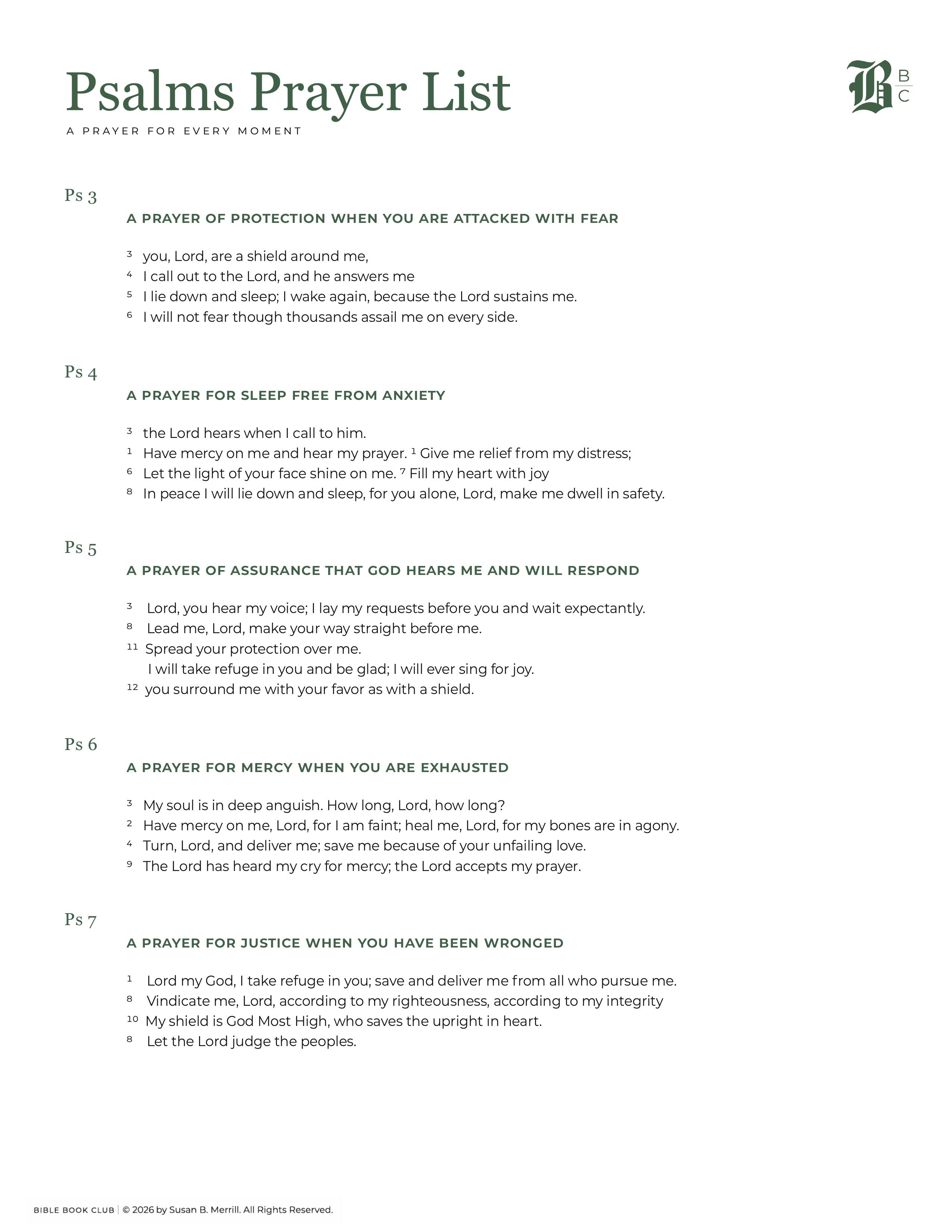
A Prayer from Psalm 107, Praising God for He Is Good, and His Love Endures Forever
1 Give thanks to the Lord, for he is good; his love endures forever.
14 He brought them out of darkness and broke away their chains.’
20 He sent out his word and healed them; he rescued them from the grave.
43 Let the one who is wise heed these things and ponder the loving deeds of the Lord.
Psalm 108: Great Is Your Love, Higher Than the Heavens
Psalms 108, 109, and 110 are all written by David. Psalm 108 is a repeated combination of Psalm 57:7-11 and Psalm 60:5-12, so we will read it but not discuss it again.
Psalm 108
A song. A psalm of David.
1 My heart, O God, is steadfast;
I will sing and make music with all my soul.
2 Awake, harp and lyre!
I will awaken the dawn.
3 I will praise you, Lord, among the nations;
I will sing of you among the peoples.
4 For great is your love, higher than the heavens;
your faithfulness reaches to the skies.
5 Be exalted, O God, above the heavens;
let your glory be over all the earth.6 Save us and help us with your right hand,
that those you love may be delivered.
7 God has spoken from his sanctuary:
“In triumph I will parcel out Shechem
and measure off the Valley of Sukkoth.
8 Gilead is mine, Manasseh is mine;
Ephraim is my helmet,
Judah is my scepter.
9 Moab is my washbasin,
on Edom I toss my sandal;
over Philistia I shout in triumph.”10 Who will bring me to the fortified city?
Who will lead me to Edom?
11 Is it not you, God, you who have rejected us
and no longer go out with our armies?
12 Give us aid against the enemy,
for human help is worthless.
13 With God we will gain the victory,
and he will trample down our enemies.
Psalms 109-110: Sitting on the Right Hand of God
The right side of the battle is on the right hand of God. Psalms 109 and 110 are a stark contrast.
- Psalm 109 is considered the darkest imprecatory or curse psalm. David is angry at his enemies.
- Psalm 110 is the most quoted psalm in the New Testament. David is prophesying about the great King to come.
Together, the two psalms reveal David’s reality. He is living in a dark world. Yet even in the darkness, his heart is filled with the light of hope for the promised King to come. It is a story we still live today. The comparison of earthly trials versus heavenly victory. The hinge between these two psalms is the phrase, “For he stands at the right hand.”
Psalm 109
For the director of music. Of David. A psalm.
1 My God, whom I praise,
do not remain silent,
2 for people who are wicked and deceitful
have opened their mouths against me;
they have spoken against me with lying tongues.
3 With words of hatred they surround me;
they attack me without cause.
4 In return for my friendship they accuse me,
but I am a man of prayer.
5 They repay me evil for good,
and hatred for my friendship.6 Appoint someone evil to oppose my enemy;
let an accuser stand at his right hand.
7 When he is tried, let him be found guilty,
and may his prayers condemn him.
8 May his days be few;
may another take his place of leadership.
9 May his children be fatherless
and his wife a widow.
10 May his children be wandering beggars;
may they be driven from their ruined homes.
11 May a creditor seize all he has;
may strangers plunder the fruits of his labor.
12 May no one extend kindness to him
or take pity on his fatherless children.
13 May his descendants be cut off,
their names blotted out from the next generation.
14 May the iniquity of his fathers be remembered before the Lord;
may the sin of his mother never be blotted out.
15 May their sins always remain before the Lord,
that he may blot out their name from the earth.16 For he never thought of doing a kindness,
but hounded to death the poor
and the needy and the brokenhearted.
17 He loved to pronounce a curse—
may it come back on him.
He found no pleasure in blessing—
may it be far from him.
18 He wore cursing as his garment;
it entered into his body like water,
into his bones like oil.
19 May it be like a cloak wrapped about him,
like a belt tied forever around him.
20 May this be the Lord’s payment to my accusers,
to those who speak evil of me.21 But you, Sovereign Lord,
help me for your name’s sake;
out of the goodness of your love, deliver me.
22 For I am poor and needy,
and my heart is wounded within me.
23 I fade away like an evening shadow;
I am shaken off like a locust.
24 My knees give way from fasting;
my body is thin and gaunt.
25 I am an object of scorn to my accusers;
when they see me, they shake their heads.26 Help me, Lord my God;
save me according to your unfailing love.
27 Let them know that it is your hand,
that you, Lord, have done it.
28 While they curse, may you bless;
may those who attack me be put to shame,
but may your servant rejoice.
29 May my accusers be clothed with disgrace
and wrapped in shame as in a cloak.30 With my mouth I will greatly extol the Lord;
in the great throng of worshipers I will praise him.
31 For he stands at the right hand of the needy,
to save their lives from those who would condemn them.
Psalm 110
Of David. A psalm.
“Sit at my right hand
until I make your enemies
a footstool for your feet.”2 The Lord will extend your mighty scepter from Zion, saying,
“Rule in the midst of your enemies!”
3 Your troops will be willing
on your day of battle.
Arrayed in holy splendor,
your young men will come to you
like dew from the morning’s womb.4 The Lord has sworn
and will not change his mind:
“You are a priest forever,
in the order of Melchizedek.”5 The Lord is at your right hand;
he will crush kings on the day of his wrath.
6 He will judge the nations, heaping up the dead
and crushing the rulers of the whole earth.
7 He will drink from a brook along the way,
and so he will lift his head high.
How does Psalm 109 begin?
Psalm 109 begins in verse 6 with David crying out against a malicious enemy.
Psalm 109:6 6 Appoint someone evil to oppose my enemy;
let an accuser stand at his right hand.
The King James translation is much more interesting. It says:
Psalm 109:6 6 Set thou a wicked man over him: and let Satan stand at his right hand.
In an ancient Near Eastern legal setting, the accuser stands at the accused person’s right side to bring charges and secure a conviction. The right side is the unprotected side, as most would hold their shield in their left hand. It is where we are most vulnerable or exposed.
Why does Psalm 109 ask for Satan to stand at an enemy’s right hand?
In Psalm 109, David feels his persecutor deserves to be prosecuted and wants someone evil to judge this enemy. So he asks that the Accuser, or Satan, be appointed prosecutor over his enemy and for him to stand at their vulnerable side.
At the end of Psalm 109, the narrative shifts, and David speaks not of his prosecutor but of his defender:
Psalm 109:30-31 30 With my mouth I will greatly extol the Lord;
in the great throng of worshipers I will praise him.
31 For he stands at the right hand of the needy,
to save their lives from those who would condemn them.
God displaces the prosecutor at David’s right hand. The Divine Defender takes the vulnerable spot where the accuser tried to stand. So Psalm 109 ends with God at the right hand of the needy, and Psalm 110 opens with:
“Sit at my right hand
until I make your enemies
a footstool for your feet.”
David is no longer concerned with the enemy because the Lord has David’s Lord at his right side, and the battle will be waged from the throne of the universe, not from earth. It says, “The Lord says to my lord,” but who is David’s Lord? This is a Bible Bender, so stay with me.
Bible Bender
The Hebrew reads, “Yahweh says to my Adonai.” Adonai means Lord or master. David was the highest king, so his Lord or master had to be God. But how could the Lord say something to God?
Jesus himself gives the answer to the Pharisees in the Book of Matthew:
Matthew 22:41-46 41 While the Pharisees were gathered together, Jesus asked them, 42 “What do you think about the Messiah? Whose son is he?”
43 He said to them, “How is it then that David, speaking by the Spirit, calls him ‘Lord’? For he says,
44 “‘The Lord said to my Lord:
“Sit at my right hand
until I put your enemies
under your feet.”’45 If then David calls him ‘Lord,’ how can he be his son?” 46 No one could say a word in reply, and from that day on no one dared to ask him any more questions.
How did Jesus use Psalm 110:1 to challenge the Pharisees in Matthew 22?
The Pharisees can’t say a word in response because the only answer is incarnation. The only way the Son of God can be David’s Lord and the Messiah is to be born as a human into the family of David. So sitting at the right hand of God, protecting his exposed side as he wields the sword of justice is Jesus, the Son of David.
What David saw, “The Lord saying to my Lord,” was just the beginning of this prophetic psalm. From here on, we move to the battle that is the Lord’s as he makes Christ’s enemies a footstool. And a switch: the Lord is now at Christ’s right hand. Verse 44, “sit at my right hand,” is also mentioned in Mark 12, Luke 20, Acts 2, and Hebrews 1.
In David’s prophecy, God makes promises to David’s Adonai, Jesus, that He will extend His scepter or kingdom. God also states that Jesus will reign not only as king but also as a priest. This is unheard of in the Old Testament, because the priests come from the line of Levi and the kings from the line of Judah. So how could one man be both priest and king? David sees a king and a priest. A priest not from the line of Levi but from the order of Melchizedek.
Who is Melchizedek, and why is he mentioned in Psalm 110:4?
What we know about the mysterious Melchizedek from Genesis 14 is that:
- He was the King of Salem, which means king of peace, a title also given to Christ.
- He was a priest of the Most High God, and this is the first reference to a priest.
- Melchizedek refreshes with bread and wine and blesses Abraham, similar to Christ.
- Abraham offers him a tithe of 10%. This is the first tithe, honoring him as greater.
Why the Order of Melchizedek Is Important
To prove there is a case for Jesus to be both King and Priest, as explained in Hebrews 7:11-28, Melchizedek:
- Was from Salem, and Salem is where Jerusalem is now.
- Was King of Salem, and Jesus is the promised King of the Jews whose temple is in Jerusalem.
- Melchizedek had no genealogy, and yet Abraham accepted him.
He came out of nowhere, disappeared, and is a priest forever, like Christ. Melchizedek set the precedent for Christ to have a priestly function, even though he was from the house of Judah, not Levi. The Book of Hebrews chapter 7 explains this in the New Testament.
Hebrews 7:11 11 If perfection could have been attained through the Levitical priesthood—and indeed the law given to the people established that priesthood—why was there still need for another priest to come, one in the order of Melchizedek, not in the order of Aaron?
Why? The author of Hebrews answers in verse 26.
Hebrews 7:26-28 26 Such a high priest truly meets our need—one who is holy, blameless, pure, set apart from sinners, exalted above the heavens. 27 Unlike the other high priests, he does not need to offer sacrifices day after day, first for his own sins, and then for the sins of the people. He sacrificed for their sins once for all when he offered himself. 28 For the law appoints as high priests men in all their weakness; but the oath, which came after the law, appointed the Son, who has been made perfect forever.
So in David’s prophecy there is a King and Priest, a Son of God, from the line of David, and the order of Melchizedek. And He will sit at the right hand of God forever.
A Prayer from Psalm 109 for Anyone in Need of Christ at Their Right Hand Defending Them
109:22 I am poor and needy, my heart is wounded within me.23 I fade away like an evening shadow;
109:21 Sovereign Lord, help me for your name’s sake; out of the goodness of your love, deliver me.
109:30 With my mouth I will greatly extol the Lord; in the great throng of worshipers I will praise him.
109:31 For he stands at the right hand of the needy, to save their lives from those who would condemn them.
Psalm 111-112: Blessed Are Those Who Fear the Lord
Psalm 111
I will extol the Lord with all my heart
in the council of the upright and in the assembly.2 Great are the works of the Lord;
they are pondered by all who delight in them.
3 Glorious and majestic are his deeds,
and his righteousness endures forever.
4 He has caused his wonders to be remembered;
the Lord is gracious and compassionate.
5 He provides food for those who fear him;
he remembers his covenant forever.6 He has shown his people the power of his works,
giving them the lands of other nations.
7 The works of his hands are faithful and just;
all his precepts are trustworthy.
8 They are established for ever and ever,
enacted in faithfulness and uprightness.
9 He provided redemption for his people;
he ordained his covenant forever—
holy and awesome is his name.10 The fear of the Lord is the beginning of wisdom;
all who follow his precepts have good understanding.
To him belongs eternal praise.
Psalm 112
Blessed are those who fear the Lord,
who find great delight in his commands.2 Their children will be mighty in the land;
the generation of the upright will be blessed.
3 Wealth and riches are in their houses,
and their righteousness endures forever.
4 Even in darkness light dawns for the upright,
for those who are gracious and compassionate and righteous.
5 Good will come to those who are generous and lend freely,
who conduct their affairs with justice.6 Surely the righteous will never be shaken;
they will be remembered forever.
7 They will have no fear of bad news;
their hearts are steadfast, trusting in the Lord.
8 Their hearts are secure, they will have no fear;
in the end they will look in triumph on their foes.
9 They have freely scattered their gifts to the poor,
their righteousness endures forever;
their horn will be lifted high in honor.10 The wicked will see and be vexed,
they will gnash their teeth and waste away;
the longings of the wicked will come to nothing.
What is the connection between Psalm 111 and Psalm 112?
Psalm 111 and 112 are a matched pair of alphabetic acrostics about the character of God and of those who fear Him. Each line starts with successive Hebrew letters, and they mirror each other.
- Psalm 111 describes God’s character as gracious and compassionate.
- Psalm 112 describes the character of those who fear God as gracious and compassionate.
Those who fear or revere God mirror God.
Fear of the Lord
One thing to remember is that fearing the Lord is not a bad thing. The last verse of Psalm 111 and the first verse of Psalm 112 explain this.
Psalm 111:10 10 The fear of the Lord is the beginning of wisdom;
all who follow his precepts have good understanding.Psalm 112:1 1 … Blessed are those who fear the Lord,
who find great delight in his commands.
To fear the Lord is to delight in His commands and is the beginning of wisdom. The result is that when we fear the Lord, we have no need to fear anything.
A Prayer from Psalm 111 and 112 Praising the Blessing of Fearing God
112:1 Praise the Lord. Blessed are those who fear the Lord, who find great delight in his commands.
112:4 Even in darkness light dawns for the upright, for those who are gracious and compassionate and righteous.
112:7 They will have no fear of bad news; their hearts are steadfast, trusting in the Lord.
111:10 The fear of the Lord is the beginning of wisdom; all who follow his precepts have good understanding. To him belongs eternal praise.
What are the Egyptian Hallel psalms (Psalms 113-118) and how are they used?
Psalms 113-118 are called the Egyptian Hallel psalms, a specific set of psalms that praise God for leading Israel out of Egypt. These psalms play an important role in Jewish liturgy and are recited during Passover.
Psalm 113-118: Give Thanks to the Lord, for He Is Good, His Love Endures Forever
Psalm 113 is a hallel praising God for lifting his people out of the dust. Psalm 114 is the story of the exodus from Egypt and how creation responded: the waters divided, Mount Sinai quaked, and water came from rocks. Psalm 115 is about idols.
Psalm 113
Praise the Lord, you his servants;
praise the name of the Lord.
2 Let the name of the Lord be praised,
both now and forevermore.
3 From the rising of the sun to the place where it sets,
the name of the Lord is to be praised.4 The Lord is exalted over all the nations,
his glory above the heavens.
5 Who is like the Lord our God,
the One who sits enthroned on high,
6who stoops down to look
on the heavens and the earth?7 He raises the poor from the dust
and lifts the needy from the ash heap;
8 he seats them with princes,
with the princes of his people.
9 He settles the childless woman in her home
as a happy mother of children.
Psalm 114
1 When Israel came out of Egypt,
Jacob from a people of foreign tongue,
2 Judah became God’s sanctuary,
Israel his dominion.3 The sea looked and fled,
the Jordan turned back;
4 the mountains leaped like rams,
the hills like lambs.5 Why was it, sea, that you fled?
Why, Jordan, did you turn back?
6 Why, mountains, did you leap like rams,
you hills, like lambs?7 Tremble, earth, at the presence of the Lord,
at the presence of the God of Jacob,
8 who turned the rock into a pool,
the hard rock into springs of water.
Psalm 115
1 Not to us, Lord, not to us
but to your name be the glory,
because of your love and faithfulness.2 Why do the nations say,
“Where is their God?”
3 Our God is in heaven;
he does whatever pleases him.
4 But their idols are silver and gold,
made by human hands.
5 They have mouths, but cannot speak,
eyes, but cannot see.
6 They have ears, but cannot hear,
noses, but cannot smell.
7 They have hands, but cannot feel,
feet, but cannot walk,
nor can they utter a sound with their throats.
8 Those who make them will be like them,
and so will all who trust in them.9 All you Israelites, trust in the Lord—
he is their help and shield.
10 House of Aaron, trust in the Lord—
he is their help and shield.
11 You who fear him, trust in the Lord—
he is their help and shield.12 The Lord remembers us and will bless us:
He will bless his people Israel,
he will bless the house of Aaron,
13 he will bless those who fear the Lord—
small and great alike.14 May the Lord cause you to flourish,
both you and your children.
15 May you be blessed by the Lord,
the Maker of heaven and earth.16 The highest heavens belong to the Lord,
but the earth he has given to mankind.
17 It is not the dead who praise the Lord,
those who go down to the place of silence;
18 it is we who extol the Lord,
both now and forevermore.
Psalm 116
1 I love the Lord, for he heard my voice;
he heard my cry for mercy.
2 Because he turned his ear to me,
I will call on him as long as I live.3 The cords of death entangled me,
the anguish of the grave came over me;
I was overcome by distress and sorrow.
4 Then I called on the name of the Lord:
“Lord, save me!”5 The Lord is gracious and righteous;
our God is full of compassion.
6 The Lord protects the unwary;
when I was brought low, he saved me.7 Return to your rest, my soul,
for the Lord has been good to you.8 For you, Lord, have delivered me from death,
my eyes from tears,
my feet from stumbling,
9 that I may walk before the Lord
in the land of the living.10 I trusted in the Lord when I said,
“I am greatly afflicted”;
11 in my alarm I said,
“Everyone is a liar.”12 What shall I return to the Lord
for all his goodness to me?13 I will lift up the cup of salvation
and call on the name of the Lord.
14 I will fulfill my vows to the Lord
in the presence of all his people.15 Precious in the sight of the Lord
is the death of his faithful servants.
16 Truly I am your servant, Lord;
I serve you just as my mother did;
you have freed me from my chains.17 I will sacrifice a thank offering to you
and call on the name of the Lord.
18 I will fulfill my vows to the Lord
in the presence of all his people,
19 in the courts of the house of the Lord—
in your midst, Jerusalem.
Psalm 117
1 Praise the Lord, all you nations;
extol him, all you peoples.
2 For great is his love toward us,
and the faithfulness of the Lord endures forever.
Psalm 118
1 Give thanks to the Lord, for he is good;
his love endures forever.2 Let Israel say:
“His love endures forever.”
3 Let the house of Aaron say:
“His love endures forever.”
4 Let those who fear the Lord say:
“His love endures forever.”5 When hard pressed, I cried to the Lord;
he brought me into a spacious place.
6 The Lord is with me; I will not be afraid.
What can mere mortals do to me?
7 The Lord is with me; he is my helper.
I look in triumph on my enemies.8 It is better to take refuge in the Lord
than to trust in humans.
9 It is better to take refuge in the Lord
than to trust in princes.
10 All the nations surrounded me,
but in the name of the Lord I cut them down.
11 They surrounded me on every side,
but in the name of the Lord I cut them down.
12 They swarmed around me like bees,
but they were consumed as quickly as burning thorns;
in the name of the Lord I cut them down.
13 I was pushed back and about to fall,
but the Lord helped me.
14 The Lord is my strength and my defense;
he has become my salvation.15 Shouts of joy and victory
resound in the tents of the righteous:
“The Lord’s right hand has done mighty things!
16 The Lord’s right hand is lifted high;
the Lord’s right hand has done mighty things!”
17 I will not die but live,
and will proclaim what the Lord has done.
18 The Lord has chastened me severely,
but he has not given me over to death.
19 Open for me the gates of the righteous;
I will enter and give thanks to the Lord.
20 This is the gate of the Lord
through which the righteous may enter.
21 I will give you thanks, for you answered me;
you have become my salvation.22 The stone the builders rejected
has become the cornerstone;
23 the Lord has done this,
and it is marvelous in our eyes.
24 The Lord has done it this very day;
let us rejoice today and be glad.25 Lord, save us!
Lord, grant us success!26 Blessed is he who comes in the name of the Lord.
From the house of the Lord we bless you.
27 The Lord is God,
and he has made his light shine on us.
With boughs in hand, join in the festal procession
up to the horns of the altar.28 You are my God, and I will praise you;
you are my God, and I will exalt you.29 Give thanks to the Lord, for he is good;
his love endures forever.
Why does Psalm 115 compare human idols to unseeing eyes and deaf ears?
Idols have no power nor any of the five senses. They cannot speak, see, hear, smell, or feel. The psalm warns that those who trust in idols will be like them, but those who trust in the living God will flourish.
Psalms 116’s Thank You
Psalm 116 is a thank you to God for the cup of salvation and a personal commitment to fulfill vows to God.
Psalm 116:3 3 The cords of death entangled me…
Psalm 116:4 4 Then I called on the name of the Lord
What is the shortest chapter in the Bible (and is it the center)?
Psalm 117 is the shortest chapter in the entire Bible, yet it makes the most expansive demand that every nation and all peoples on Earth worship the God of Israel. In a standard Protestant Bible with 1,189 chapters, Psalm 117 is the 595th chapter, placing it precisely at the mathematical middle of Scripture with 594 chapters before and 594 after.
The physical center of the Bible is literally a command for global unity under God. In Romans 15:11, the apostle Paul uses Psalm 117 in his argument for the Jews to accept the Gentiles just as Christ accepted them.
Six times in this one episode we have read the phrase “His love endures forever.” How do we know that His love endures forever? Because He opened the gate to salvation with the stone the builders rejected. Read these verses again:
Psalm 118:19-24 19 Open for me the gates of the righteous;
I will enter and give thanks to the Lord.
20 This is the gate of the Lord
through which the righteous may enter.
21 I will give you thanks, for you answered me;
you have become my salvation.22 The stone the builders rejected
has become the cornerstone;
23 the Lord has done this,
and it is marvelous in our eyes.
24 The Lord has done it this very day;
let us rejoice today and be glad.
The Temple gates can only be accessed by the righteous, the priests. Yet here is one asking for them to be opened. The one the builders, or Pharisees, rejected. Peter explains:
1 Peter 2:4-8 4 As you come to him, the living Stone—rejected by humans but chosen by God and precious to him— 5 you also, like living stones, are being built into a spiritual house to be a holy priesthood, offering spiritual sacrifices acceptable to God through Jesus Christ. 6 For in Scripture it says:
“See, I lay a stone in Zion,
a chosen and precious cornerstone,
and the one who trusts in him
will never be put to shame.”7 Now to you who believe, this stone is precious. But to those who do not believe,
“The stone the builders rejected
has become the cornerstone,”8 and, “A stone that causes people to stumble
and a rock that makes them fall.”They stumble because they disobey the message—which is also what they were destined for.
Proof that God’s love endures forever lies in the fact that He sacrificed His Son to be the cornerstone, the foundation, the one essential piece that guarantees our access to God through those gates that only Christ could open.
What does “the stone the builders rejected” mean in Psalm 118:22?
God’s deliverance. The Hallel psalms are beautiful. To think that Jews sing them every year and that the one Jew who saved us most likely sang them the night before He died at the Passover supper.
Matthew 26:30 30 When they had sung a hymn, they went out to the Mount of Olives.
That hymn was most likely a Hallel. Then He went out, was arrested, and was sacrificed to become our cornerstone!
A Prayer from a Psalm Praising God, for He Is Good and He Has Delivered Us
118:1 Give thanks to the Lord, for he is good; his love endures forever.
113:4 The Lord is exalted over all the nations, his glory above the heavens
118:21 I will give you thanks, for you answered me; you have become my salvation.
116:8 For you, Lord, have delivered me from death,
118:22 The stone the builders rejected has become the cornerstone;
117:1 Praise the Lord, all you nations; extol him, all you peoples.
117:2 For great is his love toward us, and the faithfulness of the Lord endures forever.
New Psalms Playlist Song
- “The Blessing” by Kari Jobe Carnes (Psalm 118)
Listen to the entire Psalms Playlist on Apple Music or Spotify.
Group Discussion Questions for Psalms 107-118
- Psalm 107 reminds us that God delivers us in four ways: when we lose our way, are slaves due to rebellion against God, are foolish and become afflicted, and when we lose hope. Do you think this pattern still exists today? If so, does that surprise you?
- Psalms 111 and 112 tell us it’s good to fear the Lord. What does that phrase “fear the Lord” mean to you? Has that understanding changed at all throughout your life?
- Jesus likely sang the Hallel psalms (Psalms 113-118) with His disciples the night before the cross. Does that make you feel closer to Him? Is there anything else in this world, perhaps physical or historical, that helps you feel closer to Jesus?