Previously on the Bible Book Club
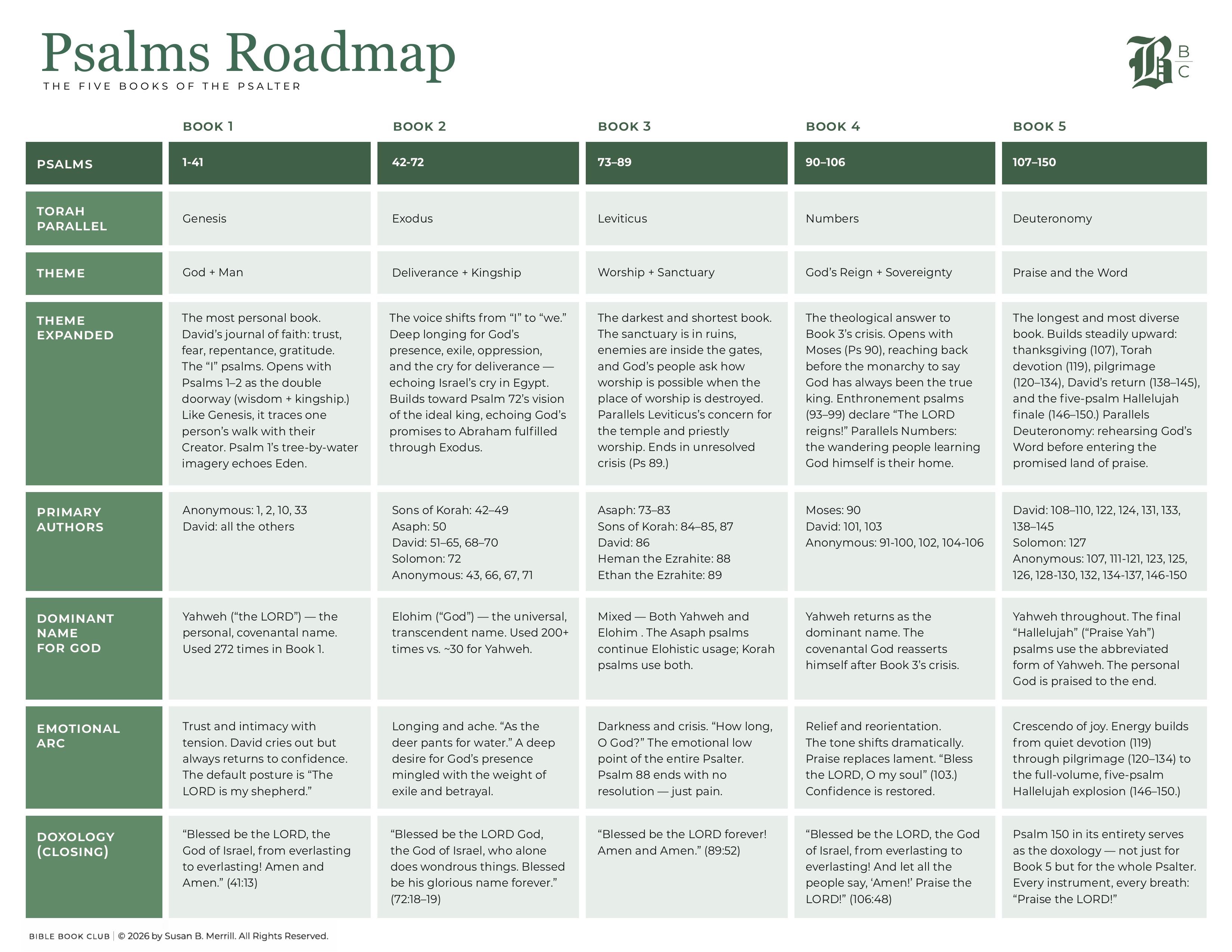
In Psalms 42-49, we began Book 2 of the Psalms, which echoes the book of Exodus and focuses on deliverance and kingship. It also moves from the voice of the individual, David, to a corporate voice. All these psalms were written by the Sons of Korah.
- Psalms 42 and 43 were written together and share the same refrain, “Why, my soul, are you downcast?” Each time, the author responds in the next verse, urging us to put our hope in God.
- Psalm 44 is a cry of protest to God when He does not rescue the faithful.
- Psalm 45 is a celebration of the Davidic king and his bride and also a prophecy of Christ and the church.
- Psalm 46 is about overcoming fear with the knowledge that God is our refuge and strength in times of trouble.
- Psalms 47 and 48 are a praise for the king over all nations and Zion.
- Psalm 49 is more of a proverb. It warns us that all die, the rich and the poor, and only God can redeem you, not money.
Psalm 50: God Judges the Heart and Wants More Than Sacrifice
In Psalms 50-58, we will continue in Book 2 of Psalms with a series of psalms that seem to warn us that God sees what humans hide.
Psalm 50
A psalm of Asaph.
1 The Mighty One, God, the Lord, speaks and summons the earth from the rising of the sun to where it sets. 2 From Zion, perfect in beauty, God shines forth. 3 Our God comes and will not be silent; a fire devours before him, and around him a tempest rages. 4 He summons the heavens above, and the earth, that he may judge his people: 5 “Gather to me this consecrated people, who made a covenant with me by sacrifice.” 6 And the heavens proclaim his righteousness, for he is a God of justice.
7 “Listen, my people, and I will speak; I will testify against you, Israel: I am God, your God. 8 I bring no charges against you concerning your sacrifices or concerning your burnt offerings, which are ever before me. 9 I have no need of a bull from your stall or of goats from your pens, 10 for every animal of the forest is mine, and the cattle on a thousand hills. 11 I know every bird in the mountains, and the insects in the fields are mine. 12 If I were hungry I would not tell you, for the world is mine, and all that is in it. 13 Do I eat the flesh of bulls or drink the blood of goats? 14 “Sacrifice thank offerings to God, fulfill your vows to the Most High, 15 and call on me in the day of trouble; I will deliver you, and you will honor me.”
“What right have you to recite my laws or take my covenant on your lips? 17 You hate my instruction and cast my words behind you. 18 When you see a thief, you join with him; you throw in your lot with adulterers. 19 You use your mouth for evil and harness your tongue to deceit. 20 You sit and testify against your brother and slander your own mother’s son. 21 When you did these things and I kept silent, you thought I was exactly like you. But I now arraign you and set my accusations before you.
22 “Consider this, you who forget God, or I will tear you to pieces, with no one to rescue you: 23 Those who sacrifice thank offerings honor me, and to the blameless I will show my salvation.”
Who was Asaph in the Bible, and how many psalms did he write?
Asaph was one of King David’s worship leaders, and Psalm 50 is the first of 11 psalms Asaph wrote.
What is the main message of Psalm 50?
In Psalm 50, God tells us He cares more about an obedient heart than outward sacrifice. He goes on to explain why: the people who are sacrificing are outwardly religious but inwardly sinful. They assume they are there for God. To provide Him with sacrifices, as if He were dependent on them.
But the Lord doesn’t need their sacrifices. If He is hungry, He can get His own food. Their sacrifices are for them to express their thanks, to honor God. The act of sacrifice is an expression of their relationship with God. God is not blind. He understands the heart of man better than we do. He sees every motive of the heart, and if it isn’t for a relationship with Him, it is a worthless sacrifice.
Sacrifices Today
We don’t offer sacrifices today as they did in the Old Testament, but we can sacrifice our time, talent, or treasure. If we do it to check a box, with a grumbling attitude, or in a manner lacking excellence, we are cheating our relationship with God. God is not blind. You may get away with cheating on your earthly relationships, but you won’t with God. He sees the heart.
A Prayer for God to Judge My Actions
4 God summons the heavens above, and the earth, that he may judge his people:
23 Those who sacrifice thank offerings honor me, and to the blameless I will show my salvation.”
Psalm 51: A Cry for God to Create in Me a Pure Heart
Psalm 51
For the director of music. A psalm of David. When the prophet Nathan came to him after David had committed adultery with Bathsheba.
1 Have mercy on me, O God, according to your unfailing love; according to your great compassion blot out my transgressions. 2 Wash away all my iniquity and cleanse me from my sin.
3 For I know my transgressions, and my sin is always before me. 4 Against you, you only, have I sinned and done what is evil in your sight; so you are right in your verdict and justified when you judge. 5 Surely I was sinful at birth, sinful from the time my mother conceived me. 6 Yet you desired faithfulness even in the womb; you taught me wisdom in that secret place.
7 Cleanse me with hyssop, and I will be clean; wash me, and I will be whiter than snow. 8 Let me hear joy and gladness; let the bones you have crushed rejoice. 9 Hide your face from my sins and blot out all my iniquity.
10 Create in me a pure heart, O God, and renew a steadfast spirit within me. 11 Do not cast me from your presence or take your Holy Spirit from me. 12 Restore to me the joy of your salvation and grant me a willing spirit, to sustain me.
13 Then I will teach transgressors your ways, so that sinners will turn back to you. 14 Deliver me from the guilt of bloodshed, O God, you who are God my Savior, and my tongue will sing of your righteousness. 15 Open my lips, Lord, and my mouth will declare your praise. 16 You do not delight in sacrifice, or I would bring it; you do not take pleasure in burnt offerings. 17 My sacrifice, O God, is a broken spirit; a broken and contrite heart you, God, will not despise.
18 May it please you to prosper Zion, to build up the walls of Jerusalem. 19 Then you will delight in the sacrifices of the righteous, in burnt offerings offered whole; then bulls will be offered on your altar.
What is Psalm 51 about?
Psalm 51 is about turning from sin because you care more about your relationship with God. David committed adultery and murder, then tried to hide his sin with Bathsheba from God and the people. But God sees the heart, and David, of all people, should have known better.
Why did the prophet Nathan visit King David before Psalm 51 was written?
God loves David and sends a prophet named Nathan to bring the truth to light. It has to be the most painful moment of David’s life. Listen to the backstory in 2 Samuel from Season 10, Episode 8 of the Bible Book Club.
Because David is a man after God’s own heart, he recovers. By recovering, I don’t mean that all is well. There are so many consequences, but David’s relationship with God is fully restored, which is always what’s most important, both then and now.
- Sin separates us from God.
- Repentance restores us to God.
That is why God sent Nathan to David. That is why God sent Jesus for us, so that our sins could be forgiven. David accepts Nathan’s rebuke, and in Psalm 51 he humbly asks God:
- For mercy.
- To cleanse him of his sins.
- To create in him a pure heart.
- To renew a steadfast spirit within.
And then he says something I had never really thought about. He says:
Psalm 51:16-17 16 You do not delight in sacrifice, or I would bring it; you do not take pleasure in burnt offerings. 17 My sacrifice, O God, is a broken spirit; a broken and contrite heart you, God, will not despise.
David acknowledges that God does not delight in sacrifice, which we discussed in the prior psalm. Instead, he offers a different sacrifice: a broken spirit, a contrite heart. I have never really thought of my repentance as being a sacrifice to God, but it is an offering. An offering that restores the relationship with God, which is all God wants. That is an important point for us to remember.
A Note for Us
God does not want a perfect heart. He wants a contrite heart. The heart will wander and make mistakes. David acknowledges that in verse five:
Psalm 51:5 5 Surely I was sinful at birth, sinful from the time my mother conceived me.
But if we are open to seeing our mistakes, if we allow our heart to feel the weight of remorse and repent, God will create a new heart and renew our broken spirit. He will erase the weight of the sin pressing down on our hearts, and our spirits will lift.
The Word Used for “Create” in Psalm 51
The word “create” used in Psalm 51 is so much more interesting when you consider the Hebrew meaning. The word for create is “bara,” and it is used in Genesis. In the beginning God created the heavens and the earth. Bara, or create, is something only God can do.
What does the Hebrew word “bara” mean in Psalm 51?
In Psalm 51, when David uses the word “bara,” he is emphasizing that only God can create a new heart in him. While true repentance is something we must do, creating a new heart is something God does in response. It is a gift, a life-giving lift.
This is a prayer to take to heart. From David’s own words, it includes a request for:
- Mercy.
- Cleansing from sin.
- The creation of a new heart.
- Renewal of a steadfast spirit.
Past sin, present cleansing, and for the future, a new heart and steadfast desire to do what is right.
A Prayer for Cleansing from Sin and a Pure Heart
1 Have mercy on me, O God, according to your unfailing love.
2 Wash away all my iniquity and cleanse me from my sin.
17 My sacrifice is a broken spirit; a broken and contrite heart.
10 Create in me a pure heart, O God, and renew a steadfast spirit within me.
Psalm 52: Trusting God to Bring Down Evil
Psalm 52
For the director of music. A maskil of David. When Doeg the Edomite had gone to Saul and told him: “David has gone to the house of Ahimelek.”
1 Why do you boast of evil, you mighty hero? Why do you boast all day long, you who are a disgrace in the eyes of God? 2 You who practice deceit, your tongue plots destruction; it is like a sharpened razor. 3 You love evil rather than good, falsehood rather than speaking the truth. 4 You love every harmful word, you deceitful tongue!
5 Surely God will bring you down to everlasting ruin: He will snatch you up and pluck you from your tent; he will uproot you from the land of the living. 6 The righteous will see and fear; they will laugh at you, saying, 7 “Here now is the man who did not make God his stronghold but trusted in his great wealth and grew strong by destroying others!”
8 But I am like an olive tree flourishing in the house of God; I trust in God’s unfailing love for ever and ever. 9 For what you have done I will always praise you in the presence of your faithful people. And I will hope in your name, for your name is good.
What is Psalm 52 about?
Psalm 52 is about trusting God to bring down evil.
What is the historical context behind the writing of Psalm 52?
David spent years on the run from Saul, and in 1 Samuel 21, there is a story of a time when David and his men were starving. A priest named Ahimelech feeds them with the holy bread and gives David Goliath’s sword. One of Saul’s servants named Doeg tattles on the priest.
Why did King Saul order Doeg the Edomite to kill the priests?
Saul is so angry at the priest who helped David that he orders Doeg to kill 85 priests and their families. In this psalm, David writes about Doeg and men like him who love evil.
A Prayer for God to Overcome Evil for Good
1 Why do you boast all day long, you who are a disgrace in the eyes of God?
3 You love evil rather than good, falsehood rather than speaking the truth.5 Surely God will bring you down to everlasting ruin:
8 But I am like an olive tree flourishing in the house of God; I trust in God’s unfailing love.
Psalm 53: A Cry of Frustration at the Arrogant Fool
Psalm 53
For the director of music. According to mahalath. A maskil of David.
1 The fool says in his heart, “There is no God. They are corrupt, and their ways are vile; there is no one who does good.
2 God looks down from heaven on all mankind to see if there are any who understand, any who seek God. 3 Everyone has turned away, all have become corrupt; there is no one who does good, not even one.
They devour my people as though eating bread; they never call on God. 5 But there they are, overwhelmed with dread, where there was nothing to dread. God scattered the bones of those who attacked you; you put them to shame, for God despised them.
6 Oh, that salvation for Israel would come out of Zion! When God restores his people, let Jacob rejoice and Israel be glad!
What is Psalm 53 about?
Psalm 53 is about frustration with an unbeliever. It is a duplicate of Psalm 14, which we covered in Season 19, Episode 3 of the Bible Book Club. The Hebrew word for “fool” in verse 1 is Nabal. The story of Abigail and Nabal in 1 Samuel 25 is the story of a fool.
As we discussed in Psalm 14, this type of fool is not a fool because of a lack of intelligence. This fool has a problem that originates in the heart. He doesn’t believe there is a God. We would call him the practical atheist, someone who does not deny God, but lives as if there is no God.
David is frustrated with these types of people and cries out to God. It is possible he wrote this psalm when he met Nabal and, in his frustration, almost killed Nabal’s entire household, had it not been for Abigail, who intervened. You can listen to the whole story and how Abigail went from being married to the fool to the king in Season 9, Episode 15 of the Bible Book Club.
A Prayer of Frustration Over Combative Unbelievers
1 The fool says in his heart, “There is no God.” They are corrupt, their deeds are vile;
4 They never call on the Lord.
5 But God is present in the company of the righteous.6 The Lord is their refuge.
7 Oh, that salvation for Israel would come out of Zion!
Psalms 54-55: A Cry When You Are Betrayed by Friends and Enemies
Psalms 54
For the director of music. With stringed instruments. A maskil of David. When the Ziphites had gone to Saul and said, “Is not David hiding among us?”
1 Save me, O God, by your name; vindicate me by your might. 2 Hear my prayer, O God; listen to the words of my mouth.
3 Arrogant foes are attacking me; ruthless people are trying to kill me— people without regard for God. 4 Surely God is my help; the Lord is the one who sustains me.
5 Let evil recoil on those who slander me; in your faithfulness destroy them.
6 I will sacrifice a freewill offering to you; I will praise your name, Lord, for it is good. 7 You have delivered me from all my troubles, and my eyes have looked in triumph on my foes.
Psalms 55
For the director of music. With stringed instruments. A maskil of David.
1 Listen to my prayer, O God, do not ignore my plea; 2 hear me and answer me. My thoughts trouble me and I am distraught 3 because of what my enemy is saying, because of the threats of the wicked; for they bring down suffering on me and assail me in their anger.
4 My heart is in anguish within me; the terrors of death have fallen on me. 5 Fear and trembling have beset me; horror has overwhelmed me. 6 I said, “Oh, that I had the wings of a dove! I would fly away and be at rest. 7 I would flee far away and stay in the desert; 8 I would hurry to my place of shelter, far from the tempest and storm.”
9 Lord, confuse the wicked, confound their words, for I see violence and strife in the city. 10 Day and night they prowl about on its walls; malice and abuse are within it. 11 Destructive forces are at work in the city; threats and lies never leave its streets.
12 If an enemy were insulting me, I could endure it; if a foe were rising against me, I could hide. 13 But it is you, a man like myself, my companion, my close friend, 14 with whom I once enjoyed sweet fellowship at the house of God, as we walked about among the worshipers.
15 Let death take my enemies by surprise; let them go down alive to the realm of the dead, for evil finds lodging among them.
16 As for me, I call to God, and the Lord saves me. 17 Evening, morning and noon I cry out in distress, and he hears my voice. 18 He rescues me unharmed from the battle waged against me, even though many oppose me. 19 God, who is enthroned from of old, who does not change—he will hear them and humble them, because they have no fear of God.
20 My companion attacks his friends; he violates his covenant. 21 His talk is smooth as butter, yet war is in his heart; his words are more soothing than oil, yet they are drawn swords.
22 Cast your cares on the Lord and he will sustain you; he will never let the righteous be shaken. 23 But you, God, will bring down the wicked into the pit of decay; the bloodthirsty and deceitful will not live out half their days.
What are Psalms 54 and 55 about?
Psalms 54 and 55 are about betrayal by friends and enemies. In both of these psalms written by David, he is being attacked through betrayal. In Psalm 54, it is by his enemies, and he has many. In Psalm 55, it is a friend, someone he enjoyed sweet fellowship at the house of God with.
According to King David, what is the most painful type of betrayal?
We can understand, even expect, betrayal by enemies, but the betrayal of a friend and fellow believer, one you have worshiped with, strikes hard at the heart and is surely the most painful type of betrayal.
What we must remember is this: no matter who betrays us, the ultimate reason for the attack is not a war on us. It is a war with God. We live in a constant state of battle. Everyone is either for God or against God. Christ explained this to the disciples
John 15:18-19 18 “If the world hates you, keep in mind that it hated me first. 19 If you belonged to the world, it would love you as its own. As it is, you do not belong to the world, but I have chosen you out of the world. That is why the world hates you.
I often feel the overwhelming tension of the battle in these verses. The news is a constant reminder of the world at war between families, neighborhoods, and nations. Betrayal is everywhere. David’s phrase:
Psalm 55:6 6 Oh, that I had the wings of a dove! I would fly away and be at rest.
This is surely something we all long for at some point. Peace eludes us in this world. Outside of Christ, we would not know a minute’s rest from strife.
A Prayer for Rest from the Distress of a Friend’s Betrayal
55:1 Listen to my prayer, O God. 2 My thoughts trouble me and I am distraught.
12 If an enemy were insulting me, I could endure it; 13 But it is my companion, my close friend,
6 Oh, that I had the wings of a dove! I would fly away and be at rest.
23 But you, God, will bring down the wicked into the pit of decay;
But as for me, I trust in you. 22 Cast your cares on the Lord and he will sustain you.
Psalms 56-57: Trusting God When You Are Afraid
Psalms 56
For the director of music. To the tune of “A Dove on Distant Oaks.” Of David. A miktam. When the Philistines had seized him in Gath.
1 Be merciful to me, my God, for my enemies are in hot pursuit; all day long they press their attack.
2 My adversaries pursue me all day long; in their pride many are attacking me.3 When I am afraid, I put my trust in you.
4 In God, whose word I praise—in God I trust and am not afraid. What can mere mortals do to me?5 All day long they twist my words; all their schemes are for my ruin.
6 They conspire, they lurk, they watch my steps, hoping to take my life.
7 Because of their wickedness do not let them escape;
in your anger, God, bring the nations down.8 Record my misery; list my tears on your scroll— are they not in your record?
9 Then my enemies will turn back when I call for help. By this I will know that God is for me.10 In God, whose word I praise, in the Lord, whose word I praise—
11 in God I trust and am not afraid. What can man do to me?12 I am under vows to you, my God; I will present my thank offerings to you.
13 For you have delivered me from death and my feet from stumbling,
that I may walk before God in the light of life.
Psalms 57
For the director of music. To the tune of “Do Not Destroy.” Of David. A miktam. When he had fled from Saul into the cave.
1 Have mercy on me, my God, have mercy on me, for in you I take refuge.
I will take refuge in the shadow of your wings until the disaster has passed.2 I cry out to God Most High, to God, who vindicates me.
3 He sends from heaven and saves me, rebuking those who hotly pursue me—
God sends forth his love and his faithfulness.4 I am in the midst of lions; I am forced to dwell among ravenous beasts—
men whose teeth are spears and arrows, whose tongues are sharp swords.5 Be exalted, O God, above the heavens; let your glory be over all the earth.
6 They spread a net for my feet—I was bowed down in distress.
They dug a pit in my path— but they have fallen into it themselves.7 My heart, O God, is steadfast, my heart is steadfast; I will sing and make music.
8 Awake, my soul! Awake, harp and lyre! I will awaken the dawn.9 I will praise you, Lord, among the nations; I will sing of you among the peoples.
10 For great is your love, reaching to the heavens; your faithfulness reaches to the skies.11 Be exalted, O God, above the heavens; let your glory be over all the earth.
What are Psalms 56 and 57 about?
Psalms 56 and 57 are about trusting God when you are afraid. There is an urgency in these two psalms. David is fearing for his life.
What inspired King David to write Psalms 56 and 57?
In Psalm 56, David fears the Philistines who seized him at Gath in 1 Samuel 21. This is the story we discussed in Season 19, Episode 7, on Psalm 34. David was seized and, to escape, pretended to be insane. In Psalm 57, David is hiding in fear of Saul. He is helpless and on the defensive. It is a humiliating low point.
Recall this is the man who, as a boy, faced Goliath. He seems rather fearless, but no one is immune to fear. David’s trust in God is always greater than his fear of man, and that makes him courageous. Here, he writes a psalm about trust in God and taking refuge in the shadow of God’s wings.
A Prayer to Trust God When You Are Afraid
56:3 When I am afraid, I put my trust in you. 10 In God, whose word I praise.
11 in God I trust and am not afraid. What can man do to me?
57:1 I will take refuge in the shadow of your wings until the disaster has passed.
10 For great is your love, reaching to the heavens; your faithfulness reaches to the skies.
Psalm 58: A Cry for God to Judge Evil Leaders
Psalm 58
For the director of music. To the tune of “Do Not Destroy.” Of David. A miktam.
1 Do you rulers indeed speak justly? Do you judge people with equity?
2 No, in your heart you devise injustice, and your hands mete out violence on the earth.3 Even from birth the wicked go astray; from the womb they are wayward, spreading lies.
4 Their venom is like the venom of a snake, like that of a cobra that has stopped its ears,
5 that will not heed the tune of the charmer, however skillful the enchanter may be.6 Break the teeth in their mouths, O God; Lord, tear out the fangs of those lions!
7 Let them vanish like water that flows away; when they draw the bow, let their arrows fall short.
8 May they be like a slug that melts away as it moves along,
like a stillborn child that never sees the sun.9 Before your pots can feel the heat of the thorns—
whether they be green or dry—the wicked will be swept away.
10 The righteous will be glad when they are avenged,
when they dip their feet in the blood of the wicked.
11 Then people will say,
“Surely the righteous still are rewarded; surely there is a God who judges the earth.”
What is Psalm 58 about?
Psalm 58 is a cry for God to judge evil leaders. We began our discussion of Psalms 50-58 by discussing how God sees the heart and judges us not on our outward religious activity but by our inward motivation, the heart. We end here with David, furious about those who dish out injustice, and a warning of God’s coming judgment for their actions.
How does David handle his frustration with unjust leaders in Psalm 58?
In Psalm 58, rather than holding onto his anger and letting it simmer into hatred and revenge, David takes his frustration with unjust leaders to the Lord in a lament. It doesn’t make for a pretty prayer, but David knows from experience how evil men, especially leaders, take advantage of their power.
A Prayer for Justice When Evil Leaders Prey Upon the People
1 Do you rulers indeed speak justly?
2 No, in your heart you devise injustice, and your hands mete out violence on the earth.10 The righteous will be glad when they are avenged,
11 Then people will say, surely there is a God who judges the earth.”
Join us for our Bible study on Psalms 59-67 here.
New Psalms Playlist Song
- “Create in Me a Clean Heart” by Worthy Of Praise (Psalm 51)
- “Psalm 51, Wisdom in the Secret Heart” by Shane and Shane
- “Awake My Soul” by Chris Tomlin (Psalm 57)
Listen to the entire Psalms Playlist on Apple Music or Spotify.
Group Discussion Questions for Psalms 50-58
- God says he cares more about an obedient, honest heart than about the outward things we do for Him. What is an area of your life right now (family, work, friendships, or faith) where you find yourself just “checking the box” or going through the motions? What’s one thing you could do this week to intentionally engage your heart in this area?
- We’ve all had those moments where life feels overwhelming, and we just want to “fly away” for a little bit like David in Psalm 55. When you hit that point of needing a mental or emotional escape, what does your ideal “dove wings” moment look like?
- David brought his fear and frustration straight to God instead of hiding it or handling it on his own. What is something you are carrying right now that you could bring to God in prayer? How do you think that might help you avoid lingering anger, bitterness, or a desire for revenge?