Previously on Bible Book Club
In Psalms 37-42, we discussed a variety of psalms:
- Psalm 37 is a wisdom psalm that clearly instructs us not to fret or envy those who are evil.
- Psalm 38 is a confession to God when your heart is crushed by your own sin.
- Psalm 39 is a cry for understanding life when it seems futile and fleeting.
- Psalm 40 is a thanksgiving to God for rescuing us from the pit and giving us a new song.
- Psalm 41 is a wisdom psalm, a blessing for those who care for the weak, the sick, and the vulnerable.
Psalms 42-49 Introduction
What is the purpose of the Book of Psalms?
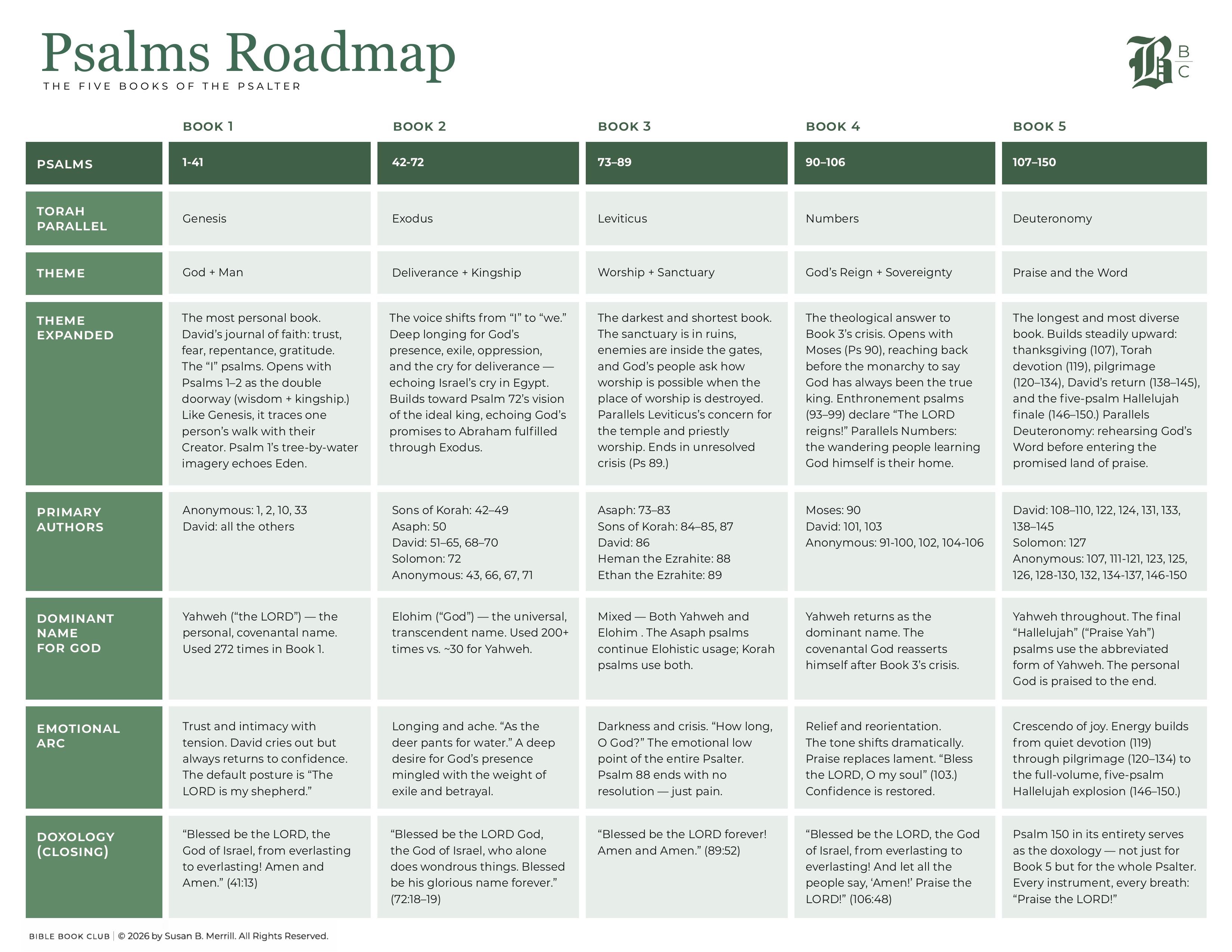
The psalms are a teaching tool, and the editors organized the five books of the psalms to mirror the five books of the Torah, creating a counterpart hymnbook to the Torah. With the Torah, God is speaking down to His people. The psalms are His people singing back up to Him.
The psalms are God’s playlist for His people, which is brilliant because people remember words more easily when sung. So the editors arranged each of the five Psalms books around a theme from the corresponding book of the Torah.
- Book 1 echoes Genesis: God and man
- Book 2 echoes Exodus: deliverance and kingship
- Book 3 echoes Leviticus: worship and sanctuary
- Book 4 echoes Numbers: God’s reign and sovereignty
- Book 5 echoes Deuteronomy: praise and the Word
How does the narrative tone shift in Book 2 of Psalms?
The voice in Book 2 of Psalms shifts from “I” to “we.” Psalm 41 ended with a doxology, our hint that it was the end of Book 1. In Psalms 42-49, we move from Book 1 (the companion book to Genesis) with a focus on God and man to Book 2 (the companion book to Exodus) with a focus on deliverance and kingship.
There is a deep longing for God’s presence, with sentiments of exile, oppression, and the cry for deliverance all echoing Israel’s cry in Egypt. The book also builds toward Psalm 72’s vision of the ideal king, echoing God’s promises to Abraham that all nations will be blessed through him.
Book 2 moves from the personal cries of distress and exile in its opening chapters to a corporate, triumphant hope in a future king who will restore justice and bring God’s blessings to the ends of the earth. In short, from longing far from God to confidence in God’s reign over everything. This is the beginning of the ‘we’ sentiment. The voice is written from a group of people, not just David.
The Importance of the Sons of Korah
Who are the Sons of Korah in the Bible?
Korah was a prominent son of Levi, and from him came the Kohath clan. The Korah family has a very interesting story of redemption that began in Exodus. The Levites were responsible for the care of the Tabernacle as the Israelites roamed through the wilderness, and specifically the Kohaths were responsible for the most important part of the Tabernacle, the transportation of the most sacred elements like the Ark.
But as Levites, they were not priests like their cousins Aaron, nor leaders like Moses. They grew envious, and the envy led to a rebellion. God judged the rebellion in Numbers 16:31-32.
Numbers 16:31-32 31 As soon as Moses finished saying all this, the ground under them split apart 32 and the earth opened its mouth and swallowed them and their households, and all those associated with Korah, together with their possessions.
For the whole backstory, listen to Season 2, Episode 8 of the Bible Book Club, Moses Faces a Mutiny. Fortunately for the line of Korah, not all the tribe had rebelled, and in Numbers 26:11 we learn that some have survived to carry the line forward. However, for generations, the “Sons of Korah,” or the Korahites, carried the stigma of their rebellion. Yet the faithful remnant persevered, serving God with humility in the tasks they were given, and slowly, over time, their faithfulness paid off.
- 1 Chronicles 9:19 – They were appointed as gatekeepers and custodians of the Tabernacle and later the Temple.
- 1 Chronicles 12:6 – During the reign of King David, a group of Korahites proved themselves to be elite, expert warriors, joining David during his military exploits when he was hiding from King Saul.
- 1 Chronicles 6:33-38 – The most famous biological descendant of this line was the prophet Samuel, one of Israel’s greatest judges and spiritual leaders.
- Finally, David appointed Heman the Korahite, the grandson of Samuel, as one of his three chief choral and orchestral directors.
How does the Korahite family history appear in the psalms?
The family went from humiliated gatekeepers to leading the entire nation in the worship of God through music. And with that, they wrote 11 of the psalms, including two that hold special meaning for them. In Psalm 46:2, they wrote:
Psalm 46:2 2 “Therefore we will not fear, though the earth give way and the mountains fall into the heart of the sea.”
A definite sentiment from the fate of their forefathers who were literally swallowed up by the earth. And in Psalm 84:10, they wrote:
Psalm 84:10 10 “I would rather be a doorkeeper in the house of my God than dwell in the tents of wickedness.”
This was a literal nod to their family’s day job as gatekeepers, proudly choosing a humble task for God over the luxurious “tents of wickedness” that ruined their forefather, Korah. Those from the line of Kohath who held firm for the Lord created some of the most beautiful sentiments in the Psalms, from a difficult place of humility… like the one we are about to read, which is one of my favorites.
Psalms 42 and 43: A Cry of Anguish When Your Soul Is Downcast
Psalm 42
For the director of music. A maskil of the Sons of Korah.
1 As the deer pants for streams of water, so my soul pants for you, my God. 2 My soul thirsts for God, for the living God. When can I go and meet with God? 3 My tears have been my food day and night, while people say to me all day long, “Where is your God?” 4 These things I remember as I pour out my soul: how I used to go to the house of God under the protection of the Mighty One with shouts of joy and praise among the festive throng.
5 Why, my soul, are you downcast? Why so disturbed within me? Put your hope in God, for I will yet praise him, my Savior and my God.
6 My soul is downcast within me; therefore I will remember you from the land of the Jordan, the heights of Hermon—from Mount Mizar. 7 Deep calls to deep in the roar of your waterfalls; all your waves and breakers have swept over me.
8 By day the Lord directs his love, at night his song is with me— a prayer to the God of my life.
9 I say to God my Rock, “Why have you forgotten me? Why must I go about mourning, oppressed by the enemy?” 10 My bones suffer mortal agony as my foes taunt me, saying to me all day long, “Where is your God?”
11 Why, my soul, are you downcast? Why so disturbed within me? Put your hope in God, for I will yet praise him, my Savior and my God.
Psalm 43
1 Vindicate me, my God, and plead my cause against an unfaithful nation. Rescue me from those who are deceitful and wicked. 2 You are God my stronghold. Why have you rejected me? Why must I go about mourning, oppressed by the enemy? 3 Send me your light and your faithful care, let them lead me; let them bring me to your holy mountain, to the place where you dwell. 4 Then I will go to the altar of God, to God, my joy and my delight. I will praise you with the lyre, O God, my God.
5 Why, my soul, are you downcast? Why so disturbed within me? Put your hope in God, for I will yet praise him, my Savior and my God.
Why are Psalms 42 and 43 combined in Hebrew manuscripts?
To start Book 2, we will combine Psalms 42 and 43, as they have the same refrain and, in many Hebrew manuscripts, are one psalm. Psalms 42 and 43 are about heartfelt discouragement, becoming so downcast or disturbed that you feel it in your soul. The key to this song’s purpose lies in the refrain, which is sung three times.
Psalm 43:5 5 Why, my soul, are you downcast? Why so disturbed within me? Put your hope in God, for I will yet praise him, my Savior and my God.
The writer alternates between spiritual depression and forced hope. You can tell he aches from his isolation from God. He compares it to thirst for God, and he almost seems to be frustrated with himself for his despondency. Like, “What’s wrong with you? Why are you so down? Trust God.” It is a song many of us can probably relate to. There are times in life where grief, hardship, loss, and stress overwhelm us, and it feels as if:
Psalm 42:3 3 tears have been my food day and night.
We can get lost in those days. The inability to pull ourselves out is so frustrating, and our frustration just makes us feel worse.
What do Psalms 42 and 43 teach about dealing with discouragement?
Like this psalmist, we must pull ourselves out of the haze of sorrow and focus on when we felt God’s presence in the past. We cry to God in hope and praise him, despite it all. For there is no quick fix to the trials of life.
Psalm 42:4 4 These things I remember as I pour out my soul: how I used to go to the house of God under the protection of the Mighty One with shouts of joy and praise among the festive throng.
What does Psalm 42 teach about depression and faith?
This side of heaven, we will always thirst for perfection. Paradise lost in the garden. That sense of this world not being enough leads to depression. In this world, you may struggle relationally, financially, mentally, physically, and emotionally. But Jesus himself promised:
John 16:33 33 “I have told you these things, so that in me you may have peace. In this world you will have trouble. But take heart! I have overcome the world.”
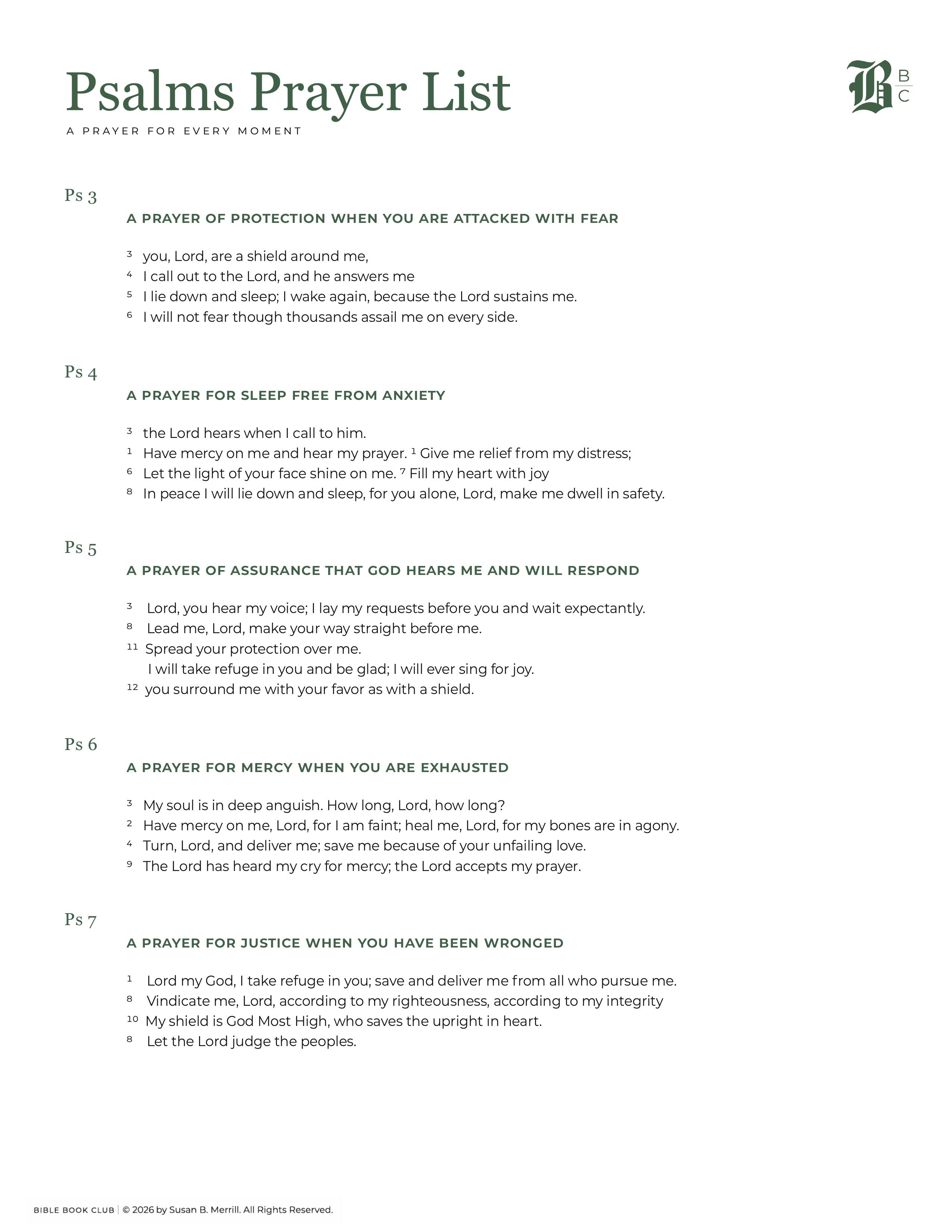
We must not allow the imperfections of this world to disturb us. Instead, take captive to God your struggles and take heart despite them. Like the psalmist, put this psalm on daily repeat in this prayer:
A Prayer from Psalms 42 and 43 for When You Are Downcast or Disturbed
42:5, 11+ 43:5 Why, my soul, are you downcast? Why so disturbed within me?
1 As the deer pants for streams of water, so my soul pants for you, my God.
8 By day the Lord directs his love, at night his song is with me— a prayer to the God of my life.
42:5,11 + 43:5 Put your hope in God, for I will yet praise him, my Savior and my God.
Psalm 44: A Cry of Protest When God Does Not Rescue the Faithful
Psalm 44
For the director of music. Of the Sons of Korah. A maskil.
1 We have heard it with our ears, O God; our ancestors have told us what you did in their days, in days long ago. 2 With your hand you drove out the nations and planted our ancestors; you crushed the peoples and made our ancestors flourish. 3 It was not by their sword that they won the land, nor did their arm bring them victory; it was your right hand, your arm, and the light of your face, for you loved them.
4 You are my King and my God, who decrees victories for Jacob. 5 Through you we push back our enemies; through your name we trample our foes. 6 I put no trust in my bow, my sword does not bring me victory; 7 but you give us victory over our enemies, you put our adversaries to shame. 8 In God we make our boast all day long, and we will praise your name forever.
9 But now you have rejected and humbled us; you no longer go out with our armies. 10 You made us retreat before the enemy, and our adversaries have plundered us. 11 You gave us up to be devoured like sheep and have scattered us among the nations. 12 You sold your people for a pittance, gaining nothing from their sale.
13 You have made us a reproach to our neighbors, the scorn and derision of those around us. 14 You have made us a byword among the nations; the peoples shake their heads at us. 15 I live in disgrace all day long, and my face is covered with shame 16 at the taunts of those who reproach and revile me, because of the enemy, who is bent on revenge.
17 All this came upon us, though we had not forgotten you; we had not been false to your covenant. 18 Our hearts had not turned back; our feet had not strayed from your path. 19 But you crushed us and made us a haunt for jackals; you covered us over with deep darkness.
20 If we had forgotten the name of our God or spread out our hands to a foreign god, 21 would not God have discovered it, since he knows the secrets of the heart? 22 Yet for your sake we face death all day long; we are considered as sheep to be slaughtered.
23 Awake, Lord! Why do you sleep? Rouse yourself! Do not reject us forever. 24 Why do you hide your face and forget our misery and oppression?
25 We are brought down to the dust; our bodies cling to the ground. 26 Rise up and help us; rescue us because of your unfailing love.
Why does the author protest God’s silence in Psalm 44?
Psalm 44 is a protest to God, calling on Him to wake up and rescue the faithful. It’s a psalm Job himself could have written: Why do bad things happen to faithful people who love the Lord? It opens with eight verses of praise for all God has done for Israel. The author clearly declares his people’s allegiance in verse eight.
Psalm 44:8 8 we will praise your name forever.
Then he gets to his point, his complaint, his lament.
Psalm 44:9 9 But now you have rejected and humbled us;
And he wants to know why, because in this case, he says they do not deserve it.
Psalm 44:17 17 All this came upon us, though we had not forgotten you; we had not been false to your covenant.
The author wants to know why God doesn’t just rise up and fix it all. It is a lament our hearts cannot help but cry out when caught in life’s storms today. We know God has the power to lift us out of the trial. We know He loves us and does not want us to suffer. So, is He asleep? Why won’t He wake up? Or, as much as we hate it, is the suffering part of His plan?
In Matthew 8, the disciples cry out for Jesus to wake in a storm and save them, and He does. So we know He can do whatever we need. But that is a temporary rescue just for a few of them. Jesus does so much more for all mankind. The eternal rescue is when Jesus awakens on the third day after suffering for all of us. That is the rescue that counts above all others. We may not always be rescued from earthly trials, but be assured that God sees them and answers with the sacrifice of his only Son. And when Jesus comes again, every trial will be laid to rest.
A Prayer from Psalm 44 for When You Suffer Despite Being Faithful
8 In God we make our boast all day long, and we will praise your name forever.
9 But now you have rejected and humbled us; 17though we had not forgotten you;
23 Awake, Lord! Why do you sleep? Do not reject us forever.
26 Rise up and help us; rescue us because of your unfailing love.
Psalm 45: A Celebration of the King and His Bride, Christ and the Church
This is a royal wedding psalm. The author is writing to the king or groom in the first half and to the bride in the second. It is also a messianic psalm about Christ as the groom and the church as the bride. It is a royal wedding song, both literally and prophetically.
Psalm 45
For the director of music. To the tune of “Lilies.” Of the Sons of Korah. A maskil. A wedding song.
1 My heart is stirred by a noble theme as I recite my verses for the king; my tongue is the pen of a skillful writer.
2 You are the most excellent of men and your lips have been anointed with grace, since God has blessed you forever.
3 Gird your sword on your side, you mighty one; clothe yourself with splendor and majesty. 4 In your majesty ride forth victoriously in the cause of truth, humility and justice; let your right hand achieve awesome deeds. 5 Let your sharp arrows pierce the hearts of the king’s enemies; let the nations fall beneath your feet. 6 Your throne, O God, will last for ever and ever; a scepter of justice will be the scepter of your kingdom. 7 You love righteousness and hate wickedness; therefore God, your God, has set you above your companions by anointing you with the oil of joy. 8 All your robes are fragrant with myrrh and aloes and cassia; from palaces adorned with ivory the music of the strings makes you glad. 9 Daughters of kings are among your honored women; at your right hand is the royal bride in gold of Ophir.
10 Listen, daughter, and pay careful attention: Forget your people and your father’s house. 11 Let the king be enthralled by your beauty; honor him, for he is your lord. 12 The city of Tyre will come with a gift, people of wealth will seek your favor. 13 All glorious is the princess within her chamber; her gown is interwoven with gold. 14 In embroidered garments she is led to the king; her virgin companions follow her— those brought to be with her. 15 Led in with joy and gladness, they enter the palace of the king.
16 Your sons will take the place of your fathers; you will make them princes throughout the land.
17 I will perpetuate your memory through all generations; therefore the nations will praise you for ever and ever.
What is Psalm 45 celebrating?
With Psalm 45, the poet has written a love song to celebrate the wedding of the Davidic king. We don’t know which king it is from the line of David, but it serves as a prophetic glimpse of the ultimate King. It praises the king’s majesty, his righteousness, and his bride.
Hebrews 1 quotes Psalm 45:6-7 and applies it directly to Christ.
Hebrews 1:8-9 8 But about the Son he says, “Your throne, O God, will last for ever and ever; a scepter of justice will be the scepter of your kingdom. 9 You have loved righteousness and hated wickedness; therefore God, your God, has set you above your companions by anointing you with the oil of joy.”
The author of Hebrews is stating that these two verses from Psalm 45 are a prophecy of what God has said to them about His Son.
How does Psalm 45 predict the relationship between Christ and the Church?
Because the author of Psalm 45 is speaking of the wedding of the Davidic king, the psalm is prophetic for Christ, who is the last Davidic king and bridegroom. And his bride is symbolically the Church.
Ephesians 5:25-32 25 Husbands, love your wives, just as Christ loved the church and gave himself up for her 26 to make her holy, cleansing her by the washing with water through the word, 27 and to present her to himself as a radiant church, without stain or wrinkle or any other blemish, but holy and blameless. 28 In this same way, husbands ought to love their wives as their own bodies. He who loves his wife loves himself. 29 After all, no one ever hated their own body, but they feed and care for their body, just as Christ does the church— 30 for we are members of his body. 31 “For this reason a man will leave his father and mother and be united to his wife, and the two will become one flesh.” 32 This is a profound mystery—but I am talking about Christ and the church.
This is a profound mystery: Christ and the church, the bride and the groom. The apostle John speaks of this from a vision he saw.
Revelation 19:6-7 6 Then I heard what sounded like a great multitude, like the roar of rushing waters and like loud peals of thunder, shouting: “Hallelujah! For our Lord God Almighty reigns. 7 Let us rejoice and be glad and give him glory! For the wedding of the Lamb has come, and his bride has made herself ready.
This is a beautiful picture of hope. We live as one with Christ and, just as the bride and groom, the two will become one.
A Prayer from Psalm 45 Praising Jesus Christ, the Messiah
6 Your throne, O God, will last for ever and ever;
4 In your majesty, ride forth victoriously in the cause of truth, humility, and justice.
7 God has set you above your companions by anointing you with the oil of joy.
17 Therefore, the nations will praise you forever and ever.
Psalm 46: Trust That God Is Our Refuge and Strength
Psalm 46
For the director of music. Of the Sons of Korah. According to alamoth. A song.
1 God is our refuge and strength, an ever-present help in trouble. 2 Therefore we will not fear, though the earth give way and the mountains fall into the heart of the sea, 3 though its waters roar and foam and the mountains quake with their surging.
4 There is a river whose streams make glad the city of God, the holy place where the Most High dwells. 5 God is within her, she will not fall; God will help her at break of day. 6 Nations are in uproar, kingdoms fall; he lifts his voice, the earth melts.
7 The Lord Almighty is with us; the God of Jacob is our fortress.
8 Come and see what the Lord has done, the desolations he has brought on the earth. 9 He makes wars cease to the ends of the earth. He breaks the bow and shatters the spear; he burns the shields with fire. 10 He says, “Be still, and know that I am God; I will be exalted among the nations, I will be exalted in the earth.”
11 The Lord Almighty is with us; the God of Jacob is our fortress.
What is the meaning of being still in Psalm 46?
Being still in Psalm 46 is a command to cease the frantic effort to fix, fight, or flee and instead recognize who actually holds the world and has power over it. It is about overcoming fear with the knowledge that God is our refuge and strength in times of trouble.
Being still in Psalm 46 does not mean to sit back and relax. It is probably the most famous of the Korahite psalms. This one celebrates God’s absolute sovereignty over worldly chaos. Even if the mountains fall into the sea, there is a river, a river of life, and God is in it. We must, however:
Psalm 46:10 10 “Be still, and know that I am God.”
This is the psalm that Martin Luther took inspiration from in the 1500s, called “A Mighty Fortress Is Our God.” It will be added to our song playlist on Apple Music and Spotify.
A Prayer from Psalm 46 for When You Are in Trouble and Need God’s Refuge and Strength
1 God is our refuge and strength, an ever-present help in trouble.
2 Therefore we will not fear, though the earth give way and the mountains fall10 He says, “Be still, and know that I am God;
11 The Lord Almighty is with us; the God of Jacob is our fortress.
Psalms 47 and 48: Praise for the King Over All Nations and Zion
Psalms 47
For the director of music. Of the Sons of Korah. A psalm.
1 Clap your hands, all you nations; shout to God with cries of joy.
2 For the Lord Most High is awesome, the great King over all the earth. 3 He subdued nations under us, peoples under our feet. 4 He chose our inheritance for us, the pride of Jacob, whom he loved.
5 God has ascended amid shouts of joy, the Lord amid the sounding of trumpets. 6 Sing praises to God, sing praises; sing praises to our King, sing praises. 7 For God is the King of all the earth; sing to him a psalm of praise.
8 God reigns over the nations; God is seated on his holy throne. 9 The nobles of the nations assemble as the people of the God of Abraham, for the kings of the earth belong to God; he is greatly exalted.
Psalms 48
A song. A psalm of the Sons of Korah.
1 Great is the Lord, and most worthy of praise, in the city of our God, his holy mountain.
2 Beautiful in its loftiness, the joy of the whole earth, like the heights of Zaphon is Mount Zion, the city of the Great King. 3 God is in her citadels; he has shown himself to be her fortress.
4 When the kings joined forces, when they advanced together, 5 they saw her and were astounded; they fled in terror. 6 Trembling seized them there, pain like that of a woman in labor. 7 You destroyed them like ships of Tarshish shattered by an east wind.
8 As we have heard, so we have seen in the city of the Lord Almighty, in the city of our God: God makes her secure forever.
9 Within your temple, O God, we meditate on your unfailing love. 10 Like your name, O God, your praise reaches to the ends of the earth; your right hand is filled with righteousness. 11 Mount Zion rejoices, the villages of Judah are glad because of your judgments.
12 Walk about Zion, go around her, count her towers, 13 consider well her ramparts, view her citadels, that you may tell of them to the next generation.
14 For this God is our God for ever and ever; he will be our guide even to the end.
What are Psalms 47 and 48 about?
Psalms 47 and 48 are about praising God, who rules over all nations and Zion, which is the city of God. These are celebration songs. Psalm 47 was most likely written when David brought the Ark to the capital. It is a celebration of God over the nations.
Psalm 48 is a song about the City of God, also called Zion, which at the time was Jerusalem. Zion is considered the dwelling place of God, which is over the Ark in the Temple.
How does the New Testament change the meaning of Zion from Psalm 48?
For us in the New Testament, we know Zion, God’s dwelling place, is a city without boundaries, and God’s dwelling place is more than a place on the map. Jesus spoke of this place of worship to the woman at the well.
John 4:21 21 “Woman,” Jesus replied, “believe me, a time is coming when you will worship the Father neither on this mountain nor in Jerusalem.
That time is now. The curtain in the Temple was torn at Christ’s resurrection. Through Jesus, we have access to God. His presence no longer dwells only in the Temple but within us.
A Prayer from Psalms 47 and 48 to Celebrate Our Awesome God
48:1 Great is the Lord, and most worthy of praise,
47:2 For the Lord Most High is awesome, the great King over all the earth.
48:14 For this God is our God for ever and ever; he will be our guide even to the end.
Psalm 49: Wealth Cannot Buy Life
Psalm 49
For the director of music. Of the Sons of Korah. A psalm.
1 Hear this, all you peoples; listen, all who live in this world, 2 both low and high, rich and poor alike: 3 My mouth will speak words of wisdom; the meditation of my heart will give you understanding. 4 I will turn my ear to a proverb; with the harp I will expound my riddle:
5 Why should I fear when evil days come, when wicked deceivers surround me—6 those who trust in their wealth and boast of their great riches? 7 No one can redeem the life of another or give to God a ransom for them—8 the ransom for a life is costly, no payment is ever enough—9 so that they should live on forever and not see decay. 10 For all can see that the wise die, that the foolish and the senseless also perish, leaving their wealth to others. 11 Their tombs will remain their houses forever, their dwellings for endless generations, though they had named lands after themselves.
12 People, despite their wealth, do not endure; they are like the beasts that perish.
13 This is the fate of those who trust in themselves, and of their followers, who approve their sayings. 14 They are like sheep and are destined to die; death will be their shepherd (but the upright will prevail over them in the morning). Their forms will decay in the grave, far from their princely mansions. 15 But God will redeem me from the realm of the dead; he will surely take me to himself. 16 Do not be overawed when others grow rich, when the splendor of their houses increases; 17 for they will take nothing with them when they die, their splendor will not descend with them. 18 Though while they live they count themselves blessed— and people praise you when you prosper—19 they will join those who have gone before them, who will never again see the light of life.
20 People who have wealth but lack understanding are like the beasts that perish.
Why does Psalm 49 state that wealth cannot buy eternal life?
Rich or poor, all die; only God can redeem your soul. This psalm is more like a proverb than a song. It is a sobering reminder that wealth cannot buy life. Nor can you take any of what you buy with you when you die.
This is a great reminder to us, for our eyes are bombarded with images of more.
- More vacations
- More house
- More entertainment
- More of what we don’t have compared to everyone else
In the end, the life we are really destined for, eternal life, cannot be bought by us. It was paid for already by the only One who could: Jesus Christ.
A Prayer from Psalm 49 for When You Want More Than What You Really Need: Redemption
1 Hear this, all you peoples; listen, all who live in this world, 2 both rich and poor alike:
16 Do not be overawed when others grow rich, when the splendor of their houses increases;
20 People who have wealth but lack understanding are like the beasts that perish.
15 But God will redeem me from the realm of the dead; he will surely take me to himself.
Join us for our Bible study on Psalms 50-58 here.
New Psalms Playlist Song
- “Psalm 42” by Tori Kelly
- “As the Deer” by Shane & Shane
- “A Mighty Fortress Is Our God” Martin Luther’s hymn sung by Travis Cottrell
Listen to the entire Psalms Playlist on Apple Music or Spotify.
Group Discussion Questions for Psalms 42-49
- When you’re downcast or disturbed, Psalms 42 suggests you intentionally turn your attention to all the good God has done for you. What’s one thing you could do right now to help you remember to do that? For example, memorize a prayer or Bible verse you can turn to that focuses your attention on God’s gifts or protection, put a sign on your bathroom mirror, hang pictures of your loved ones, etc.
- Can you relate to Psalm 44 when the psalmist did not feel rescued despite his faithfulness? How do you respond when you don’t get the outcome you hoped for?
- Psalm 49 reminds us that wealth cannot buy life. Is there an area of your life where you feel tempted to chase “more” than you need or are called to, even though we can’t take anything with us when we die? Examples: cars, the latest technology, respect, work titles, etc.