Previously on Bible Book Club
In the last six psalms, we discussed how each was a different example of how to trust God with our fear, sin, enemies, and future.
- Psalm 31: Trusting God for refuge and rescue
- Psalm 32: The joy of trusting God with our sin and receiving forgiveness
- Psalm 33: Trusting and praising God’s Word and plans
- Psalm 34: How God meets us in our fear and brokenness and rescues us
- Psalm 35: Trusting God to fight our enemies for us when their attack is unjust
- Psalm 36: How God’s love is infinitely greater than human evil
Psalms 37-41 Introduction
How is the Book of Psalms structurally organized?
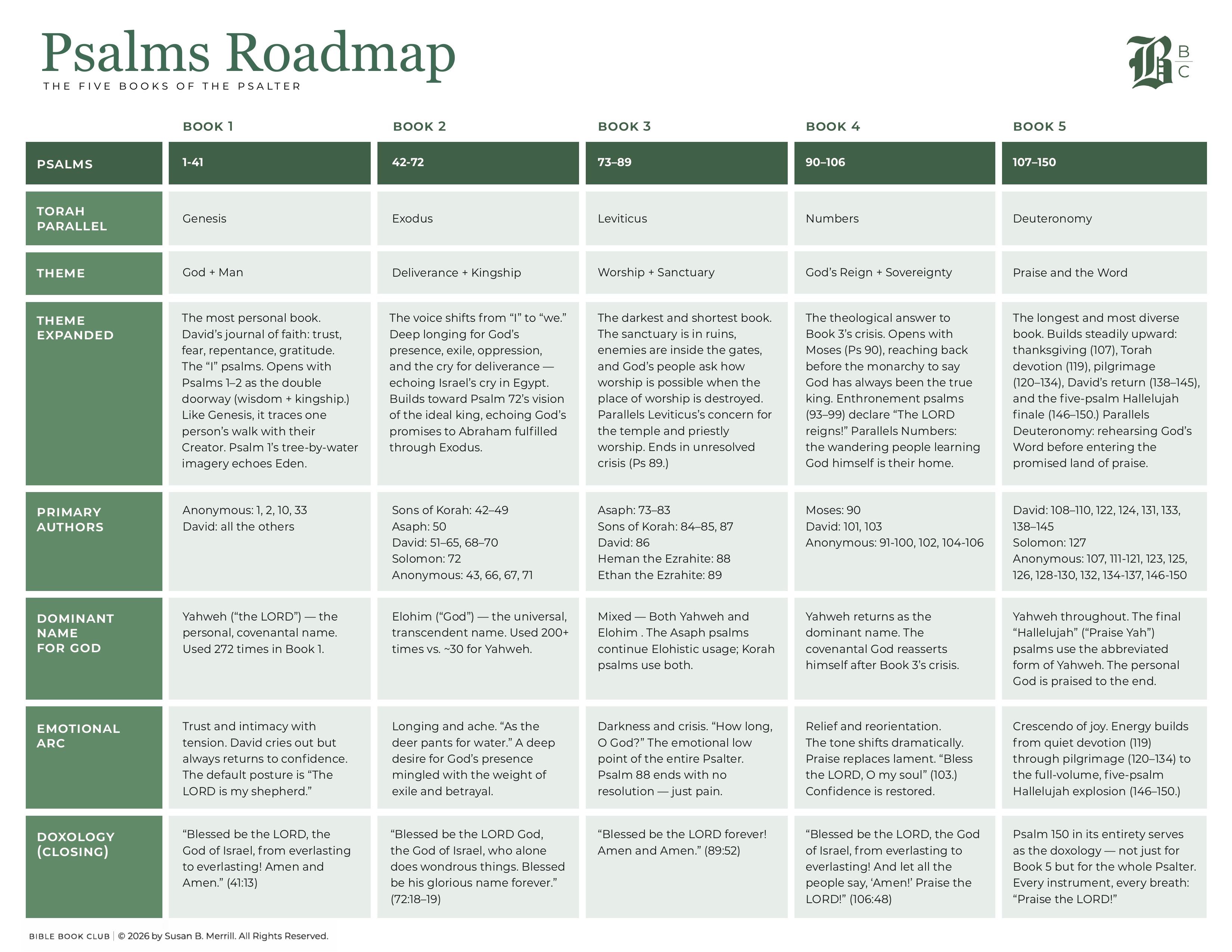
The Book of Psalms is structurally organized into five books. Each section ends with a doxology, which is a verse of praise that marks its conclusion, and each book on its own is a micro-journey from difficulty toward the doxology.
The entire collection of psalms does the same on a macro scale, building from Psalm 1 all the way to Psalm 150. Book Five is the praise crescendo of the whole Psalter. None of this is random. All of it is by design. With Psalms 37-41, we will finish Book 1.
What is the overarching theme of Psalms Book 1?
The overarching theme of Book 1 is God and man, and it is the Israelite hymn book that parallels the Book of Genesis. Like Genesis, Book 1 traces one person’s walk with their Creator. As David wrestled with trust and his relationship with God in the Psalms, so did Abraham, Isaac, and Jacob in Genesis.
Psalms Book 1 is the most personal book, often called the “I” psalms because David is writing for himself, about himself. They are David’s journal of faith, trust, fear, repentance, and gratitude. Most of the psalms we have read begin with David lamenting an honest struggle that leads him to turn to God in confident hope.
David was a man after God’s own heart, and therefore his heart is clearly expressed in the emotion of every psalm. It makes sense that Book 1 has more laments than anything else because David had many struggles, and our nature is to turn to God most when we need Him. So, Psalms Book 1 is where you want to go when you feel lost, discouraged, alone, or suffering. For when you need God.
See our Psalms Roadmap for a more detailed review of how God divinely organized the psalms.
Psalm 37: Do Not Fret Over the Wicked
Psalm 37
1 Do not fret because of those who are evil or be envious of those who do wrong; 2 for like the grass they will soon wither, like green plants they will soon die away.
3 Trust in the Lord and do good; dwell in the land and enjoy safe pasture. 4 Take delight in the Lord, and he will give you the desires of your heart.
5 Commit your way to the Lord; trust in him and he will do this: 6 He will make your righteous reward shine like the dawn, your vindication like the noonday sun.
7 Be still before the Lord and wait patiently for him; do not fret when people succeed in their ways, when they carry out their wicked schemes.
8 Refrain from anger and turn from wrath; do not fret—it leads only to evil. 9 For those who are evil will be destroyed, but those who hope in the Lord will inherit the land.
10 A little while, and the wicked will be no more; though you look for them, they will not be found. 11 But the meek will inherit the land and enjoy peace and prosperity.
12 The wicked plot against the righteous and gnash their teeth at them; 13 but the Lord laughs at the wicked, for he knows their day is coming.
14 The wicked draw the sword and bend the bow to bring down the poor and needy, to slay those whose ways are upright. 15 But their swords will pierce their own hearts, and their bows will be broken.
16 Better the little that the righteous have than the wealth of many wicked; 17 for the power of the wicked will be broken, but the Lord upholds the righteous.
18 The blameless spend their days under the Lord’s care, and their inheritance will endure forever. 19 In times of disaster they will not wither; in days of famine they will enjoy plenty.
20 But the wicked will perish: Though the Lord’s enemies are like the flowers of the field, they will be consumed, they will go up in smoke.
21 The wicked borrow and do not repay, but the righteous give generously; 22 those the Lord blesses will inherit the land, but those he curses will be destroyed.
23 The Lord makes firm the steps of the one who delights in him; 24 though he may stumble, he will not fall, for the Lord upholds him with his hand.
25 I was young and now I am old, yet I have never seen the righteous forsaken or their children begging bread. 26 They are always generous and lend freely; their children will be a blessing.
27 Turn from evil and do good; then you will dwell in the land forever. 28 For the Lord loves the just and will not forsake his faithful ones.
Wrongdoers will be completely destroyed; the offspring of the wicked will perish.m29 The righteous will inherit the land and dwell in it forever.
30 The mouths of the righteous utter wisdom, and their tongues speak what is just. 31 The law of their God is in their hearts; their feet do not slip.
32 The wicked lie in wait for the righteous, intent on putting them to death; 33 but the Lord will not leave them in the power of the wicked or let them be condemned when brought to trial.
34 Hope in the Lord and keep his way. He will exalt you to inherit the land; when the wicked are destroyed, you will see it.
35 I have seen a wicked and ruthless man flourishing like a luxuriant native tree, 36 but he soon passed away and was no more; though I looked for him, he could not be found.
37 Consider the blameless, observe the upright; a future awaits those who seek peace. 38 But all sinners will be destroyed; there will be no future for the wicked.
39 The salvation of the righteous comes from the Lord; he is their stronghold in time of trouble. 40 The Lord helps them and delivers them; he delivers them from the wicked and saves them, because they take refuge in him.
What is Psalm 37 about?
Psalm 37 is about fretting related to people who are intent on being evil. There is nothing more vexing than bullies, cheaters, and people who delight in stirring up dissension. We all know someone like this. They can be a constant thorn in your side, especially because sometimes they are undeservedly prosperous.
Psalm 37:1 1 Do not fret because of those who are evil or be envious of those who do wrong;
And twice more David uses the word fret:
Psalm 37:7-8: 7 Be still before the Lord and wait patiently for him; do not fret when people succeed in their ways, when they carry out their wicked schemes. 8 Refrain from anger and turn from wrath; do not fret—it leads only to evil.
What does the Hebrew word ‘charah’ mean in Psalm 37?
The word fret used by David is the Hebrew word ‘charah,’ and its root meaning is to burn, glow, or grow hot. In English, “fret” sounds like quiet anxiety, but anxiety is more invasive and mostly damaging to us. Charah is closer to seething.
David isn’t talking about worrying here. He is talking about fretting as a smoldering heat. The fretting person burns with envy, resentment, and vengeance. A burning that can, if it gets too hot, ignite and cause irreparable damage.
This is a wisdom psalm. David is teaching us not to get heated up over evil people. Because he says:
Psalm 37:2 2 for like the grass they will soon wither, like green plants they will soon die away.
In other words, they are going to burn up on their own. Instead, David says we should:
Psalm 37:5-7 5 Commit your way to the Lord; trust in him and he will do this: 6 He will make your righteous reward shine like the dawn, your vindication like the noonday sun. 7 Be still before the Lord and wait patiently for him;
What anxiety statistic did the American Psychiatric Association report for 2024?
The American Psychiatric Association reported that in 2024, 43% of all U.S. adults felt fundamentally more anxious than they did the previous year. We live in a world where anxiety is on the rise.
I cannot say whether this rise is only an anxious worry or a burning charah. However, it appears animosity is also on the rise, and animosity is heavily driven by fear or anxiety.
It is a check for us. Do we live with daily anxiety, anger, or fear? If so, listen to the wisdom of David. Trust God and let go of the age-old frustration of fretting. There will always be evil on this side of heaven. Be patient. The prosperity of the wicked is short-lived, while the righteous will ultimately inherit the land.
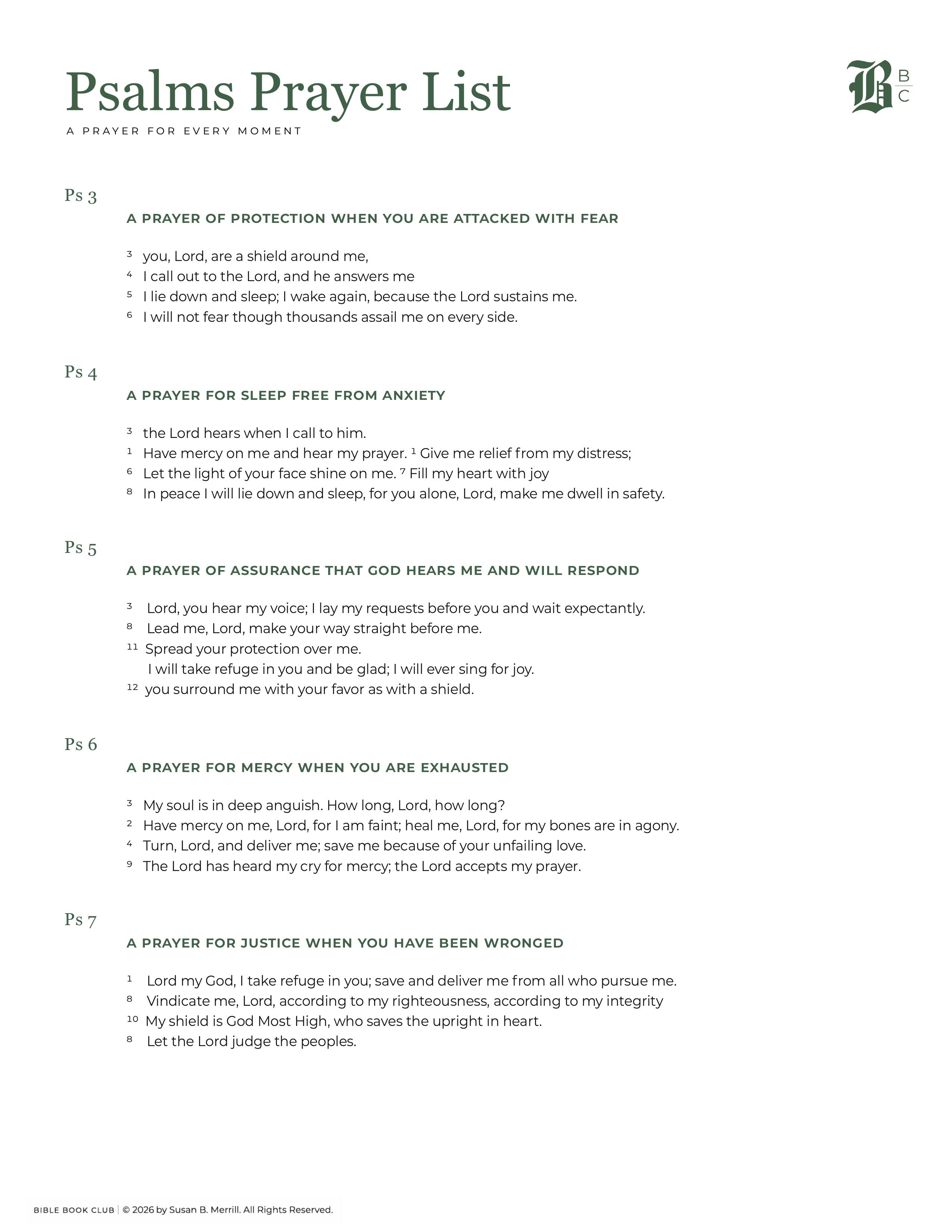
A Prayer for When Your Anger Burns Against the Wicked
1 Do not fret because of those who are evil or be envious of those who do wrong;
2 for like the grass, they will soon wither.10 A little while, and the wicked will be no more;
4 Take delight in the Lord, and he will give you the desires of your heart.
34 Hope in the Lord and keep his way. 11 The meek will inherit the land and enjoy peace and prosperity.
Psalm 38: A Cry of Confession When You Are Crushed by Your Sin
Psalm 38
A psalm of David. A petition.
1 Lord, do not rebuke me in your anger or discipline me in your wrath. 2 Your arrows have pierced me, and your hand has come down on me. 3 Because of your wrath there is no health in my body; there is no soundness in my bones because of my sin. 4 My guilt has overwhelmed me like a burden too heavy to bear.
5 My wounds fester and are loathsome because of my sinful folly. 6 I am bowed down and brought very low; all day long I go about mourning. 7 My back is filled with searing pain; there is no health in my body. 8 I am feeble and utterly crushed; I groan in anguish of heart.
9 All my longings lie open before you, Lord; my sighing is not hidden from you. 10 My heart pounds, my strength fails me; even the light has gone from my eyes. 11 My friends and companions avoid me because of my wounds; my neighbors stay far away. 12 Those who want to kill me set their traps, those who would harm me talk of my ruin; all day long they scheme and lie.
13 I am like the deaf, who cannot hear, like the mute, who cannot speak; 14 I have become like one who does not hear, whose mouth can offer no reply. 15 Lord, I wait for you; you will answer, Lord my God. 16 For I said, “Do not let them gloat or exalt themselves over me when my feet slip.”
17 For I am about to fall, and my pain is ever with me. 18 I confess my iniquity; I am troubled by my sin. 19 Many have become my enemies without cause; those who hate me without reason are numerous. 20 Those who repay my good with evil lodge accusations against me, though I seek only to do what is good.
21 Lord, do not forsake me; do not be far from me, my God. 22 Come quickly to help me, my Lord and my Savior.
What is Psalm 38 about?
Psalm 38 is one of the classic “Penitential Psalms.” David has sinned, and he describes his guilt as a physical experience. It is an agonizing mix of physical pain and emotional isolation. David sounds very much like Job, a man who has hit absolute rock bottom. The psalm ends mid-struggle, with no resolution.
Psalm 38:22 22 Come quickly to help me, my Lord and my Savior
Psalm 38 is a great example to us that sometimes trust doesn’t always mean you feel better. Sometimes it just means you give it to God and press on.
A Prayer of Confession When You Are Crushed by Your Own Sin
21 Lord, do not forsake me; 18 I confess my iniquity; I am troubled by my sin.
17 For I am about to fall. 4 My guilt has overwhelmed me like a burden too heavy to bear.
22 Come quickly to help me, my Lord and my Savior.
Psalm 39: A Cry to Understand the Futility of Life
Psalm 39
For the director of music. For Jeduthun. A psalm of David.
1 I said, “I will watch my ways and keep my tongue from sin; I will put a muzzle on my mouth while in the presence of the wicked.” 2 So I remained utterly silent, not even saying anything good. But my anguish increased; 3 my heart grew hot within me. While I meditated, the fire burned; then I spoke with my tongue:
4 “Show me, Lord, my life’s end and the number of my days; let me know how fleeting my life is. 5 You have made my days a mere handbreadth; the span of my years is as nothing before you. Everyone is but a breath, even those who seem secure.
6 “Surely everyone goes around like a mere phantom; in vain they rush about, heaping up wealth without knowing whose it will finally be.
7 “But now, Lord, what do I look for? My hope is in you. 8 Save me from all my transgressions; do not make me the scorn of fools. 9 I was silent; I would not open my mouth, for you are the one who has done this. 10 Remove your scourge from me; I am overcome by the blow of your hand. 11 When you rebuke and discipline anyone for their sin, you consume their wealth like a moth— surely everyone is but a breath.
12 “Hear my prayer, Lord, listen to my cry for help; do not be deaf to my weeping. I dwell with you as a foreigner, a stranger, as all my ancestors were. 13 Look away from me, that I may enjoy life again before I depart and am no more.”
What is Psalm 39 about?
Psalm 39 is about pondering life’s fleeting and sometimes painful significance. This is a question for the ages. Moses expresses this sentiment in Psalm 90.
Psalm 90:10 10 Our days may come to seventy years, or eighty, if our strength endures;
yet the best of them are but trouble and sorrow, for they quickly pass, and we fly away.
James questioned it in the New Testament:
James 4:14 14 What is your life? You are a mist that appears for a little while and then vanishes.
Moses, James, David, and most of us have all pondered the question: What is the point? Like them, we must take our questions about life to God. Venting to God is always the right course of action. The tricky part, though, is leaving it with God.
What is the antidote for bitterness when life feels futile?
Leaving it with God is the antidote for bitterness when life feels not worth the effort. We must live as the Apostle Paul challenged us to in Galatians.
Galatians 2:20 20 I have been crucified with Christ and I no longer live, but Christ lives in me. The life I now live in the body, I live by faith in the Son of God, who loved me and gave himself for me.
Living for Christ by faith is the purpose and meaning of the believer’s life. Whatever it brings, it is His plan for our good.
Romans 8:28-29 28 And we know that in all things God works for the good of those who love him, who have been called according to his purpose. 29 For those God foreknew he also predestined to be conformed to the image of his Son, that he might be the firstborn among many brothers and sisters.
The best way to combat frustration with life is with acceptance. Acceptance that God works for the good of those who love him. And while this life may appear fleeting and futile at times, it is not. Nothing in God’s plan is a waste.
A Prayer When You Feel Life Is Futile and Fleeting
4 “Show me, Lord, my life’s end and the number of my days; let me know how fleeting my life is.
5 Everyone is but a breath, even those who seem secure
6 in vain they rush about, heaping up wealth without knowing whose it will finally be.
7 But now, Lord, what do I look for? My hope is in you.
Psalm 40: God Rescues Us From the Pit and Gives Us a New Song
Psalm 40
For the director of music. Of David. A psalm.
1 I waited patiently for the Lord; he turned to me and heard my cry. 2 He lifted me out of the slimy pit, out of the mud and mire; he set my feet on a rock and gave me a firm place to stand. 3 He put a new song in my mouth, a hymn of praise to our God. Many will see and fear the Lord and put their trust in him.
4 Blessed is the one who trusts in the Lord, who does not look to the proud, to those who turn aside to false gods. 5 Many, Lord my God, are the wonders you have done, the things you planned for us. None can compare with you; were I to speak and tell of your deeds, they would be too many to declare.
6 Sacrifice and offering you did not desire— but my ears you have opened—burnt offerings and sin offerings you did not require. 7 Then I said, “Here I am, I have come— it is written about me in the scroll. 8 I desire to do your will, my God; your law is within my heart.”
9 I proclaim your saving acts in the great assembly; I do not seal my lips, Lord, as you know. 10 I do not hide your righteousness in my heart; I speak of your faithfulness and your saving help. I do not conceal your love and your faithfulness from the great assembly.
11 Do not withhold your mercy from me, Lord; may your love and faithfulness always protect me. 12 For troubles without number surround me; my sins have overtaken me, and I cannot see. They are more than the hairs of my head, and my heart fails within me. 13 Be pleased to save me, Lord; come quickly, Lord, to help me.
14 May all who want to take my life be put to shame and confusion; may all who desire my ruin be turned back in disgrace. 15 May those who say to me, “Aha! Aha!” be appalled at their own shame. 16 But may all who seek you rejoice and be glad in you; may those who long for your saving help always say, “The Lord is great!”
17 But as for me, I am poor and needy; may the Lord think of me. You are my help and my deliverer; you are my God, do not delay.
What is Psalm 40 about?
Psalm 40 is about how God rescues us from the pit and fills us with a new song. This psalm begins with God as a rescuer. He has lifted David from the slimy pit, the mud and mire, and set his feet on a firm place to stand, a rock.
Psalm 40 has a strong tie to Christ as well. Certainly, He has lifted us from the greatest pit of all, the pit of sin.
Which Psalm 40 verses does the New Testament cite?
In the New Testament, at His incarnation, Christ quoted Psalm 40:6 and Psalm 40:7.
Hebrews 10:5-7 5 Therefore, when Christ came into the world, he said: “Sacrifice and offering you did not desire, but a body you prepared for me;
6 with burnt offerings and sin offerings you were not pleased.
7 Then I said, ‘Here I am—it is written about me in the scroll—
I have come to do your will, my God.’”
The argument here in Hebrews is that the old sacrificial system couldn’t actually take away sin, so Christ did. Jesus’ obedient self-offering becomes the true sacrifice the psalm is pointing toward. God doesn’t just want ritual sacrifices. He wants a heart that is eager to do His will. Christ made that clear. It is better to obey than to sacrifice.
While David usually starts with a lament and ends in thanks, praise, or trust, this time he flips the script, and the second half of this psalm shifts to a cry for help. David has been lifted out of the pit, but he is still poor and needy. Aren’t we all?
A Prayer of Thanks, for God Rescues Us from the Pit
1 I waited patiently for the Lord; he turned to me and heard my cry.
2 He lifted me out of the slimy pit; he set my feet on a rock.3 He put a new song in my mouth,5 Many, Lord my God, are the wonders you have done, the things you planned for us.
16 May all who seek you rejoice and be glad in you.
Psalm 41: A Blessing for Those Who Care for the Weak, the Sick, the Vulnerable
Psalm 41
For the director of music. A psalm of David.
1 Blessed are those who have regard for the weak; the Lord delivers them in times of trouble. 2 The Lord protects and preserves them— they are counted among the blessed in the land—he does not give them over to the desire of their foes. 3 The Lord sustains them on their sickbed and restores them from their bed of illness.
4 I said, “Have mercy on me, Lord; heal me, for I have sinned against you.” 5 My enemies say of me in malice, “When will he die and his name perish?” 6 When one of them comes to see me, he speaks falsely, while his heart gathers slander; then he goes out and spreads it around.
7 All my enemies whisper together against me; they imagine the worst for me, saying, 8 “A vile disease has afflicted him; he will never get up from the place where he lies.” 9 Even my close friend, someone I trusted, one who shared my bread, has turned against me.
10 But may you have mercy on me, Lord; raise me up, that I may repay them. 11 I know that you are pleased with me, for my enemy does not triumph over me. 12 Because of my integrity you uphold me and set me in your presence forever.
13 Praise be to the Lord, the God of Israel, from everlasting to everlasting. Amen and Amen.
What is Psalm 41 about?
Psalm 41 is about God’s blessing on those who care for the weak. Psalm 41 is a lament, thanks, trust, and wisdom psalm all rolled into one.
Psalm 1 started with “blessed is the man,” so it is fitting to bookend with “blessed are those.” So book one in Psalms starts with a blessing for one man and expands to a blessing for many.
What does “have regard for the weak” mean in Psalm 41?
In Psalm 41, “have regard for the weak” means to treat them properly, to care for them, and to be compassionate toward them. In short, minister to them as Jesus did, and those who take up this ministry will be blessed.
Our Call
Each one of us will be called upon to take care of someone.
- Children
- Aging parents
- Vulnerable friends
- Neighbors
The opportunity comes to all of us. And so does the blessing.
What is the Psalm 41 prophecy?
In verse four, David turns to consider his own case, and he makes several prophetic statements that are fulfilled by his descendant, Jesus Christ.
Psalm 41:9 9 Even my close friend, someone I trusted, one who shared my bread, has turned against me.
Right after Jesus washes His disciples’ feet in the book of John, Jesus says:
John 13:18-19 18 “I am not referring to all of you; I know those I have chosen. But this is to fulfill this passage of Scripture: ‘He who shared my bread has turned against me.’ 19 “I am telling you now before it happens, so that when it does happen you will believe that I am who I am.
Which specific prophecy in Psalm 41 did Judas fulfill?
Jesus’ close friend Judas betrays Him with a kiss the same night he shares bread with Jesus at the Last Supper.
- David prophesies it.
- Jesus predicts it.
- Judas does it.
Yet again, God works all things together for good. Even evil has a role in the divine plan. That is why it is best not to fret over the wicked. God has it all under His control. Evil will not win.
What is the closing doxology?
Each of the five books of the Psalms ends with a different doxology. You can compare them all on our Psalms Roadmap. Psalm 41 and Book 1 end with a doxology that is most likely added by the editors who arranged the five books.
Psalm 41:13 13 Praise be to the Lord, the God of Israel, from everlasting to everlasting. Amen and Amen
Each of these five books is a micro-journey. This one started with the blessed person who is like a tree planted by streams of water, quietly meditating on Scripture day and night. It is internal, protected, peaceful, and promising.
Then we read through 40 chapters of David navigating fear, guilt, confession, sickness, and running for his life. In that journey, the definition of “blessed” shifts.
How does the definition of “blessed” shift from Psalm 1 to Psalm 41?
By Psalm 41, being blessed is no longer just about sitting quietly alone with your Bible. The journey has action, risks, and consequences. It involves others and is no longer internal but external. The blessed person is no longer on a peaceful retreat by themselves, but is the one who actively notices, protects, and delivers the weak and the poor.
The first image is the paradise we crave and will one day have. The 40 psalms that follow are the reality show of the life of the believer. A life, like David’s, spent lamenting, thanking, praying, and soaking up the wisdom gained from a life lived obeying the two greatest commandments: To love the Lord with all your heart, soul and mind this is the first, and to love your neighbor as yourself.
A Prayer of Praise for God Who Blesses Those Who Care for Others
1 Blessed are those who have regard for the weak
11 I know that you are pleased with me, for my enemy does not triumph over me.
12 Because of my integrity you uphold me and set me in your presence forever.
13 Praise be to the Lord, the God of Israel, from everlasting to everlasting.
Amen and Amen.
Join us for our Bible study on Psalms 42-49 here.
New Psalms Playlist Song
- “40” (Psalm 40) by U2
Listen to the entire Psalms Playlist on Apple Music or Spotify.
Group Discussion Questions for Psalms 37-41
- David tells us not to fret over people who succeed through wickedness. Where in your life right now are you most tempted to let that slow burn of envy or resentment take hold, and what would it look like to trust God with it instead?
- Psalm 39 asks God to reveal how fleeting life is, yet the psalmist still brings his honest frustration to God rather than burying it. Is there a frustration about the futility of your life or circumstances that you’ve been holding back from bringing to God?
- Psalm 41 closes the book with a blessing on those who care for the weak, the sick, and the vulnerable. Who in your life right now needs you to notice them and step in, and what’s one concrete way you could do that this week?