Previously on Bible Book Club
In Psalms 17-21, we covered psalms for when you:
- Need God to see your heart and protect you
- Want to thank God for delivering you from an enemy
- Want to praise God for His creation and His Word
- Are going into a battle and need his intercession
- Want to thank God for a victory
What is the Shepherd’s Trilogy in Psalms 22 through 24?
Prophetically, in Psalms 22-24 there is a hidden messianic sequence called the Shepherd’s Trilogy. The savior who suffers in Psalm 22 becomes the shepherd who provides in 23 and the sovereign who reigns in 24. It is a death–resurrection–ascension arc hiding in three psalms, which the editors placed in this order hundreds of years before Christ.
The Shepherd’s Trilogy starts with questioning God. The shepherd is giving his life for his sheep. This part of the prophecy is in the past for us.
Psalm 22:1 1 My God, my God, why have you forsaken me?
Then the trilogy moves to trusting God. The shepherd is caring for his sheep. This is the present for us. We are living in this era.
The trilogy finishes with praising God. The shepherd is reigning as king. This is in the future for us. It will happen when Christ returns.
Psalm 24:1 1 The earth is the Lord’s, and everything in it, the world, and all who live in it
In summary, you can look at the Shepherd’s Trilogy from three different ways:
- Savior → Shepherd → King
- Cross → Crook → Crown
- Past work → Present → Future
Psalm 22: A Cry for God When You Feel Abandoned
Psalm 22
For the director of music. To the tune of “The Doe of the Morning.” A psalm of David.
1 My God, my God, why have you forsaken me? Why are you so far from saving me, so far from my cries of anguish? 2 My God, I cry out by day, but you do not answer, by night, but I find no rest.
3 Yet you are enthroned as the Holy One; you are the one Israel praises. 4 In you our ancestors put their trust; they trusted and you delivered them. 5 To you they cried out and were saved; in you they trusted and were not put to shame.
6 But I am a worm and not a man, scorned by everyone, despised by the people. 7 All who see me mock me; they hurl insults, shaking their heads. 8 “He trusts in the Lord,” they say, “let the Lord rescue him. Let him deliver him, since he delights in him.”
9 Yet you brought me out of the womb; you made me trust in you, even at my mother’s breast. 10 From birth I was cast on you; from my mother’s womb you have been my God. 11 Do not be far from me, for trouble is near and there is no one to help.
12 Many bulls surround me; strong bulls of Bashan encircle me. 13 Roaring lions that tear their prey open their mouths wide against me. 14 I am poured out like water, and all my bones are out of joint. My heart has turned to wax; it has melted within me. 15 My mouth is dried up like a potsherd, and my tongue sticks to the roof of my mouth; you lay me in the dust of death.
16 Dogs surround me, a pack of villains encircles me; they pierce my hands and my feet. 17 All my bones are on display; people stare and gloat over me. 18 They divide my clothes among them and cast lots for my garment.
19 But you, Lord, do not be far from me. You are my strength; come quickly to help me. 20 Deliver me from the sword, my precious life from the power of the dogs. 21 Rescue me from the mouth of the lions; save me from the horns of the wild oxen.
22 I will declare your name to my people; in the assembly I will praise you. 23 You who fear the Lord, praise him! All you descendants of Jacob, honor him! Revere him, all you descendants of Israel! 24 For he has not despised or scorned the suffering of the afflicted one; he has not hidden his face from him but has listened to his cry for help.
25 From you comes the theme of my praise in the great assembly; before those who fear you I will fulfill my vows. 26 The poor will eat and be satisfied; those who seek the Lord will praise him— may your hearts live forever!
27 All the ends of the earth will remember and turn to the Lord, and all the families of the nations will bow down before him, 28 for dominion belongs to the Lord and he rules over the nations.
29 All the rich of the earth will feast and worship; all who go down to the dust will kneel before him— those who cannot keep themselves alive. 30 Posterity will serve him; future generations will be told about the Lord. 31 They will proclaim his righteousness, declaring to a people yet unborn: He has done it!
What is the most prophetic psalm?
Psalm 22 is the most prophetic of all psalms. Written by David nearly 1000 years before the crucifixion, it describes details that David himself never experienced. But David is a prophet, and the Holy Spirit’s inspiration is evident in the words he writes in the psalms.
Psalm 22 is a lament, but it is also a royal or messianic psalm about the Davidic Covenant. Jesus is the prophesied King who will come from the line of David and rule forever. In this psalm, David sees what his (very) future, greater grandson, Christ, will experience.
Psalm opens with David in total despair. This feeling of abandonment is one that is familiar to Israel. Their repetitive cycle of unfaithfulness often leaves them isolated from God. The meaning and the depths of pain it expresses would have resonated with them. Because of that, this psalm was well known to the Israelites and most likely sung frequently. Christ, a Jew, would have been very familiar with David’s words. Christ’s use of this phrase can be found in both Matthew 27 and Mark 15.
David’s cry to God is both from experience and prophetic. Much of it was about the persecution that both David and Christ experienced. They were both mocked and surrounded by attackers, and we know both were parched with thirst. David in the cave of Adullam, hiding from the Philistines and Jesus on the cross. Both could have been told, “He trusts in the Lord, let the Lord deliver him.” But we only know for sure that Christ was from Matthew.
Matthew 27:43 43 He trusts in God. Let God rescue him now if he wants him, for he said, ‘I am the Son of God.’”
While much of the suffering described could have been experienced by David, some of the suffering in this psalm is very specific to Christ.
How does Psalm 22 predict the crucifixion of Jesus Christ?
In Psalm 22, David is having a very painful vision of what his future grandson will suffer. These phrases are prophetic. They begin with a reference to the nails in Jesus’ hands and feet in John 20 and Luke 24.
Psalm 22:16 16 They pierce my hands and my feet
This is followed by events that can be found in Matthew 27, Mark 15, Luke 23, and John 19.
Psalm 22:18 18 They divide clothes among them and cast lots for my garment.
These words are the cry of the suffering servant and the suffering Savior. David and Christ are both suffering servants to the end, but only one is a suffering Savior.
Psalm 22 starts with a cry of abandonment, but it doesn’t end there. It takes a hard pivot into praise. And I say hard because…wouldn’t it have been hard? How does David always pivot from despair, pain, and frustration to praise?
The sufferer who felt utterly abandoned is suddenly declaring God’s faithfulness to future generations. David’s pain hasn’t disappeared. David has learned a difficult lesson: How to reorient his focus from earthly pain to heavenly purpose.
A Lesson for Us
David has emotions, and he complains, even vents. But by directing his feelings to God in a cry for help, David is going to God for the outcome. He lays it at God’s feet in trust. The suffering is still there, but the burden of it is transferred. And the release of the burden creates a lift. A lightness of the heart and the desire to praise.
If we want to live lighter with less anxiety and anger, we need to release the control, bitterness, and blame regarding our trials and trust God. This life we have been given is God’s plan for us; whether we like it or not, we praise Him for it.
What is Psalm 22 about?
Psalm 22 is about feeling forsaken and finding the Savior. David makes the tie to finding the Savior in this last half of the psalm, ending with two great connections to Christ. First, in verse 22, David says:
Psalm 22:22 22 I will declare your name to my people; in the assembly I will praise you.
Paul states that this same verse is declared by Jesus:
Hebrews 2:10-12 10 In bringing many sons and daughters to glory, it was fitting that God, for whom and through whom everything exists, should make the pioneer of their salvation perfect through what he suffered. 11 Both the one who makes people holy and those who are made holy are of the same family. So Jesus is not ashamed to call them brothers and sisters. 12 He says, “I will declare your name to my brothers and sisters; in the assembly I will sing your praises.”
Bible Bender
This is a Bible Bender for me. I have never thought about how that tied to Jesus’ final words on the Cross.
John 19:30 30 When he had received the drink, Jesus said, “It is finished.” With that, he bowed his head and gave up his spirit.
In the original Hebrew, the phrase in Psalms translated as “he has done it” or “he has performed it” is the single word asah. When the Hebrew Old Testament was translated into Greek centuries before Jesus, the exact Hebrew word at the end of Psalm 22 was rendered as a Greek verb form that shares the same root as Tetelestai. This is the word Jesus spoke in John 19:30, but both phrases carry the exact same meaning: “It is completed.” or “The work is done.”
As we discussed earlier, on the cross Jesus used the first line of Psalm 22 at the beginning of the crucifixion, “My God, my God, why have you forsaken me?” In ancient Jewish teaching, if you wanted to point a crowd to a specific psalm or Scripture, you would quote the first line and the last line of a psalm. By crying out, “My God, my God” at the start of the crucifixion and essentially shouting “It is finished/He has done it” at the very end, Jesus effectively “bookended” His crucifixion with Psalm 22.
What did Jesus mean by quoting Psalm 22 on the cross?
Jesus is essentially telling the onlookers, “Everything between the first verse and last verse of Psalm 22 has just been accomplished right before your eyes by me, Jesus Christ, son of David, the Messiah. I don’t have the breath to preach the whole psalm and explain what I am doing here on the cross, but you know the psalm. Here is the beginning and the end.”
And what is it that Jesus has completed? A work that began far before David ever lived.
Psalm 22:27-28 27 All the ends of the earth will remember and turn to the Lord, and all the families of the nations will bow down before him, 28 for dominion belongs to the Lord and he rules over the nations.
How does Psalm 22 connect to the Abrahamic Covenant?
In Psalm 22, David is restating the Abrahamic Covenant. God made a promise to Abraham in Genesis 22 right after Abraham was willing to sacrifice Isaac, but God provided the Lamb as a substitute, so he didn’t have to. The angel of the Lord said:
Genesis 22:16-18 18 “I swear by myself, declares the Lord, that because you have done this and have not withheld your son, your only son, 17 I will surely bless you and make your descendants as numerous as the stars in the sky and as the sand on the seashore. Your descendants will take possession of the cities of their enemies, 18 and through your offspring all nations on earth will be blessed, because you have obeyed me.”
Genesis promises that “all families of the earth” will be blessed. Psalm 22 promises that “all families of the nations” will worship.
- Abraham was obedient to sacrifice his one and only son, but didn’t have to because God provided the lamb.
- God actually sacrificed His one and only Son, who is the Lamb God provided for us.
We are part of the “families of the nations,” the “nations on earth who will be blessed.” The heirs of the righteousness of Abraham through Christ’s obedience. Yes, full circle, it is finished with Jesus.
This is a psalm for when you feel as if God is far away and out of reach. The fact that both David and Christ felt the anguish of God’s silence should be a comfort. While they felt abandoned, they were not abandoned. Nor are you. Remember this: Our separation from God…it is finished. He has done it.
A prayer when you feel God has abandoned you
1 My God, my God, why have you forsaken me? 19 Lord, do not be far from me.
3 You are enthroned as the Holy One; 9 You made me trust in you
19 You are my strength; come quickly to help me.
28 for dominion belongs to the Lord and he rules over the nations.
31 They will proclaim his righteousness, declaring to a people yet unborn: He has done it!
Psalm 23: A Song of Trust in the Shepherd Who Comforts
Psalm 23
A psalm of David.
1 The Lord is my shepherd, I lack nothing. 2 He makes me lie down in green pastures, he leads me beside quiet waters, 3 he refreshes my soul. He guides me along the right paths for his name’s sake. 4 Even though I walk through the darkest valley, I will fear no evil, for you are with me; your rod and your staff, they comfort me.
5 You prepare a table before me in the presence of my enemies. You anoint my head with oil; my cup overflows. 6 Surely your goodness and love will follow me all the days of my life, and I will dwell in the house of the Lord forever.
What is Psalm 23 about?
Psalm 23 is about the Shepherd who cares for his sheep. This psalm ranks in the top three most popular psalms. And most people don’t realize it, but Psalm 22 is purposely paired with Psalm 23.
Why are Psalm 22 and Psalm 23 paired together?
Psalm 22 and Psalm 23 are paired together because they are an important contrast. In Psalm 23, the rest and comfort we feel is a direct result of the Savior’s suffering in Psalm 22. We no longer fear the dark valley of death, because we have the promise of quiet waters, living water, and the light of eternity.
We got the spiritual upgrade that David prophesied about in this psalm. We will dwell in the house of the Lord forever.
Moving from Questioning to Trust
The trilogy of psalms moves from questioning God in Psalm 22:
Psalm 22:1 1 My God, my God, why have you forsaken me?
In short, from savior to shepherd, or from cross to crook, and by crook I mean shepherd’s crook. To add depth to this short psalm, we must understand sheep and David’s familiarity with them, because David started out as a shepherd.
What unique traits of sheep explain the imagery in Psalm 23?
Sheep and people have a lot in common, and that is why the Bible uses the image of a shepherd so often.
- Sheep are defenseless and need constant care.
- They must be led to food and water.
- Sheep will not lie down when they are hungry. Only when provided for will the sheep lie down to rest.
- They are fearful of fast-flowing water and can’t swim because their wool is too heavy when wet. So, if needed, a shepherd will dam up a stream to calm or still the water so the sheep will drink.
When did King David write the 23rd psalm?
Contrary to popular belief, David did not write the 23rd psalm when he was a young shepherd of sheep. It is thought that he was much older and a shepherd of men as the king.
How does God train leaders?
I have a theory. It seems to me God has training schools for his leaders. There are no colleges, but I can see patterns. There is no need for testing because God knows our ability. But I can imagine angelic processing conversations.
Wilderness School
“God wants this one to be a prophet, but he needs to learn to be uncomfortable. Send him to wilderness school.”
- Elijah was sent to the wilderness after Carmel
- John the Baptist lived in the wilderness
- Moses was in the wilderness for 40 years
Royal School
“God wants this one to be a politician, but he needs to learn to be strategically diplomatic. Send him to the royal school.
- Joseph
- Moses
- Esther
- Nehemiah
- Daniel
Shephard School
“Now this one God wants to be a leader, but he needs to learn to get uncooperative people to follow him. Send him to shepherd school.”
- Moses, 40 years again
- David, of course
Moses seems to be a student of all three schools. Perhaps that is why he is so great.
Our School
A thought for us. How is God developing you, and for what purpose? What schools or seasons has God placed in your story, and what did you learn while there? Job went to the school of suffering. Ruth to the school of trust. How do you use what you learn for His glory?
My School
I have always been a reader, a learner. But when I was 17, I had a cardiac arrest and landed in the school of suffering. It was that single point that turned my love of learning into a desire to learn about God. And here I am still learning, still amazed that even though I am still studying the same book, there is so much more to learn. One never knows what God is doing, but God does, and I hope He never stops sending me to school.
Back to this psalm and David. We know that Psalms 22 and 23 go together. Psalm 22 was about David and Jesus.
How is the water imagery in Psalm 23 fulfilled in the New Testament?
Jesus called Himself the Good Shepherd in John 10. Instead of leading us to quiet water, He provides Living Water.
John 4:13-14 13 Jesus answered, “Everyone who drinks this water will be thirsty again, 14 but whoever drinks the water I give them will never thirst. Indeed, the water I give them will become in them a spring of water welling up to eternal life.”
In a single verse from Revelation, the metaphor comes full circle. The Lamb (Jesus) is the Shepherd (from Psalm 23).
Revelation 7:17 17 For the Lamb at the center of the throne will be their shepherd; he will lead them to springs of living water. And God will wipe away every tear from their eyes.
Jesus leads us not just to a quiet pool but to springs of living water (John 4). The result is the ultimate fulfillment of restoration: no more sorrow, no more thirst, and eternal rest. The “quiet waters” of the Old Testament are a destination we had to visit. The “living water” of the New Testament is a limitless, eternal reality.
A prayer for when you need comfort
1 The Lord is my shepherd, I lack nothing.
2 He makes me lie down in green pastures, he leads me beside quiet waters,
4 Even though I walk through the darkest valley, I will fear no evil, for you are with me;6 Surely your goodness and love will follow me all the days of my life,
and I will dwell in the house of the Lord forever.
Psalm 24: Praise for the King and Lord of All the Earth
Psalm 24
Of David. A psalm.
1 The earth is the Lord’s, and everything in it, the world, and all who live in it; 2 for he founded it on the seas and established it on the waters.
3 Who may ascend the mountain of the Lord? Who may stand in his holy place? 4 The one who has clean hands and a pure heart, who does not trust in an idol or swear by a false god.
5 They will receive blessing from the Lord and vindication from God their Savior. 6 Such is the generation of those who seek him, who seek your face, God of Jacob. 7 Lift up your heads, you gates; be lifted up, you ancient doors, that the King of glory may come in. 8 Who is this King of glory? The Lord strong and mighty, the Lord mighty in battle.
9 Lift up your heads, you gates; lift them up, you ancient doors, that the King of glory may come in. 10 Who is he, this King of glory? The Lord Almighty— he is the King of glory.
What is Psalm 24 about?
Psalm 24 is a triumphant psalm about God as creator and king. The trilogy of psalms has moved from questioning God:
Psalm 22:1 1 My God, my God, why have you forsaken me?
Psalm 24:1 1 The earth is the Lord’s, and everything in it, the world, and all who live in it
- Savior → Shepherd → King
- Cross → Crook → Crown
What historical event inspired the writing of Psalm 24?
Most commentators connect the beginning of Psalm 24 with David bringing the Ark of the Covenant into Jerusalem in 2 Samuel 6 and also in 1 Chronicles 15. The Ark was the seat of God’s presence and, after a long stint in the wrong places like Abinadab’s and Obed’s homes, it is carefully put into its rightful place in the Holy City.
All these stories can be found in 1 and 2 Samuel, Seasons 9 and 10 of the Bible Book Club. The point is, the presence of God will now live in the capital of Israel. It is an occasion of great celebration and, after that, the psalm became a regular part of Jewish liturgy.
How was Psalm 24 used in worship?
It is recorded that Psalm 24 was sung every Sunday after the morning sacrifice. After the destruction of the Temple, Jews preserved the tradition of Sunday singing in synagogues. In the Christian church, it is sometimes read on Ascension Day and during Advent.
Frederic Handel used Psalm 24 in Part II of his masterpiece, Messiah, to illustrate Christ’s entry into heaven. And because Jesus entered Jerusalem on Palm Sunday, it is possible that while the people outside the Temple were shouting:
Psalm 118:26 26Blessed is he who comes in the name of the Lord!
The Priests within the Temple walls were literally singing:
Psalm 24:9 9 Lift up your heads, you gates; lift them up, you ancient doors, that the King of glory may come in.
A Prayer for When You Want to Praise God as Creator and King
1 The earth is the Lord’s, and everything in it, the world, and all who live in it;
8 Who is this King of glory? The Lord strong and mighty, the Lord mighty in battle.
9 Lift up your heads, you gates; lift them up, you ancient doors, that the King of glory may come in.
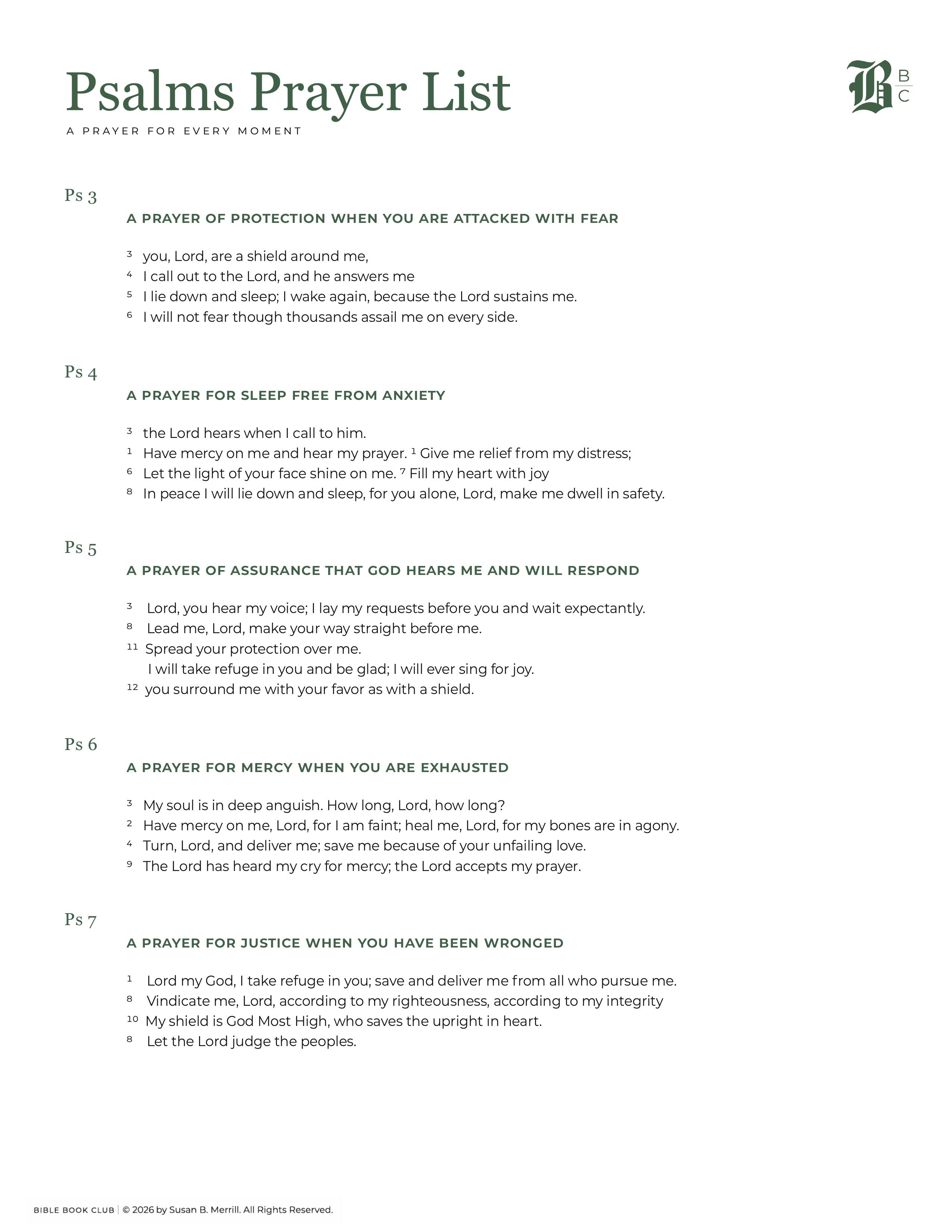
We now have 24 prayers on the Psalms Prayer List! Join us for our Bible study on Psalms 25-30 here.
New Psalms Playlist Song
We’ve added two more songs to our Psalms Playlist this week for Psalms 22-24:
- “Still Waters” (Psalm 23) by Leanna Crawford
- “King of Glory” (Psalm 24) by Passion + Kristian Stanfill
Listen to our Psalms Playlist on Apple Music or Spotify.
Group Discussion Questions for Psalms 22-24
- David vented his pain to God and then pivoted to praise, not because the suffering stopped, but because he transferred the burden. Is there something you are carrying right now that you haven’t fully laid at God’s feet?
- God put David through “shepherd school,” Moses through the wilderness, and Esther through the royal court. In your life, what season or “school” has God put you through, and what do you think He was preparing you for?
- People and sheep have a lot in common. What characteristics of a sheep can you most see in yourself: defenseless, needing constant care and to be led to (spiritual) food and water, resisting rest, or fearful?