What is the Book of Esther about?
The Book of Esther is the story of how God’s providence works behind the scenes through the courage and wisdom of faithful individuals to save His people. Esther is the perfect encouragement whenever you find yourself in a difficult, even dangerous, situation you never saw coming and do not think you are equipped to handle.
For such a time as this, you must trust in God and His hidden divine providence! And that brings us to our verse for this book:
Esther 4:14 14 And who knows but that you have come to your royal position for such a time as this?
Introduction to the Book of Esther
How does the Book of Esther fit into the Bible?
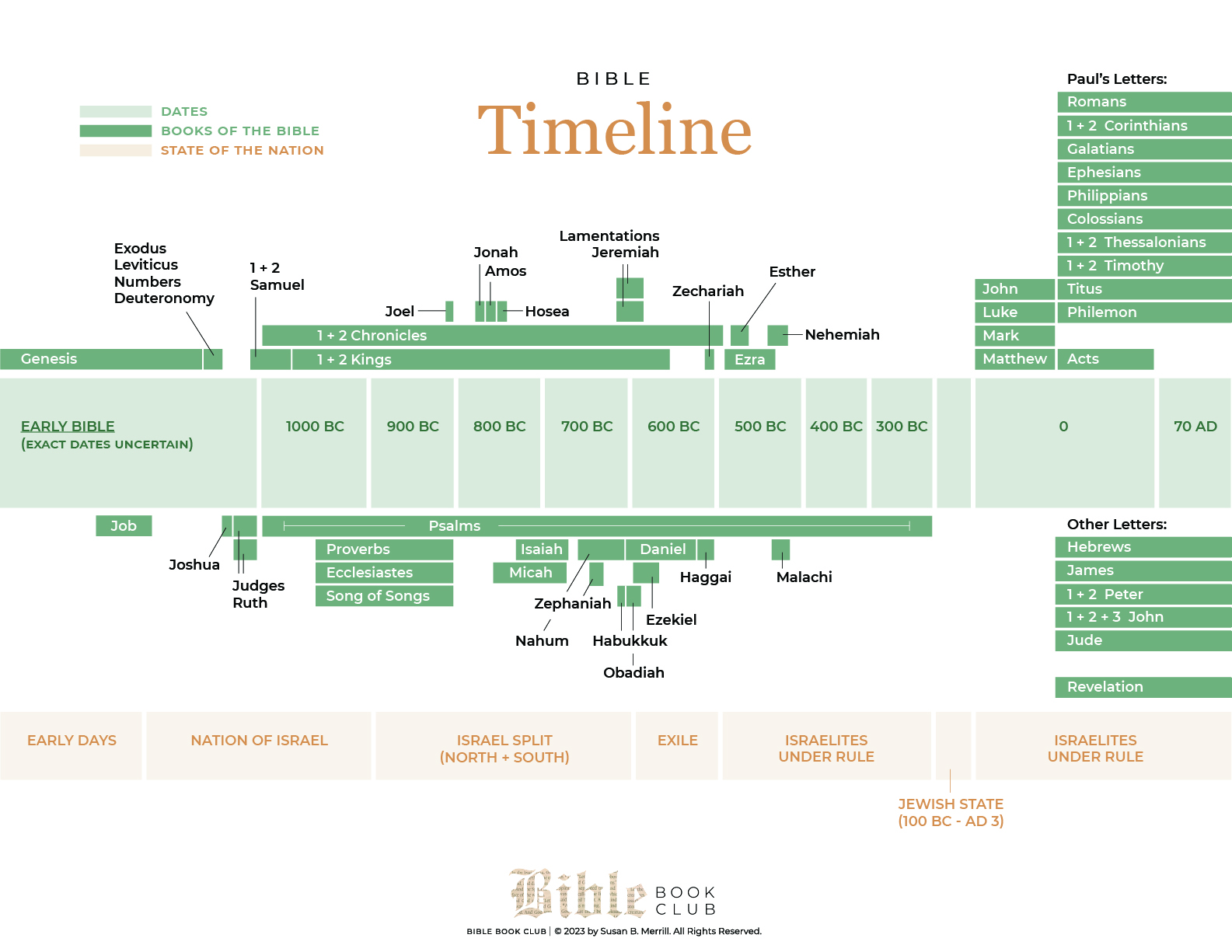
Esther appears in the Old Testament, which has five divisions. Esther is in the second division, which is called the History Books. This division contains 12 books, and Esther is the last book in the History Books division of the Bible.
Our Journey Through the Bible
The Bible is a collection of small stories that together tell the much larger story of the entire history of our redemption with Jesus as the ultimate hero. On our Bible Book Club journey, we have finished the first division, called the Pentateuch or Books of the Law. These are the first five books of the Bible. Now we’re in the second division, called the History Books. So, when we complete Esther, we can check off two of the five divisions!
When do the events in the Book of Esther take place?
Esther’s story takes place around 486-465 BC during the post-exilic period. This is the time after King Cyrus of Persia conquered Babylon and allowed the Jewish exiles to return to Jerusalem in Judah. Our story opens about 50 years after Cyrus’ decree.
It is at this point that God’s people come to be called Jews and not Israelites, because they return to Judah. The last two books we have covered in the Bible Book Club, Ezra and Nehemiah, take place in this same period. They follow the stories of the Jews who left Persia and returned to Judah.
However, Esther’s story is not about the Jews who returned to Jerusalem, as the books of Ezra and Nehemiah are. The book of Esther takes a different perspective. It is a story about the Jews who stayed in Persia.
Where do the events in the Book of Esther take place?
The story of Esther takes place in Susa, which is modern-day Iran. Susa is one of the Persian Empire’s greatest treasures. The palace in Susa is built on a 49-foot-high platform covering 250 acres. It is huge. The banquet hall where Xerxes holds his grand feasts, and where our story begins, has 72 columns, each 65 feet high.
In the book of Esther, the Jews in Judah are still struggling to overcome their exile and build a nation; think third-world situation. But other nations are experiencing major cultural, intellectual, and political advancements.
- Persia is the greatest of all and the dominant superpower of the century.
- Greece is rising to its golden age. The Greek Olympic Games already have a 200-year history.
- Pericles is building a political system in Athens.
- Sophocles is writing Oedipus Rex.
- Socrates is teaching, and Plato will soon be documenting his teacher.
- Pythagoras is establishing a school and the Pythagorean theorem that is still used in algebra today.
I say all this to set the stage for this drama. This is a period of great wealth, luxury, and political intrigue.
The Persian Palace Excavation
The details in the Book of Esther match the excavated Persian Palace so precisely that scholars believe whoever wrote Esther must have personally spent time there. The French archaeologist Jean Perrot said:
“One today rereads with renewed interest the book of Esther, whose detailed description of the interior of the palace of Xerxes is now in excellent accord with archaeological reality.”
For all those fascinated by archaeology, here is a post about the palace with a cool picture of a capital from the top of one of those 72 columns, which can be seen in the Louvre in Paris. It is absolutely huge and beautiful. I cannot imagine 72 of them standing 65 feet high.
The King Who Rules This Palace
In our story, the king who rules this enormous Persian palace is Xerxes, one of the main characters in the Book of Esther. Cyrus was the first Persian King. We first met him in the book of Ezra. Cambyses was Cyrus’s son, but he is never mentioned in the Bible. Darius is only distantly related to Cyrus and is also mentioned by Ezra. He ascended the throne by assassinating an alleged usurper.
King Xerxes is not Darius’s oldest son, who normally would have become king. King Darius chose Xerxes over his half-brother Artabazanes because Xerxes is also the son of Atossa. Atossa is one of Cyrus’s daughters. Cyrus must have been having children well into his old age. As Atossa’s son, Xerxes has a direct link back to the founder of the Persian Empire, Cyrus the Great. The fifth king is Artaxerxes, son of Xerxes. I mention him only because we have already met him. He was the king who sponsored the return of Ezra and Nehemiah.
And if you followed all that, you realize that the story of Esther, which follows the books of Ezra and Nehemiah, actually occurred chronologically before Ezra and Nehemiah! Many theologians place the story of Esther chronologically between the sixth and seventh chapters of Ezra.
Who wrote the Book of Esther, and what is the main theme or purpose of the book?
We do not know who wrote the Book of Esther, but the four primary purposes of Esther’s narrative are to:
- Record Deliverance: Esther documents the deliverance of the Jewish people during the reign of King Xerxes.
- Establish Purim: Esther explains why Purim was added to the required feasts and festivals.
- Fulfill Prophecy: The Book of Esther reminds the Israelites of the fulfillment of God’s promise in Exodus 17 to destroy the Amalekites, because they were the first to attack the Israelites right after they left Egypt.
- Teach Divine Providence: God is teaching the Israelites (and us) to look for Him working behind the scenes, moving people and situations so that all things work together for His good.
Central Theme of Banquets and “Hidden Providence”
An interesting theme that runs throughout the book of Esther is that the events revolve around banquets. There are ten altogether.
- Vashti says no at a banquet.
- Esther gains favor through banquets.
- Esther reveals her identity at a banquet.
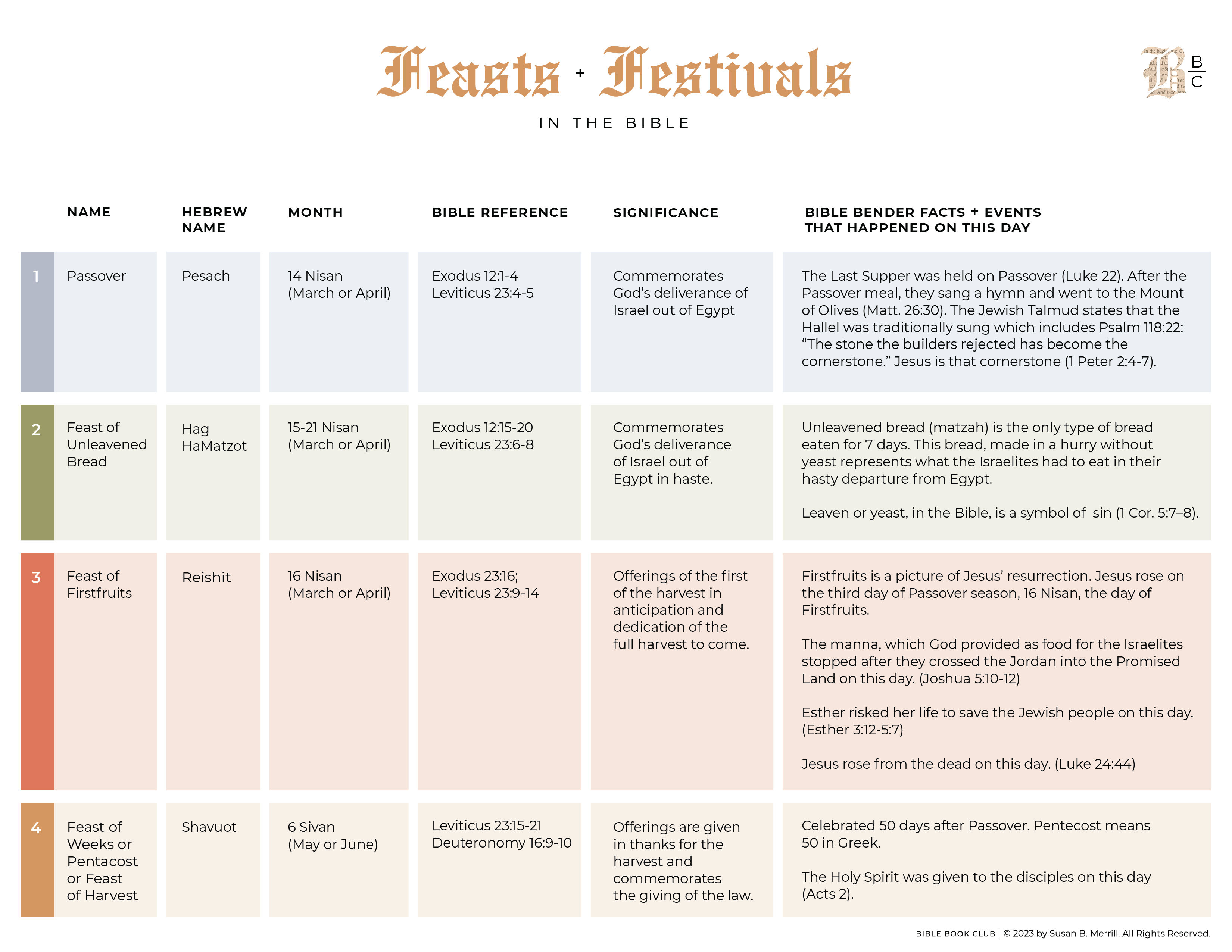
The Book of Esther uses feasting as the vehicle through which God orchestrates His hidden providence. Then the story ends in a declaration of a new national feast to be celebrated annually called Purim, which is the last religious feast or festival decreed in the Bible. It is still celebrated joyfully today on the 14th and 15th of March. See our chart with all the feasts commanded in the Old Testament.
What is the most intriguing fact about the Book of Esther?
God is not mentioned in the Book of Esther. Not even once. There are only two books in the Bible that do not mention God: Esther and Song of Solomon. It is an ingenious move and an example to us.
Think about it: during this time, the people are in exile because they have left God out of the story by turning to other gods. They have forgotten God’s name and His promises, but He has not forgotten them.
Why is God not mentioned in the Book of Esther?
God’s name is not mentioned in the Book of Esther, as if to silently prove that although they have written Him out of their story, He is indeed still the author. Even when His name is not mentioned, He is there.
Recall from our last two seasons that in the books of Ezra and Nehemiah, God moved King Cyrus, the king of Persia, to free the Jewish captives. And the three waves of return happened under Zerubbabel, Ezra, and Nehemiah. God is moving people to and in Jerusalem. But right in the middle of these three waves of returns, God makes a silent move to remind those who stay in Persia. He wants them to remember His promise to save them also. That is our current story, the Book of Esther.
The intriguing point in this story is that God can move for His people and His purposes behind the scenes while the world is unaware. God’s name is never mentioned in the Book of Esther, but God’s hand is visible in every coincidence, in the textbook timing, and in the perfect positioning of the players.
It’s a point for us to remember. God is still at work today, behind the scenes. The story of Esther is our example of how God does that, so we won’t miss it.
There is another purpose of this book. God is teaching the Israelites and us to look for Him working behind the scenes, moving people and situations so that all things work together for His good.
What is the meaning of Divine Providence in the story?
Divine providence is the theological term for the hidden movement of God. Divine providence means: God sees what is coming and acts ahead to orchestrate events according to His purpose. A helpful way to break it down is by looking at the word’s origin. Providence:
- Pro (before)
- Videre (to see).
Joseph’s story of Divine Providence
This is not the first story of divine providence we have discussed on our journey through the Bible. In the story of Joseph, which culminated in Genesis 45, Joseph, like Esther, was placed in a difficult situation. He was sold into slavery, but God moved behind the scenes to put him in a position to save his people in the palace of Pharaoh. At the end of Genesis, Joseph sums up the tragedy-turned-triumph of his life story:
Genesis 50:19-20 19 But Joseph said to his brothers, “Don’t be afraid. Am I in the place of God? 20 You intended to harm me, but God intended it for good to accomplish what is now being done, the saving of many lives.
Throughout the entire Bible, from Genesis to Esther to the Book of Acts, God has been working to deliver His people!
Acts 2:22-24 “Fellow Israelites, listen to this: Jesus of Nazareth was a man accredited by God to you by miracles, wonders and signs, which God did among you through him, as you yourselves know. 23 This man was handed over to you by God’s deliberate plan and foreknowledge; and you, with the help of wicked men, put him to death by nailing him to the cross. 24 God raised him from the dead, freeing him from the agony of death, because it was impossible for death to keep its hold on him.”
Jesus’ death on the cross was God’s plan all along. His ultimate divine providence to bring salvation to all! If you would like more examples of God’s divine providence, we have a chart on the website.
Who are the main characters in the Book of Esther?
The book of Esther has four main characters:
- King Xerxes, also known as Ahasuerus, the fourth king of Persia and ruler of the enormous Persian palace.
- Haman, a Persian official and the villain.
- Esther, a Jewish orphan, also known as Hadassah in some versions.
- Mordecai, Esther’s Jewish uncle.
In the opening scene of Esther, we only meet one of the main characters, King Xerxes. King Xerxes, we know, is the fourth king of Persia. Because of the Greek historian Herodotus, who wrote the history of the Persian Wars, we know a lot about Xerxes. Herodotus describes Xerxes as:
- The tallest and most handsome of the Persian Kings.
- Having an excess of pride.
- An ambitious and ruthless ruler.
- A jealous lover.
Apparently, Herodotus had intel about Xerxes’ disastrous passion for his sister-in-law and later for a niece. I would like to digress on the resulting bloody court intrigue, but that would be another book club, as none of that is documented in the Bible.
Scene 1: The Banquet that Set the Stage for Divine Providence, Esther 1 Explained
Esther 1:1-8
1 This is what happened during the time of Xerxes, the Xerxes who ruled over 127 provinces stretching from India to Cush: 2 At that time King Xerxes reigned from his royal throne in the citadel of Susa, 3 and in the third year of his reign he gave a banquet for all his nobles and officials. The military leaders of Persia and Media, the princes, and the nobles of the provinces were present.
4 For a full 180 days he displayed the vast wealth of his kingdom and the splendor and glory of his majesty.
5 When these days were over, the king gave a banquet, lasting seven days, in the enclosed garden of the king’s palace, for all the people from the least to the greatest who were in the citadel of Susa. 6 The garden had hangings of white and blue linen, fastened with cords of white linen and purple material to silver rings on marble pillars. There were couches of gold and silver on a mosaic pavement of porphyry, marble, mother-of-pearl and other costly stones. 7 Wine was served in goblets of gold, each one different from the other, and the royal wine was abundant, in keeping with the king’s liberality. 8 By the king’s command each guest was allowed to drink with no restrictions, for the king instructed all the wine stewards to serve each man what he wished.
What is the purpose of King Xerxes’ 180-day banquet?
This 180-day banquet is a strategic gathering in 483 BC to gain support for a military campaign against Greece. The banquet is held in the “third year of Xerxes’ reign” and corresponds to the great Persian War Council, where it is documented that Xerxes gathered support from all the nobles by displaying his wealth.
When Xerxes ascended the throne, Persia and Greece were in conflict. Persia was at its peak, and the power of Greece was growing. Xerxes’ father, Darius, had been defeated attempting to take Athens. Xerxes was preparing the Persians for their next campaign against Greece to avenge his father’s defeat.
This is the first of three banquets that providentially opened the door for Esther to become queen. Note that this banquet lasted 180 days. That’s six months of feasting! This was not an exaggeration. It involved hosting a multitude of leaders from many provinces. Some theologians do not think they all stayed the whole time, but many traveled from a great distance. We don’t know the exact number of attendees. However, the purpose is historically documented.
What would that 180-day banquet have been like?
Imagine that glorious palace filled with the most important people in the most powerful empire in the world, drinking, dining, laughing, and plotting for days on end. The boasts of their prideful king spilling into their cups. The propaganda flowed as freely as the wine until they were intoxicated with their own national importance.
Who wouldn’t succumb to such affluence? By the end of the party, they probably couldn’t wait to reunite on the battlefield with visions of another 180-day celebration at the palace after their inevitable win. Little do they know what we know: Xerxes will return from Greece four years later after a surprising defeat that depletes his royal wealth. This is the first of many ironic reversals in the book of Esther.
What was the purpose of the seven-day banquet in the garden?
Next, the entire city of Susa is invited to a seven-day party in the garden to win over the people, most of whom will likely be enlisted in fighting the Persian campaign against Greece. The gold goblets, each unique, are filled and refilled without limit. With each sip, the men drink deeply of the king’s imperial propaganda until they are convinced Persia is invincible.
This is the second banquet. Every day and every drink, the momentum is growing, and with it, the king’s pride inflates. How could it not? Has there ever been a display of such wealth in all the world? Has any leader ever been so successful in unifying the leaders and motivating the people? From where the King is sitting, he is the most powerful king ever, and no one would dare to refuse him.
So on the seventh day, when King Xerxes is in high spirits from wine, he commands the eunuchs to bring before him Queen Vashti. But when the attendants deliver the king’s command, Queen Vashti refuses to come.
Scene 2: Queen Vashti Refuses the King, Esther 1 Commentary
Esther 1:9-12
9 Queen Vashti also gave a banquet for the women in the royal palace of King Xerxes.
10 On the seventh day, when King Xerxes was in high spirits from wine, he commanded the seven eunuchs who served him—Mehuman, Biztha, Harbona, Bigtha, Abagtha, Zethar and Karkas—11 to bring before him Queen Vashti, wearing her royal crown, in order to display her beauty to the people and nobles, for she was lovely to look at. 12But when the attendants delivered the king’s command, Queen Vashti refused to come. Then the king became furious and burned with anger.
Why does Queen Vashti refuse to appear before King Xerxes?
Queen Vashti refuses the king because his command puts her in an impossible situation: either face humiliation and be mauled by hundreds of drunken men or face the volatile king drunk on his own arrogance. God, in his providence, moves to make this situation impossible for her to comply.
The Queen Is Holding a Banquet
Apparently, while King Xerxes is entertaining, so is the Queen with a banquet of her own for the women. Persian culture has strict gender separation at royal banquets, with men and women holding separate social events. They are separate but parallel expressions of power.
The Queen’s banquet is, like Xerxes’, a political move since the noble women of the kingdom will be present. This gives Queen Vashti control of another valuable group of political influencers, the wives. The banquet would have been equally opulent and no doubt even more aesthetically beautiful.
So the queen is feasting with the ladies, and the king is “in high spirits from wine.” He is drunk. And maybe, in his drunkenness, he wants to show off the queen because he has shown off every other beautiful thing he can by this time.
The queen is beautiful, and it sounds like very well dressed. And he is probably getting bored. His queen will add excitement, just like a parade through the palace. For she would have been seated on an elaborately decorated royal litter, lifted high and carried around for all to see. The dramatic entrance would have been a great addition to the party.
The King is Drunk
By linking the king’s drunkenness to the command to Vashti, the author implies that the king’s idea is perhaps not wise and too impulsive. He would not have made such a request had he not been drinking. We know almost nothing of Vashti’s background, other than that she was not Jewish. But much has been written about why she refused the king.
Persian Women Have Power
Persian queens have power and influence in their own right. They are economically independent, manage their own estates, employ workers, and oversee building projects. Edinburgh University’s history journal studied the power of women in the Achaemenid or Persian Court and found that:
“One of the main privileges of royal Persian mothers and wives, according to both classical and indigenous sources, was their autonomy. These royal women were free to travel alone around the empire with their own attendants, as shown by clay tablets depicting Irdabama, the mother of Darius I, travelling with her daughter-in-law, Irtaštuna.
Royal women’s autonomy is also reflected in the fact that they could hold their own banquets. This is depicted in the book of Esther in the Hebrew Bible and is inferred from the large numbers of food ordered by the king for the queen, suggesting feasts involving hundreds of people.
Similarly, Plato records that Amestris, the mother of Artaxerxes I, possessed her own vast estates, and Xenophon writes that Parysatis, the wife of Darius II (r. 423-404 BCE), had her own villages close to the river Chalus.
These activities indicate how crucial royal women were for facilitating and establishing social relations within the court, as shown by the banquets they hosted amongst other elites and by their travels across the empire. Thus, by maintaining good social relations, royal women could secure the king’s — and thereby their own — positions whilst also fulfilling their own ambitions and maintaining the king’s favour.”
Queen Vashti isn’t just decorative. She wields real authority. And the queen’s defiance is most likely justified. Otherwise, the author of the story, who is almost certainly a man living in a patriarchal era, would not have written the scene as he did. It certainly appears she is the more noble of the two, for there is no mention of her refusing because she is “high in spirits.”
There Is No Good Choice
Queen Vashti makes the difficult decision to refuse the king, knowing it is risky because she is married to a volatile man. But she makes her choice, perhaps emboldened by the Lord, and she refuses. To the King and his noble audience, her refusal is a direct challenge to his authority. She defied the king. Her husband. A man.
What is the result of Queen Vashti’s defiance?
The humiliated King is furious, so he banishes Vashti and issues an edict about wifely obedience and male rulership in the household. The King, surrounded by nobles he means to impress, has to act quickly to save face, to reassert his power, to prove to everyone, including himself, that he is the one in control.
What he doesn’t know is that he was never in control in the first place. God is. In the King’s desperation to salvage his pride, he sets in motion an unforeseen set of events that will deliver the Jews from certain death.
Scene 3: The Defiance that Set the Stage for Deliverance
Esther 1:13-22
13 Since it was customary for the king to consult experts in matters of law and justice, he spoke with the wise men who understood the times 14 and were closest to the king—Karshena, Shethar, Admatha, Tarshish, Meres, Marsena and Memukan, the seven nobles of Persia and Media who had special access to the king and were highest in the kingdom.
15 “According to law, what must be done to Queen Vashti?” he asked. “She has not obeyed the command of King Xerxes that the eunuchs have taken to her.”
16 Then Memukan replied in the presence of the king and the nobles, “Queen Vashti has done wrong, not only against the king but also against all the nobles and the peoples of all the provinces of King Xerxes. 17 For the queen’s conduct will become known to all the women, and so they will despise their husbands and say, ‘King Xerxes commanded Queen Vashti to be brought before him, but she would not come.’ 18 This very day the Persian and Median women of the nobility who have heard about the queen’s conduct will respond to all the king’s nobles in the same way. There will be no end of disrespect and discord.
19 “Therefore, if it pleases the king, let him issue a royal decree and let it be written in the laws of Persia and Media, which cannot be repealed, that Vashti is never again to enter the presence of King Xerxes. Also let the king give her royal position to someone else who is better than she. 20 Then when the king’s edict is proclaimed throughout all his vast realm, all the women will respect their husbands, from the least to the greatest.”
21 The king and his nobles were pleased with this advice, so the king did as Memukan proposed. 22 He sent dispatches to all parts of the kingdom, to each province in its own script and to each people in their own language, proclaiming that every man should be ruler over his own household, using his native tongue.
Why does the king make a decision he’ll later regret?
The king’s wine-infused pride has fallen flat, and he acts quickly. He gathers his advisors, and they blow the incident way out of proportion, fearful that all women will now refuse their husbands. The king accepts his advisors’ authoritative advice and makes a rash decision he later regrets.
Had he been sober, the king never would have asked his wife to display her beauty before his drunken leaders. Maybe that is why men and women have separate banquets. But what is really going on here? Divine providence. God moves behind the scenes to use marital conflict between the most powerful king and queen in the world to save His people. Vashti exercises her autonomy, Xerxes removes her, and suddenly the path opens for Esther.
Divine providence is always at work. Everywhere in the world. Even today.
How does Vashti’s story prepare us for Esther’s?
By introducing Esther’s story with Vashti’s, the author wants us to fully comprehend the difficulty of Esther’s position. In the Persian court, the king wields absolute power, and all bow to his whims. The next queen will be under even more pressure to please the king, or face the unpredictable consequences of his anger, due to this new wifely obedience edict.
By marrying this king, Esther will walk a tightrope of tension for life. One wrong move and she could fatally fall. This story isn’t a fairy tale rise to power, and it certainly isn’t what Esther wants for her life. But just as God could move King Xerxes, He can move Esther too. And He has a plan to use her for such a time as this. The story continues in our next chapter.
Group Discussion Questions for Esther 1
- God uses the imperfect King Xerxes (prideful, ambitious, ruthless, jealous) to accomplish his mission. In what ways has God used unlikely or flawed people in your own life to accomplish His purposes?
- In what ways are you walking your own “tightrope of tension” in relationships, work, or faith? How can you trust God’s control in those situations?
- Have you ever found yourself in a situation you “never saw coming” and didn’t feel equipped to handle? How does Esther 4:14 speak to that experience?