1 Chronicles 7-8 Introduction: The Last of the 12 Tribes of Israel
In our 1 Chronicles 7-8 commentary, we will complete the 12 genealogies with an ominous challenge. These Tribes lived on the west side of the Jordan, north of Judah and Simeon. There were six:
- Issachar.
- Naphtali.
- The other half tribe of Manasseh.
- Ephraim.
- Asher.
- Benjamin.
Notably missing are the tribes of Dan and Zebulun. Dan because they disappeared, as we have discussed. Zebulun probably because the two tribes of Zebulun and Issachar became linked, as they were always close, sharing the same mother and living in adjacent territories.
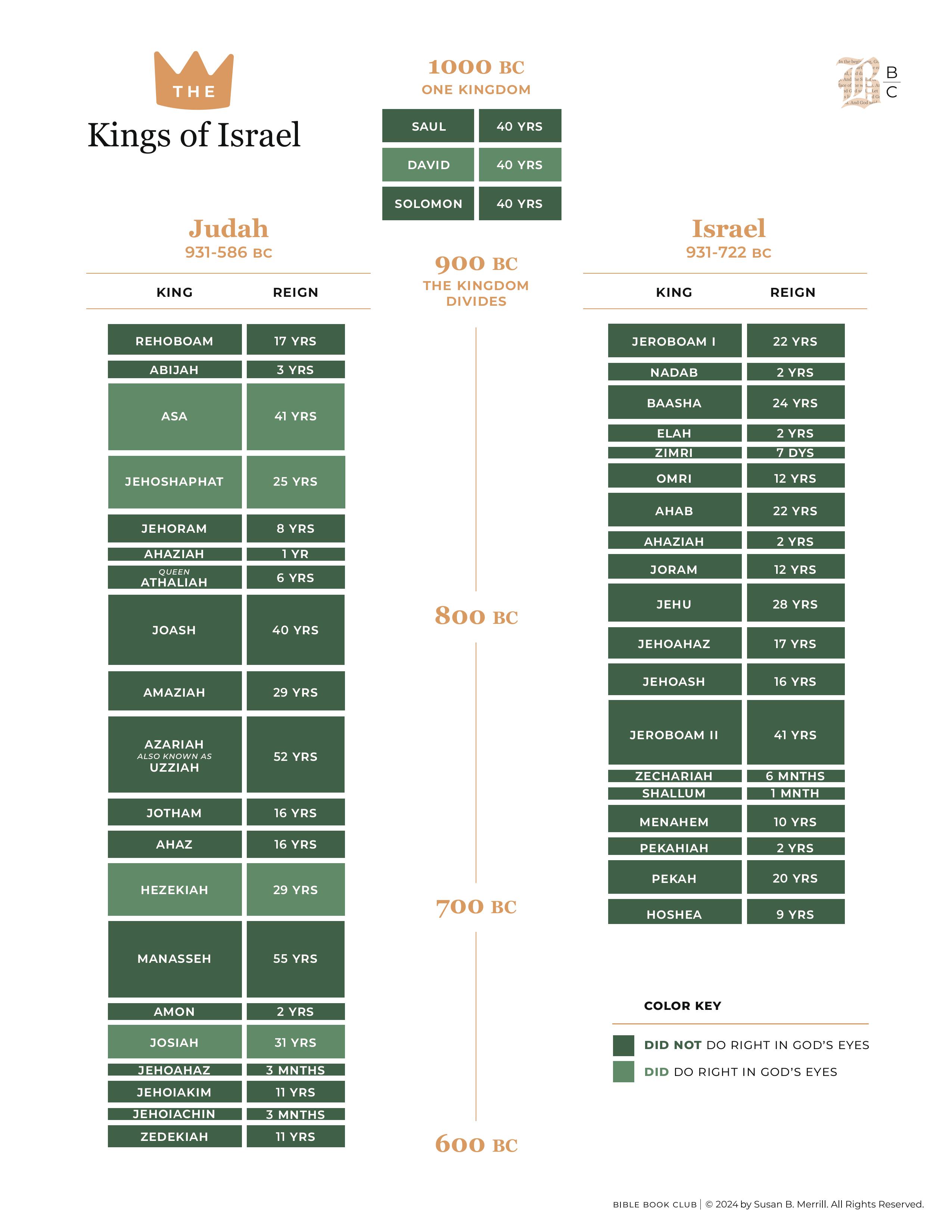
For framework, recall that the Northern tribes, along with the three Transjordan tribes, formed the Northern Kingdom of Israel during the time of Kings. They often opposed the Southern Kingdom, also called Judah. In 1 Chronicles 7-8, our author is writing post-exile, past the time of the divided kingdom, and it is his desire for the tribes to be united once again. This is a chance at a new beginning. A chance to reform the nation as God had planned.
Scene 1: The Tribe of Issachar
Issachar was the ninth son of Jacob and Leah's fifth son. His territory was not large, but it was coveted as some of the most fertile land in Israel. See our map of all the tribes’ territories if you are curious about the location of each tribe.
1 Chronicles 7:1-5
1 The sons of Issachar: Tola, Puah, Jashub and Shimron—four in all. 2 The sons of Tola: Uzzi, Rephaiah, Jeriel, Jahmai, Ibsam and Samuel—heads of their families. During the reign of David, the descendants of Tola listed as fighting men in their genealogy numbered 22,600. 3 The son of Uzzi: Izrahiah. The sons of Izrahiah: Michael, Obadiah, Joel and Ishiah. All five of them were chiefs. 4 According to their family genealogy, they had 36,000 men ready for battle, for they had many wives and children. 5 The relatives who were fighting men belonging to all the clans of Issachar, as listed in their genealogy, were 87,000 in all.
A Strong Military Force
Clearly, the tribe of Issachar had once been large, and our author is throwing them some love by mentioning their military force, because they once were a mighty contributor to Israel's military. In fact, the judge Deborah praised them for their support in Judges 5. In 1 Chronicles 12, they eventually become known more for wisdom and strategic insight than for their might in battle.
Scene 2: The Tribe of Benjamin
1 Chronicles 7:6-12
6 Three sons of Benjamin: Bela, Beker and Jediael. 7 The sons of Bela: Ezbon, Uzzi, Uzziel, Jerimoth and Iri, heads of families—five in all. Their genealogical record listed 22,034 fighting men. 8 The sons of Beker: Zemirah, Joash, Eliezer, Elioenai, Omri, Jeremoth, Abijah, Anathoth and Alemeth. All these were the sons of Beker. 9 Their genealogical record listed the heads of families and 20,200 fighting men. 10 The son of Jediael: Bilhan. The sons of Bilhan: Jeush, Benjamin, Ehud, Kenaanah, Zethan, Tarshish and Ahishahar. 11 All these sons of Jediael were heads of families. There were 17,200 fighting men ready to go out to war. 12 The Shuppites and Huppites were the descendants of Ir, and the Hushites the descendants of Aher.
Benjamin, a Favorite
Benjamin was the youngest son of Jacob and the second son born to his beloved Rachel. She died giving birth to him. Next to Joseph, Rachel's only other son, Benjamin was a favorite. His name reflects his father's favor. Benjamin means son of my right hand.
You may be confused about Benjamin’s genealogy here, as we discussed that the three most important tribes, Judah, Levi, and Benjamin form the beginning, middle, and end of the genealogies. Benjamin is placed here in the tribal list but also at the end. In this section, all three of Benjamin's sons are given print. In the final section, only the line of Bela, the line that leads to King Saul, is detailed. Much like David's line, Saul's is singled out because, although the crown was taken from him, he was anointed by God.
Who were the most famous descendants of the tribe of Benjamin?
The tribe of Benjamin produced some important leaders including:
- Saul, the first king of Israel.
- Jonathan, Saul’s son and a faithful friend of David's.
- Ehud, the second judge of Israel.
- Queen Esther
- Mordecai, Esther’s uncle
- The Apostle Paul
Ehud was a clever and violent man who tricked the guards and single-handedly sunk a knife into Eglon, the king of Moab. It’s a great story in our Judges 3-4 commentary.
Scene 3: The Tribe of Naphtali
1 Chronicles 7:13
13 The sons of Naphtali: Jahziel, Guni, Jezer and Shillem—the descendants of Bilhah.
The Shortest Genealogy
Naphtali was Jacob's sixth son, his second son by Bilhah, Rachel's servant. This genealogy is the shortest. There was one notable descendant of Naphtali, Barak, who, under the leadership of Deborah, delivered Israel from the oppression of the Canaanites.
Scene 4: The Half Tribe of Manasseh
1 Chronicles 7:14-19
14 The descendants of Manasseh: Asriel was his descendant through his Aramean concubine. She gave birth to Makir the father of Gilead. 15 Makir took a wife from among the Huppites and Shuppites. His sister’s name was Maakah. Another descendant was named Zelophehad, who had only daughters. 16 Makir’s wife Maakah gave birth to a son and named him Peresh. His brother was named Sheresh, and his sons were Ulam and Rakem. 17 The son of Ulam: Bedan. These were the sons of Gilead son of Makir, the son of Manasseh. 18 His sister Hammoleketh gave birth to Ishhod, Abiezer and Mahlah. 19 The sons of Shemida were: Ahian, Shechem, Likhi and Aniam.
The tribe of Manasseh split and took territory on both sides of the river. This is the other half that lived on what the Israelites considered the right side of the Jordan River. Manasseh and Ephraim were the sons of Jacob's favorite son Joseph.
Joseph was his first son with his favorite wife Rachel. Beloved by his father and envied by his eleven brothers, Joseph saved his family from a famine by becoming Pharaoh's right-hand man. As a result, Joseph got a double blessing of the Promised Land, and both of his sons became tribes.
What was the significance of the daughters of Zelophehad in Manasseh?
Our author has a heart for inclusivity and often includes a random detail in a genealogy about women or foreigners. In this case, he mentions the daughters of Zelophehad who advocated for revolutionary reform in the legal rights of women to inherit property in our Numbers 27 commentary.
The family of Zelophehad had a problem. Their father had no sons when he died, like all his generation of men in the wilderness. Under the existing Law, his name and property would be lost in the Promised Land. The sisters approached Moses with the dilemma, and after consulting with God, Moses established a new Law. If a man had no sons, the land would go to his daughters. Later, the Law was amended to stipulate that the daughters had to marry within their tribe so the land did not leave the tribe. The Chronicler drops this detail to remind those returning from exile that daughters will be protected now as they were then.
Scene 5: The Tribe of Ephraim
1 Chronicles 7:20-29
20 The descendants of Ephraim: Shuthelah, Bered his son, Tahath his son, Eleadah his son, Tahath his son, 21 Zabad his son and Shuthelah his son. Ezer and Elead were killed by the native-born men of Gath, when they went down to seize their livestock. 22 Their father Ephraim mourned for them many days, and his relatives came to comfort him. 23 Then he made love to his wife again, and she became pregnant and gave birth to a son. He named him Beriah, because there had been misfortune in his family. 24 His daughter was Sheerah, who built Lower and Upper Beth Horon as well as Uzzen Sheerah.
25 Rephah was his son, Resheph his son, Telah his son, Tahan his son, 26 Ladan his son, Ammihud his son, Elishama his son, 27 Nun his son and Joshua his son. 28 Their lands and settlements included Bethel and its surrounding villages, Naaran to the east, Gezer and its villages to the west, and Shechem and its villages all the way to Ayyah and its villages. 29 Along the borders of Manasseh were Beth Shan, Taanach, Megiddo and Dor, together with their villages. The descendants of Joseph son of Israel lived in these towns.
Blessings for the Younger Son
Ephraim was Joseph's other son. He was the younger son, but he received Jacob's blessing despite Joseph's protests, so the tribe of Ephraim became greater than the tribe of Manasseh.
Genesis 48:17-19 17 When Joseph saw his father placing his right hand on Ephraim’s head he was displeased; so he took hold of his father’s hand to move it from Ephraim’s head to Manasseh’s head. 18 Joseph said to him, “No, my father, this one is the firstborn; put your right hand on his head.”
19 But his father refused and said, “I know, my son, I know. He too will become a people, and he too will become great. Nevertheless, his younger brother will be greater than he…”
Why did the tribe of Ephraim become synonymous with the Northern Kingdom?
The tribe of Ephraim became so great that the entire Northern Kingdom consisting of ten tribes was often called Ephraim because of their leadership over the tribes of the North. The first king of the Northern Kingdom, Jeroboam, was from the tribe of Ephraim.
This is not something to boast about, as he was responsible for tearing the United Kingdom of Israel apart. This fact would have deeply grieved Joseph, who took such joy in being reunited with his brothers.
Which famous biblical leader was a descendant of the tribe of Ephraim?
The author gives several shout-outs to the tribe of Ephraim, including Joshua who was the Joshua who succeeded Moses and conquered Canaan. He does not mention Abdon, a minor judge in the book of Judges, nor does he mention the judge Deborah, who lived in Ephraim but may have been from another tribe. He does mention Sheerah, a notable woman who established three towns.
Scene 6: The Tribe of Asher
Asher was the eighth son of Jacob and the second son of Zilpah, Leah's servant. This tribe has significantly decreased in size from Numbers, where their military ranks had grown to 53,400.
1 Chronicles 7:30-40
30 The sons of Asher: Imnah, Ishvah, Ishvi and Beriah. Their sister was Serah. 31 The sons of Beriah: Heber and Malkiel, who was the father of Birzaith. 32 Heber was the father of Japhlet, Shomer and Hotham and of their sister Shua. 33 The sons of Japhlet: Pasak, Bimhal and Ashvath. These were Japhlet’s sons. 34 The sons of Shomer: Ahi, Rohgah, Hubbah and Aram. 35 The sons of his brother Helem: Zophah, Imna, Shelesh and Amal. 36 The sons of Zophah: Suah, Harnepher, Shual, Beri, Imrah, 37 Bezer, Hod, Shamma, Shilshah, Ithran and Beera. 38 The sons of Jether: Jephunneh, Pispah and Ara. 39 The sons of Ulla: Arah, Hanniel and Rizia. 40 All these were descendants of Asher—heads of families, choice men, brave warriors and outstanding leaders. The number of men ready for battle, as listed in their genealogy, was 26,000.
That Wraps Up the Minor Tribes
That completes the list of all the minor tribes. Next, the author will return to the tribe he strategically wants to end with. The tribe of Benjamin and the genealogy of the line of Benjamin that produced the first king, Saul
Scene 7: The Tribe of Benjamin Continued
1 Chronicles 8:1-40
1 Benjamin was the father of Bela his firstborn, Ashbel the second son, Aharah the third, 2 Nohah the fourth and Rapha the fifth. 3 The sons of Bela were: Addar, Gera, Abihud, 4 Abishua, Naaman, Ahoah, 5 Gera, Shephuphan and Huram. 6 These were the descendants of Ehud, who were heads of families of those living in Geba and were deported to Manahath: 7 Naaman, Ahijah, and Gera, who deported them and who was the father of Uzza and Ahihud. 8 Sons were born to Shaharaim in Moab after he had divorced his wives Hushim and Baara. 9 By his wife Hodesh he had Jobab, Zibia, Mesha, Malkam, 10 Jeuz, Sakia and Mirmah. These were his sons, heads of families. 11 By Hushim he had Abitub and Elpaal. 12 The sons of Elpaal: Eber, Misham, Shemed (who built Ono and Lod with its surrounding villages), 13 and Beriah and Shema, who were heads of families of those living in Aijalon and who drove out the inhabitants of Gath.
14 Ahio, Shashak, Jeremoth, 15 Zebadiah, Arad, Eder, 16 Michael, Ishpah and Joha were the sons of Beriah. 17 Zebadiah, Meshullam, Hizki, Heber, 18 Ishmerai, Izliah and Jobab were the sons of Elpaal. 19 Jakim, Zikri, Zabdi, 20 Elienai, Zillethai, Eliel, 21 Adaiah, Beraiah and Shimrath were the sons of Shimei. 22 Ishpan, Eber, Eliel, 23 Abdon, Zikri, Hanan, 24 Hananiah, Elam, Anthothijah, 25 Iphdeiah and Penuel were the sons of Shashak. 26 Shamsherai, Shehariah, Athaliah, 27 Jaareshiah, Elijah and Zikri were the sons of Jeroham. 28 All these were heads of families, chiefs as listed in their genealogy, and they lived in Jerusalem. 29 Jeiel the father of Gibeon lived in Gibeon. His wife’s name was Maakah, 30 and his firstborn son was Abdon, followed by Zur, Kish, Baal, Ner, Nadab, 31 Gedor, Ahio, Zeker 32 and Mikloth, who was the father of Shimeah. They too lived near their relatives in Jerusalem. 33 Ner was the father of Kish, Kish the father of Saul, and Saul the father of Jonathan, Malki-Shua, Abinadab and Esh-Baal.
Ehud the Judge
This section focuses on Ehud because, as we already mentioned, he became an important leader and one of the judges from the Book of Judges. Three families from this line of Benjamin left the territory and went to Manahath.
The record about heads of families being deported has produced several theories. Biblical commentaries suggest the word that was translated as "deported" may have meant "migrated." This makes sense because migrations often happened during famine. Think about Jacob's family migration to Egypt, where Joseph providentially provided for them. Naomi’s family migrated from Bethlehem in the Book of Ruth.
Or it could be that they moved because they became too large for the area and moved for more land. Whatever the reason, the important point is that Manahath is located in the tribe of Judah. They did not move into foreign territory. And again we see a close connection of the two tribes that formed the southern kingdom. Shaharaiim migrated to Moab, which was like a satellite state during the time of David and Solomon.
A detailed detour here is a story of divorce. We don’t know why Shaharain divorced Hushim and Baara, but our author honors these women and includes them in the genealogy. It is Hushim, the first wife, who is featured, as her son Elpaal is the focus of the next section of the genealogy.
The author subtly drops a dark detail on the tribe of Dan. The three cities of Ono, Lod, and Aijalon are listed as inhabited by the sons of Elpaal. These cities had all been allotted to the tribe of Dan.
How did the tribe of Benjamin end up living in Dan's territory?
Dan failed to drive out the Canaanites in their territory, so the tribe of Benjamin took over. A plus for Benjamin, a minus for Dan. The physical location of the tribe of Benjamin adds to the importance of this tribe.
Jerusalem was originally in Benjamin's territory but very close to the border of Judah. However, in Joshua 18, the Benjamites failed to drive out the Jebusites who lived there. When David conquered Jerusalem in 2 Samuel 5, it became the capital, and Judah took over Jerusalem. But it appears many Benjamites stayed or returned to Jerusalem. This makes sense because, after the kingdom split, Benjamin aligned with Judah rather than the northern kingdom of Israel. This political alliance meant Benjamites maintained close ties to Jerusalem as the capital of the southern kingdom.
The Chronicler makes this detail drop about Benjamin because he is on a mission to prove continuity between pre-exilic and post-exilic Israel. It is like he is saying the same thing over and over in different ways to build his case that all the exiles of Israel from every tribe should come back and start again in Jerusalem because, see, Benjamin, you have history here and belong here.
What is the relationship between the city of Gibeon and King Saul?
Jeiel was the founder of Gibeon. This is important because Gibeon was important, and the author is highlighting Saul's connection to the founder of Gibeon. It also could mean that Saul had foreign Gibeonite ancestors, and our inclusive author is hinting at those who were grafted into Israel.
Gibeon was a large, fortified city in the territory given to Benjamin. In Joshua 9, when Joshua was conquering Canaan, the Gibeonites tricked Joshua into making a peace treaty by pretending to be from a distant land. Because of this oath, the Israelites could not destroy the Gibeonites, and they lived as servants amongst them.
After the conquest of Canaan, Gibeon became the religious center of Israel, and the Tabernacle was set up in Gibeon until the Temple was built in Jerusalem. In Nehemiah 3, the Benjamites of Gibeon were given the credit for helping rebuild the walls of Jerusalem after the exile.
Then the author once again drops a gentile ancestor into the genealogy.
What foreign ancestors are mentioned in the genealogies of 1 Chronicles?
Throughout 1 Chronicles, the foreign ancestors mentioned are:
- Aramean: Jeiel's wife Maakah; David's wife Maakah, the mother of Absalom in 1 Chronicles 3:2; and Manasseh's wife in 1 Chronicles 7:14.
- Egyptian: Jarha, the Egyptian slave, married Sheshen's daughter in 1 Chronicles 2:34.
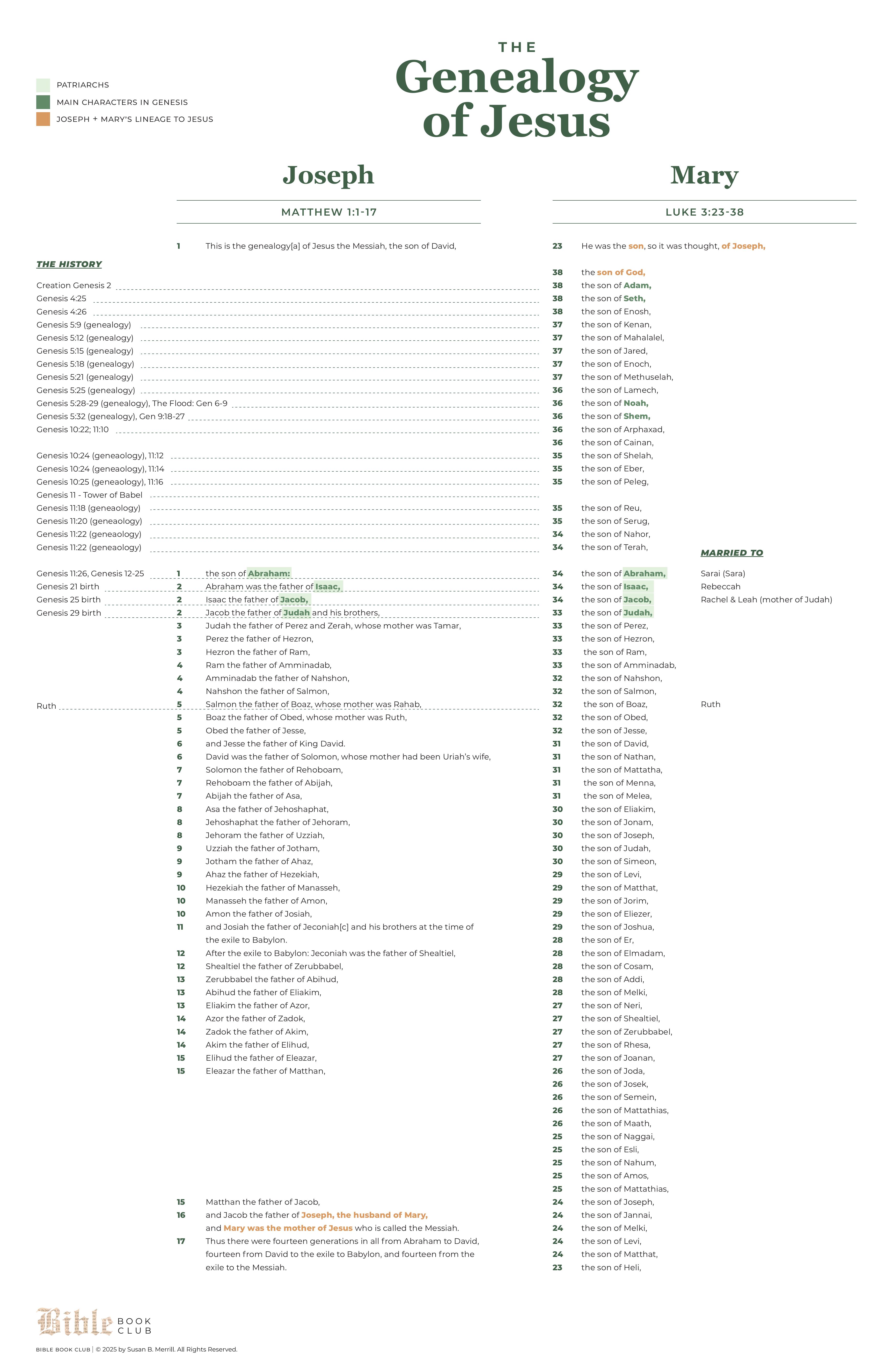
- Canaanite: Judah's first wife, Shua, and his other wife, Tamar, the mother of Perez and in the line of David and Jesus.
- Moabite: Boaz's wife, and she too is in the line of David and Jesus.
The point our author is weaving into this genealogy is this: God has a plan to include people of nations beyond Israel. God promised Abraham he would be a blessing to the nations. Our author embraces that promise and sees the grafting of the nations in these genealogies. That is why he calls out the foreigners in the genealogies, even if they are women who normally are not listed, and the lines followed by the males born to each family. This Chronicler is a visionary. He sees the future through God’s eyes.
Scene 8: The Descendants of Saul
1 Chronicles 8:33-40
and Saul the father of Jonathan, Malki-Shua, Abinadab and Esh-Baal. 34 The son of Jonathan: Merib-Baal, who was the father of Micah. 35 The sons of Micah: Pithon, Melek, Tarea and Ahaz. 36 Ahaz was the father of Jehoaddah, Jehoaddah was the father of Alemeth, Azmaveth and Zimri, and Zimri was the father of Moza. 37 Moza was the father of Binea; Raphah was his son, Eleasah his son and Azel his son. 38 Azel had six sons, and these were their names: Azrikam, Bokeru, Ishmael, Sheariah, Obadiah and Hanan. All these were the sons of Azel. 39 The sons of his brother Eshek: Ulam his firstborn, Jeush the second son and Eliphelet the third. 40 The sons of Ulam were brave warriors who could handle the bow. They had many sons and grandsons—150 in all. All these were the descendants of Benjamin.
Saul’s Line Grew
The Chronicler boldly points out that the line of Saul continued and grew during the time of David. This is a detail drop to remind the Israelites of an important relationship between Benjamin's house and Judah's house. It was a very personal relationship between Jonathan, a Benjamite and the crown prince, and David, a Judite and the one who replaced Saul as king.
1 Samuel 20:13-17 13 But if my father intends to harm you, may the Lord deal with Jonathan, be it ever so severely, if I do not let you know and send you away in peace. May the Lord be with you as he has been with my father. 14 But show me unfailing kindness like the Lord’s kindness as long as I live, so that I may not be killed, 15 and do not ever cut off your kindness from my family—not even when the Lord has cut off every one of David’s enemies from the face of the earth.”
16 So Jonathan made a covenant with the house of David, saying, “May the Lord call David’s enemies to account.” 17 And Jonathan had David reaffirm his oath out of love for him, because he loved him as he loved himself.
David was faithful to his pledge to Jonathan in 1 Samuel, because he loved Jonathan as a brother. Also because, throughout David's years on the run from Saul, David refused to lift a hand against God's anointed. The author wants all to remember that Judah was faithful to Benjamin. Jonathan's son Mephibosheth and all his descendants lived because of David's loyalty to Jonathan.
Scene 9: Conclusion
The genealogy of all those who lived in Israel before the exile is complete. The author has creatively woven together a history and a case for why all belong in the restoration of Israel. All Israel. It is so important to him that all 12 tribes are represented. It is as if he is saying, “This is who we are. Who you are. Even though you were born in captivity, you belong here.” He has filled all with hope, and then he says this:
1 Chronicles 9:1 All Israel was listed in the genealogies recorded in the book of the kings of Israel and Judah. They were taken captive to Babylon because of their unfaithfulness.
All were taken captive. And there you have it, the challenge.
According to 1 Chronicles 9, why was Israel taken captive to Babylon?
It is like the Chronicler is saying to them, “Your tribes belonged until they didn't, because they were unfaithful. And you belong now, only if you can be faithful. What do you want for Israel?”
Did the author doubt the possibility? Did he ever wonder if there would ever be a united all-the-tribes-of-Israel again? Well, we know the end of that story. There wasn't in biblical times, and there hasn't been since biblical times. But maybe in the future.
Revelation 7:2-9 2 Then I saw another angel coming up from the east, having the seal of the living God. He called out in a loud voice to the four angels who had been given power to harm the land and the sea: 3 “Do not harm the land or the sea or the trees until we put a seal on the foreheads of the servants of our God.” 4 Then I heard the number of those who were sealed: 144,000 from all the tribes of Israel. 5 From the tribe of Judah 12,000 were sealed, from the tribe of Reuben 12,000, from the tribe of Gad 12,000, 6 from the tribe of Asher 12,000, from the tribe of Naphtali 12,000, from the tribe of Manasseh 12,000, 7 from the tribe of Simeon 12,000, from the tribe of Levi 12,000, from the tribe of Issachar 12,000, 8 from the tribe of Zebulun 12,000, from the tribe of Joseph 12,000, from the tribe of Benjamin 12,000.
9 After this I looked, and there before me was a great multitude that no one could count, from every nation, tribe, people and language, standing before the throne and before the Lamb. They were wearing white robes and were holding palm branches in their hands.
Maybe it wasn't just the apostle John who saw this world vision. Maybe this vision is what our Chronicler saw. Maybe it is what drove him to include every tribe and foreigners too in his narrative. Maybe he saw a vision of the final kingdom where there will be representation from every tribe of Israel and from every nation, people, and language of the world.
Join us for our 1 Chronicles 9-10 commentary!
Group Discussion Questions for 1 Chronicles 7-8
- The transcript highlights the daughters of Zelophehad, who spoke up to protect their family's inheritance and rights when the standard legal structure left them with nothing. How would you respond if God called you to speak up, advocate for equality, or challenge cultural norms in your workplace, church, or community?
- The Chronicler intentionally points out how foreign women and non-Israelites are woven into the sacred lines of David and Jesus. How does seeing God’s history of folding "outsiders" into His kingdom inspire you to invite those who feel "out of place" because of divorce, background, or past circumstances into your Christian community?
- Jonathan asked David never to cut off his kindness from his family, and because David kept that promise, Saul's line survived for generations. Who has been a Jonathan in your life, whose prayers or intercession you are still benefiting from? How can you pray for your family’s future in a way that will impact generations to come?