1 Chronicles 3-4 Introduction
The order in which the author places the tribes in the genealogy list is purposeful. Judah, Levi, and Benjamin get top billing.
How does the author organize the tribes in the 1 Chronicles genealogy?
The author covers Judah first, places Levi in the middle, and ends with Benjamin. All the unimportant tribes are scattered around Levi. It's a symbolic order. These tribes need to follow the leadership of the tribe of Judah. Therefore, the tribe of Judah is first.
Then they need to attend the covenant worship led by the tribe of Levi, the priests and keepers of the Temple. Recall that it is assumed our author is a priest from this tribe and possibly even Ezra himself. So the tribe of Levi is in the middle of the list, just as the Temple and worship should be central to the people.
Continuing from last episode with the Tribe of Judah, we come to the line of David. The family of David is the feature attraction in the Chronicler's list of who's who from the Hebrews Hall of Fame.
What are the three sections of David's genealogy in 1 Chronicles 3?
The author divides his genealogy into three sections:
- David's children.
- The kings of Judah after David.
- David's descendants after the exile who continue the line without being kings.
This list of descendants from David's line who returned from Babylon is the most important to the Chronicler. They are proof to the people that God's plan is still in play. The promised future king, the Messiah, can come from this line just as God promised.
Scene 1: David's Children
David's children are listed according to the places they were born. People and places are a constant focus for our author. He is building a case of hope for them. This is your heritage. This is who you are from, and this is the land that was promised to you.
1 Chronicles 3:1-9
1 These were the sons of David born to him in Hebron: The firstborn was Amnon the son of Ahinoam of Jezreel; the second, Daniel the son of Abigail of Carmel; 2 the third, Absalom the son of Maakah daughter of Talmai king of Geshur; the fourth, Adonijah the son of Haggith; 3 the fifth, Shephatiah the son of Abital; and the sixth, Ithream, by his wife Eglah. 4 These six were born to David in Hebron, where he reigned seven years and six months.
David reigned in Jerusalem thirty-three years, 5 and these were the children born to him there: Shammua, Shobab, Nathan and Solomon. These four were by Bathsheba daughter of Ammiel. 6 There were also Ibhar, Elishua, Eliphelet, 7 Nogah, Nepheg, Japhia, 8 Elishama, Eliada and Eliphelet—nine in all. 9 All these were the sons of David, besides his sons by his concubines. And Tamar was their sister.
How many sons did King David have according to the Chronicler?
David had a lot of children: 19 sons and one daughter are listed in 1 Chronicles by name. David actually had more children who are omitted from the list. These children were born from his concubines.
An interesting placement unrelated to birth order is that the author places nine sons before Solomon and nine after. The author enjoys subliminally highlighting important people and places in the wording of this book.
The Chronicler adds only one intentional detail detour. He blatantly skips over all the dirty details of Israel's past because his focus is to encourage them to claim their future, the promise that is still theirs if they will return to God. However, he can't help inserting one dark detail, a nod to Tamar's tragedy. He does this by beginning the list of David's sons with Amnon, the son who committed the sin, and ending it with Amnon's victim, Tamar, who is David's daughter and Amnon's half-sister.
Why does the author mention Tamar in the list of David's sons?
The author mentions Tamar to subtly remind people of the cloud that surrounded David's children. The family was not perfect, and sin can infiltrate any home. If you missed our 2 Samuel Bible study, Amnon became so obsessed with his sister Tamar that he raped her in 2 Samuel 13.
David's handling of the affair was not just, and after two years of waiting, his other son Absalom took matters into his own hands and murdered Amnon. Absalom fled, undisciplined by David, and years later led a rebellion against David. Sin, if not addressed, grows in destruction. In this case, it destroyed David's family and grieved him for the rest of his days.
One more creative detail to note. This is not the first time the sons have been identified and listed by the mother. This practice has a theological purpose. It associates the descendant as an "offspring of the woman" promised in Genesis 3.
Genesis 3:15 15 And I will put enmity between you and the woman, and between your offspring and hers; he will crush your head, and you will strike his heel.”
Every word the author places in this book is a brick, and every brick laid along every other brick is building a case so complex, so flawless in logic and proof, that it is irrefutable. It cannot be denied.
- Divinely created man.
- Chose Abraham's family from men.
- Chose the tribe of Judah from that family.
- Chose the line of David to be kings from that tribe.
- From that line of David, chose a woman, Mary, to bring forth the offspring, Jesus, to crush the serpent.
Scene 2: The Kings of Judah from David's Line
1 Chronicles 3:10-16
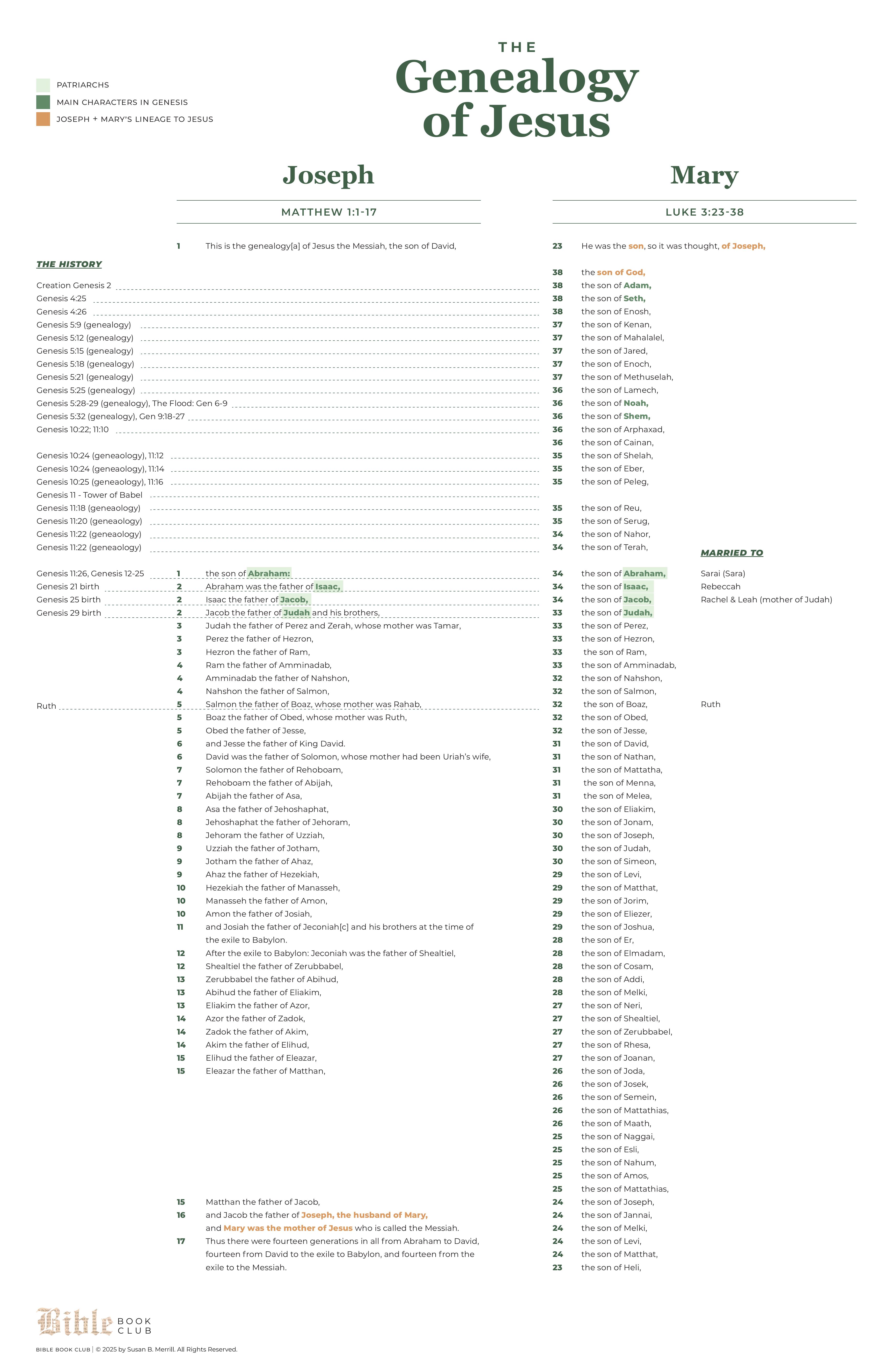
10 Solomon’s son was Rehoboam, Abijah his son, Asa his son, Jehoshaphat his son, 11 Jehoram his son, Ahaziah his son, Joash his son, 12 Amaziah his son, Azariah his son, Jotham his son, 13 Ahaz his son, Hezekiah his son, Manasseh his son, 14 Amon his son, Josiah his son. 15 The sons of Josiah: Johanan the firstborn, Jehoiakim the second son, Zedekiah the third, Shallum the fourth. 16 The successors of Jehoiakim: Jehoiachin his son, and Zedekiah.
A Bible Throwback
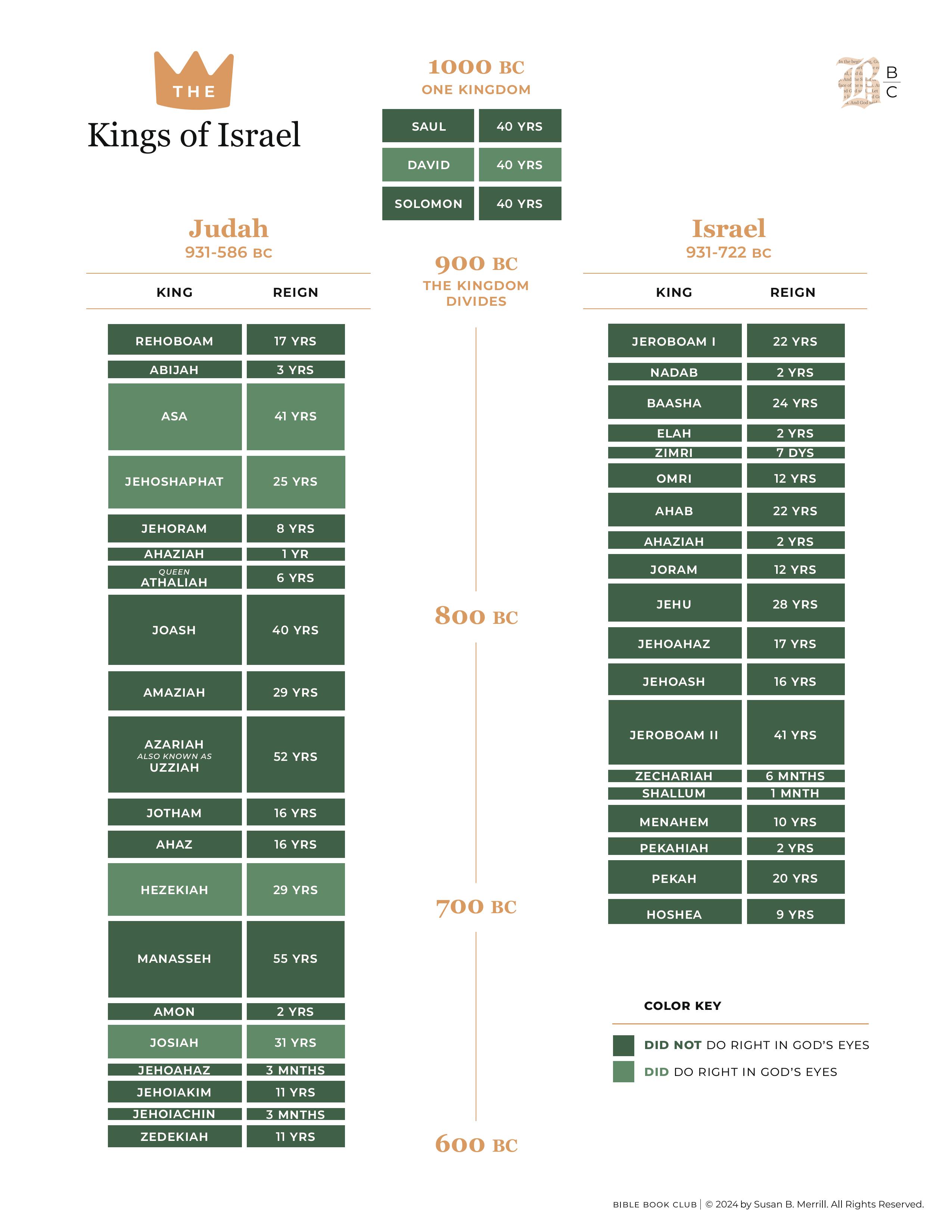
We just finished a deep dive into these kings in our Bible studies on 1 Kings and 2 Kings. These were the kings of Judah. Recall that the United Kingdom of Israel divided after Solomon's reign into two kingdoms. The kingdom of Judah in the south carried the chosen line of David. There were 19 kings in all.
Which four kings of Judah are identified as "good kings" in the text?
Four of the kings of Judah were good kings: Asa, Jehoshaphat, Hezekiah, and Josiah. Four of them were lukewarm kings: Joash, Amaziah, Azariah, and Jotham. The other 11 were evil kings, and that is why Judah was carried off into exile from their Promised Land. Because they broke their covenant promise with God too many times.
Note that the author left out Queen Athaliah, who reigned over Judah but was not from the line of David.
Scene 3: The Line of David After the Exile
This list continues with the second-to-last king, Jehoiachin, who was placed in captivity in Babylon. While Jehoiachin was in captivity, Nebuchadnezzar made Jehoiachin's uncle Zedekiah king. Zedekiah was killed, but God preserved the life of the second-to-last king, Jehoiachin, in captivity. His children continued the line.
1 Chronicles 3:17-24
17 The descendants of Jehoiachin the captive: Shealtiel his son, 18 Malkiram, Pedaiah, Shenazzar, Jekamiah, Hoshama and Nedabiah. 19 The sons of Pedaiah: Zerubbabel and Shimei. The sons of Zerubbabel: Meshullam and Hananiah. Shelomith was their sister. 20 There were also five others: Hashubah, Ohel, Berekiah, Hasadiah and Jushab-Hesed. 21 The descendants of Hananiah: Pelatiah and Jeshaiah, and the sons of Rephaiah, of Arnan, of Obadiah and of Shekaniah. 22 The descendants of Shekaniah: Shemaiah and his sons: Hattush, Igal, Bariah, Neariah and Shaphat—six in all. 23 The sons of Neariah: Elioenai, Hizkiah and Azrikam—three in all. 24 The sons of Elioenai: Hodaviah, Eliashib, Pelaiah, Akkub, Johanan, Delaiah and Anani—seven in all.
Debut Appearance
These are new names to us in our journey through the Bible. We have not yet discussed anyone who lived during or after the exile. There is so much more to these genealogies, and we could analyze these lists for days. Just to give you a taste of how deep their hidden meanings go, there is often a message in the names of the people. One name of note for future discussion is Zerubbabel.
Who was Zerubbabel, and what does his name mean?
Zerubbabel was the leader of the early post-exilic Jerusalem, and he oversaw the rebuilding of the Temple. His name means "offspring of Babylon." Zerubbabel was obviously born in exile. We will read more about him in the books of Ezra, Nehemiah, Haggai, and Zechariah.
Notice a few of Zerubbabel’s children's names.
- Meshullam means "repaid." He was likely born during the release from exile.
- Shelomith, the one daughter mentioned, means "peace." Was she born in Jerusalem after the return?
- Jushab-Hesed, the last son, means "kindness will return." Was his father struggling with hope and in need?
How does the Chronicler define the Hebrew word "Hesed"?
Hesed refers to an act performed for a person in desperate need within the context of an enduring relationship or covenant between the two people. We have had so many examples of the word hesed in our journey that I am now obsessed. It is so much more than kindness.
What is the meaning and significance of the name "Jushab-hesed"?
In this case, Zerubbabel named his son Jushab-Hesed, which means “hesed will return” or “God's kind act of mercy for Israel will return,” because Israel was a people in desperate need, in a covenant relationship with God. In other words, they needed hesed.
Zerubbabel's name means "offspring of Babylon," which is so discouraging. But he turns the despair into hope and names his children Repaid, Peace, and Kindness Will Return.
That ends the deep dive into David’s line from the tribe of Judah. But there are other clans of Judah, and they are not to be forgotten. If it feels like we are going backward, we are. We only covered Perez's line that led to David. That line was the Perez → Hezron → Ram → Amminadab → Nahshon → Salmon → Boaz → Obed → Jesse → David line. The author goes back to Judah, the father of the tribe of Judah, and his son Perez to cover other lines.
Scene 4: Other Clans of Judah
1 Chronicles 4:1-8
1 The descendants of Judah: Perez, Hezron, Karmi, Hur and Shobal. 2 Reaiah son of Shobal was the father of Jahath, and Jahath the father of Ahumai and Lahad. These were the clans of the Zorathites. 3 These were the sons of Etam: Jezreel, Ishma and Idbash. Their sister was named Hazzelelponi. 4 Penuel was the father of Gedor, and Ezer the father of Hushah. These were the descendants of Hur, the firstborn of Ephrathah and father of Bethlehem. 5 Ashhur the father of Tekoa had two wives, Helah and Naarah. 6 Naarah bore him Ahuzzam, Hepher, Temeni and Haahashtari. These were the descendants of Naarah. 7 The sons of Helah: Zereth, Zohar, Ethnan, 8 and Koz, who was the father of Anub and Hazzobebah and of the clans of Aharhel son of Harum.
The Sons of Judah
These verses list five names as the sons of Judah: Perez, Hezron, Karmi, Hur, and Shobal. However, these are not all direct sons of Judah. Rather, they represent different generations within his family tree. In this case, Perez was Judah's son, Hezron was Perez's son, Karmi may have been Caleb, Hur was a descendant of Caleb, and Shobal was a descendant of Hur. Why do this? It is confusing.
This telescoping of generations, where "sons" can mean descendants across multiple generations, is common in biblical genealogies. It allows the author to highlight significant figures without listing every generation. The author is focusing on the most important descendants outside the line of David. Maybe some of these people's descendants had returned, and the Chronicler was helping them identify their place. The author gives us more detail in this section about the clans of Hur and Shobal.
Why are the clans of Hur and Shobal important to the returned exiles?
The author probably included the clans of Hur and Shobal to connect the genealogies to the village of Zorath, because he says, "These were the clans of the Zorathites." Zorath was important to the Chronicler because it was resettled after the return. So the Chronicler encourages these people by establishing the continuity of the restored community with past Israelite history.
Scene 5: The Prayer of Jabez
Here comes another author-detail detour. He injects a short story that has become known as the Prayer of Jabez. Have you heard of it? A book was written about it years ago that created a significant stir at the time. The entire book was written based on these two short verses stuck randomly in the middle of this genealogy. We won't discuss the book's philosophy because it focused on the prosperity aspect of this prayer, and that was not the Chronicler's point.
1 Chronicles 4:9-10
9 Jabez was more honorable than his brothers. His mother had named him Jabez, saying, “I gave birth to him in pain.” 10 Jabez cried out to the God of Israel, “Oh, that you would bless me and enlarge my territory! Let your hand be with me, and keep me from harm so that I will be free from pain.” And God granted his request.
Why is the story of Jabez inserted into the tribe of Judah's genealogy?
The author’s purpose in every word is to kindle the reader’s memory of stories of their past and hope for their future. And that is why this short story about a man who isn’t mentioned anywhere else in the entire Bible is inserted here in the middle of Judah’s genealogy.
Who is Jabez in the Bible?
We don’t know who Jabez was, but the Israelites at the time must have known him well, because they didn't need an introduction.
Jabez was relatable.
Jabez was born in pain, so much so that his name means "because I bore him in pain." We don't know what the painful situation was, but that mystery makes Jabez relatable. It could be any type of pain, as everyone suffers at some point. His undetermined pain invites everyone to identify with him.
The Israelites alive at the time of the 1 Chronicles writing were born into the pain of captivity and servitude. They have been released but are poor and discouraged. The author wants them to remember Jabez and relate to his situation.
Jabez was an overcomer.
Verse 9 says: Jabez was more honorable than his brothers. He did not wallow in his misery. He used it, learned from it, and became a better person because of it. The Israelites have the same opportunity. They can learn from their past mistakes and turn to God. The author wants them to remember Jabez and overcome their situation as he did.
Jabez was bold.
Jabez prayed, and his prayer was very specific. He asked for four things.
What four things did Jabez ask for in his specific prayer?
Two of Jabez’s requests focused on physical circumstances: more land and no more pain. The other two focused on his relationship with God: blessings and protection from harm. Jabez trusted God. He cried out to God for God's hand to be with him.
Jabez Trusted God, Not Idols
Jabez didn't make idols or cover his bases by paying tribute to other gods. He went to the One he trusted. The one true God. The author of Chronicles wants the returned exiles to:
- Think about what they need physically: The land that God promised and release from the pain of captivity and oppression.
- Remember Jabez and pray for the solution. To pray for God’s blessings and protection from harm.
The author wants this motley crew of returned exiles to forget all the gods they grew up with in foreign cultures and remember Jabez, who believed and trusted the one true God.
God Answered
The Chronicler wants the Israelites to remember that God answered. We don't know how God answered. We don't know when God answered. We only know that God granted the request in a way that God saw fit.
The Israelites need to overcome, pray boldly, trust God, and wait. Just like Jabez. And as it was for the Israelites, so it is for us. We can turn to God in our struggles. We can ask for relief. However, God doesn't always give relief the way we ask. Sometimes in times of trouble, my prayer has been for the pain to end, and it didn’t. Instead, God joined me in my struggle. I felt His presence, His peace, and His protection. And the presence of God in our struggle makes the pain bearable.
Scene 6: The Remaining Clans of Judah
1 Chronicles 4:11-23
11 Kelub, Shuhah’s brother, was the father of Mehir, who was the father of Eshton. 12 Eshton was the father of Beth Rapha, Paseah and Tehinnah the father of Ir Nahash. These were the men of Rekah. 13 The sons of Kenaz: Othniel and Seraiah. The sons of Othniel: Hathath and Meonothai. 14 Meonothai was the father of Ophrah. Seraiah was the father of Joab, the father of Ge Harashim. It was called this because its people were skilled workers. 15 The sons of Caleb son of Jephunneh: Iru, Elah and Naam. The son of Elah: Kenaz. 16 The sons of Jehallelel: Ziph, Ziphah, Tiria and Asarel. 17 The sons of Ezrah: Jether, Mered, Epher and Jalon. One of Mered’s wives gave birth to Miriam, Shammai and Ishbah the father of Eshtemoa. 18 (His wife from the tribe of Judah gave birth to Jered the father of Gedor, Heber the father of Soko, and Jekuthiel the father of Zanoah.) These were the children of Pharaoh’s daughter Bithiah, whom Mered had married. 19 The sons of Hodiah’s wife, the sister of Naham: the father of Keilah the Garmite, and Eshtemoa the Maakathite. 20 The sons of Shimon: Amnon, Rinnah, Ben-Hanan and Tilon. The descendants of Ishi: Zoheth and Ben-Zoheth. 21 The sons of Shelah son of Judah: Er the father of Lekah, Laadah the father of Mareshah and the clans of the linen workers at Beth Ashbea, 22 Jokim, the men of Kozeba, and Joash and Saraph, who ruled in Moab and Jashubi Lehem. (These records are from ancient times.) 23 They were the potters who lived at Netaim and Gederah; they stayed there and worked for the king.
Only Listed Here
Kenaz was the younger brother of Caleb. The Kenizzites, or descendants of Kenaz. The Chronicler continues to list descendants who are not discoverable in other parts of the Bible. But we do learn from several author-detail detours that these people redeveloped trades necessary to the returning exiles.
What specific trades were maintained by the descendants of the tribe of Judah?
The descendants were skilled workers in linen and pottery. All of these trades would be necessary not only for the people's lives but also for the rebuilding of the Temple. And that is all we know about the tribe of Judah.
In our 1 Chronicles 4-5 commentary, the Chronicler will move quickly through some lesser tribes to focus on his favorite tribe. The one we suspect he is a member of.
Group Discussion Questions for 1 Chronicles 3-4
- Zerubbabel and his children were named based on the season of life they were in. If you could name the season you're in right now the way he named his children, what would you call it? What name of hope would you speak over your future?
- Jabez asked for four specific things: blessing, more territory, God's hand with him, and freedom from pain. When you pray, are you bold and specific, or do you tend to hold back? What keeps you from asking God plainly for what you need?
- Sometimes God doesn't end the pain but joins us in it instead. Think of a time when your prayer wasn't answered the way you hoped, yet you felt God's presence, peace, or protection in the middle of it. How did that change the way you pray now?